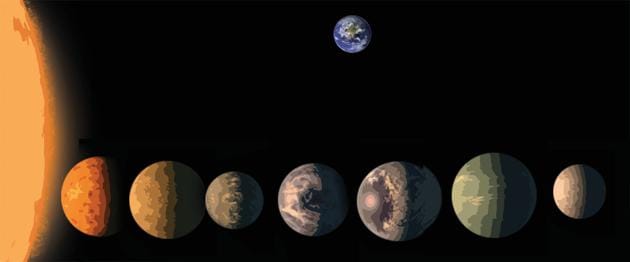
> The central star of the TRAPPIST-1 planetary system (TRAPPIST-1A) is more than twice as cold as the Sun, and a red star at a distance of 39 light years (370 trillion km) from us. TRAPPIST-1A is relatively close by and is among the 300 closest stars to the Sun. The star TRAPPIST-1A is about 10 times smaller in size and 12 times less massive than our Sun.
Read: A beginner’s guide to black holes
> TRAPPIST is an acronym for Transiting Planets and Planetesimals Small Telescope, a project devoted to the detection of exoplanets.
> TRAPPIST-1 planetary system has seven planets, with masses and sizes similar to those of Earth. The entire system is so compact, it will fit inside the orbit of Mercury. The orbital periods of these planets are less than 13 days, with the closest planet going around the star in just 1.5 days.
> The only planetary system that we knew of until the 1990s was our own solar system. The first definitive detection of an extrasolar planet or exoplanet orbiting a middle-aged star like the Sun was in 1995 when Michel Mayor and Didier Queloz of the University of Geneva discovered a planet orbiting the star 51 Pegasi. The total number of known exoplanet candidates is now close to 5,000.
> One of the primary aims of exoplanet research is to identify and characterise Earth-like planets in “habitable zones” around other stars. Habitable zone is defined as the region around the star where liquid water can exist on the planet’s surface. Astronomers are looking for exo-Earths which have a comfortable temperature and breathable atmosphere.
{{/usCountry}}> One of the primary aims of exoplanet research is to identify and characterise Earth-like planets in “habitable zones” around other stars. Habitable zone is defined as the region around the star where liquid water can exist on the planet’s surface. Astronomers are looking for exo-Earths which have a comfortable temperature and breathable atmosphere.
{{/usCountry}}> All seven planets in the TRAPPIST-1 system could potentially have liquid water on their surfaces. Detailed modelling indicates that three of the planets in the TRAPPIST-1 system could harbour oceans on their surfaces, if they were to have Earth-like atmospheres. Other planets also could have liquid water on limited regions of their surfaces.
> The compactness of the TRAPPIST-1 planetary system makes it highly likely that the planets are tidally locked, meaning that the rotation and the orbital period of the planets are the same. One consequence of this is that one side of the planets always faces the star, resulting in a permanent day side and a permanent night side. This may well be the case for most temperate Earth-like planets outside the solar system.
(Purvankara is a faculty member in the Infrared and Optical Astronomy group at the Dept. of Astronomy & Astrophysics at TIFR)
Manoj Purvankara’s Chai and Why session on How do (exo)planetary systems form? will be held on April 2, 11am
At Prithvi Theatre, Juhu Tara Road