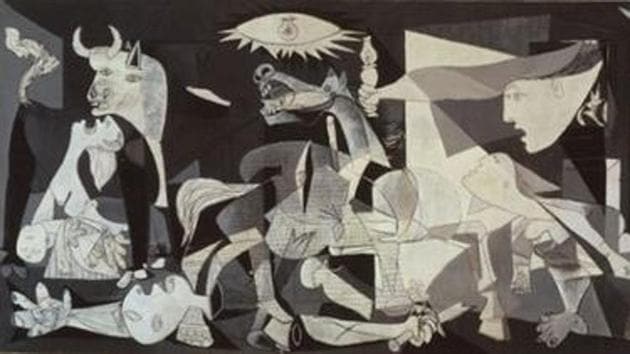
Spray-painted in murals, wielded on anti-war banners, and even once hung as a tapestry at the United Nations, Pablo Picasso’s “Guernica” might be the world’s most famous political artwork. Now organisers of a new initiative are inviting art lovers to revisit the iconic black-and-white painting, using the latest imaging technology and releasing a trove of previously unseen documents to chart its turbulent history.
“Guernica is a source of never-ending artistic material and it’s a privilege to be with as an art historian,” says Rosario Peiro, head of collections at Madrid’s Reina Sofia modern art museum. She is part of the team behind “Rethinking Guernica”, an interactive exhibition launched this week about the work. “Putting all of this together allows you to rethink the history of the painting,” Peiro told AFP.
“Guernica”, conceived in the depths of Spain’s devastating civil war, shows the bombing of a Basque town on April 26, 1937 by German and Italian air forces under the orders of future Spanish dictator Francisco Franco. Hundreds died in an aerial attack on civilians that shocked the world and set a precedent repeated often by German and allied forces in World War II. Picasso, then living in France, was commissioned by the struggling Spanish Republican government to produce a work depicting the bombing for the 1937 World Fair in Paris.
That commission and hundreds of other documents concerning “Guernica” are now available online for the first time. They tell the story of a hugely well-travelled work, with stops in Scandinavia, Britain and the United States, where it spent decades on loan at New York’s Museum of Modern Art (MoMA). There are papers relating to its trip to Venezuela in 1948 that was cut short due to a coup d’etat, and a frantic telegram sent by MoMA collections director Alfred H. Barr Jr informing the artist that his works were safe after a fire tore through the museum in 1958. “Clearly it is a political painting because it was requested by the government for a propaganda purpose,” says Peiro.
{{/usCountry}}That commission and hundreds of other documents concerning “Guernica” are now available online for the first time. They tell the story of a hugely well-travelled work, with stops in Scandinavia, Britain and the United States, where it spent decades on loan at New York’s Museum of Modern Art (MoMA). There are papers relating to its trip to Venezuela in 1948 that was cut short due to a coup d’etat, and a frantic telegram sent by MoMA collections director Alfred H. Barr Jr informing the artist that his works were safe after a fire tore through the museum in 1958. “Clearly it is a political painting because it was requested by the government for a propaganda purpose,” says Peiro.
{{/usCountry}}“The truth is during all these years of travel and being in different places, the work was depoliticised.” Researchers took thousands of images using visible and ultraviolent light as well as infrared reflectography and high-definition x-rays to create a “Gigapixel” rendering that allows users to browse a 436-gigabyte composite of the work. Details of its restoration, individual paint strokes and even rogue hairs from Picasso’s brushes can be seen still stuck to the original canvas. Residue from a 1974 act of vandalism is visible in the form of barely perceptible reddish discolouration across central areas. “For me what is interesting to see is the geography of the painting, its surface, as if it’s a kind of history map,” says Peiro.
The Reina Sofia currently displays dozens of black-and-white war images alongside “Guernica”, many captured by legendary Catalan conflict photographer Agusti Centelles. Some critics credit the photos for Picasso’s decision to eschew his usual vivid colours in the piece. As Catalonia’s independence crisis exposes Spain to its deepest political turbulence since returning to democracy in 1978, Peiro however insists the current installation isn’t about politics. “We do show a lot of Barcelona photographs but that’s because the best Spanish photojournalist of the time was Catalan,” she said. Peiro hopes the new project will provide new perspectives on one of the 20th-century’s defining images. “‘Guernica’ is the most important work, physically and symbolically, for the museum so we have to keep on working on it,” she says. “It’s the least we can do.”
Follow @htlifeandstyle for more