Long before Google Maps, there were physical maps, made on paper where lines and symbols helped you make sense of the world, and navigate from one point to the other. But maps are more than just a tool for travelling, they have also been used to denote boundaries between nations. They have also been essential for empire building where lands were surveyed to plot how to capture or govern territories. But what meaning can maps have in an era where even the compass is becoming obsolete?
As part of an exhibition curated by art critic Meera Menezes (51), 11 artists explore various ways of mapping. Titled Here be dragons (a medieval inscription on maps to denote potentially dangerous territories), the exhibition features 35 works that map time, space, bodies, histories and memories.
Read: Surprise, surprise: 12 artists interpret the act of gifting
“I noticed that maps/cartography was a motif that cropped up in a number of artists’ works. That is really how the concept arose. I wanted to bring together different ways that artists explored mapping. The show is more about different ways of mapping than about different types of maps,” says Menezes.
Artist Anju Dodiya, known for her self-portraits, showcases Sea in My Head, a sensory map depicting how we “smell the rose, hear the ocean, touch the thorn”. In her work Temporal Maps, Swiss mixed media artist Marie Velardi maps time in a multi-directional way, where the present, past and future are depicted through colours and shapes.
{{/usCountry}}Artist Anju Dodiya, known for her self-portraits, showcases Sea in My Head, a sensory map depicting how we “smell the rose, hear the ocean, touch the thorn”. In her work Temporal Maps, Swiss mixed media artist Marie Velardi maps time in a multi-directional way, where the present, past and future are depicted through colours and shapes.
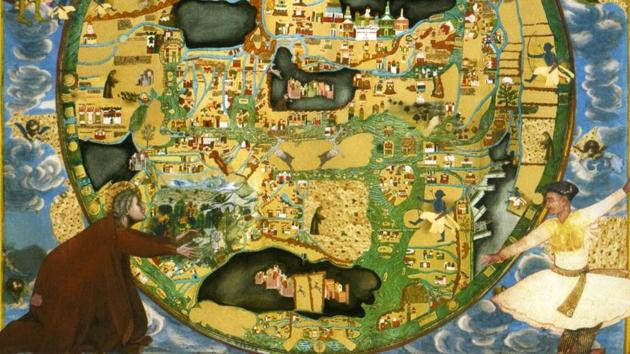
{{/usCountry}}Painter, art historian and writer Gulammohammed Sheikh’s works revolve around myths and legends and his present work, The Mappamundi Suite, revisits the concept of mappa mundi (a medieval European map often used to illustrate principles and concepts). Artist Shilpa Gupta, best known for her 32-ft high Carter Road installation — I live under your sky too (2013), highlights common flora in her Tree Drawings series to show the similarities between nations.
“Maps are, in many ways, mental constructs and even contribute to defining our identities. They make linkages between disparate places and times and thereby generate new meanings,” says Menezes. She cites the example of Varunika Saraf’s work which gives a new meaning to Dante’s vision of hell. “Varunika has created a large work which is based Botticelli’s illustration on Dante’s vision, and depicts the systemic repression of the marginalised in modern India,” says Menezes.
Menezes spent half a year planning and coordinating for the exhibition. While artists such as Mithu Sen, Anju Dodiya, Varunika Saraf and Madhvi Subrahmanian created works especially for the exhibition, Menezes also chose existing works that corresponded to the theme.
Here be dragons is on from April 13 to May 31At Sakshi Gallery, Grants Building, Arthur Bunder Road, ColabaCall 6610 3424