
 E-Paper



Will brewing resentment help former Haryana CM Hooda make comeback in Rohtak?
Out of total 90 seats, the BJP won 47 seats, the Indian National Lok Dal 19 and the Congress secured only 15 seats, down from 40 it won in 2014.


“Rohtak ka chaudhar vapis lani hai (We need to restore Rohtak’s power and prestige),” said Shamsher Singh, a Congress supporter, in Ladot village in Garhi Sampla Kiloi, former Haryana CM Bhupinder Singh Hooda’s assembly seat, as he explained the changing power dynamics in the area.
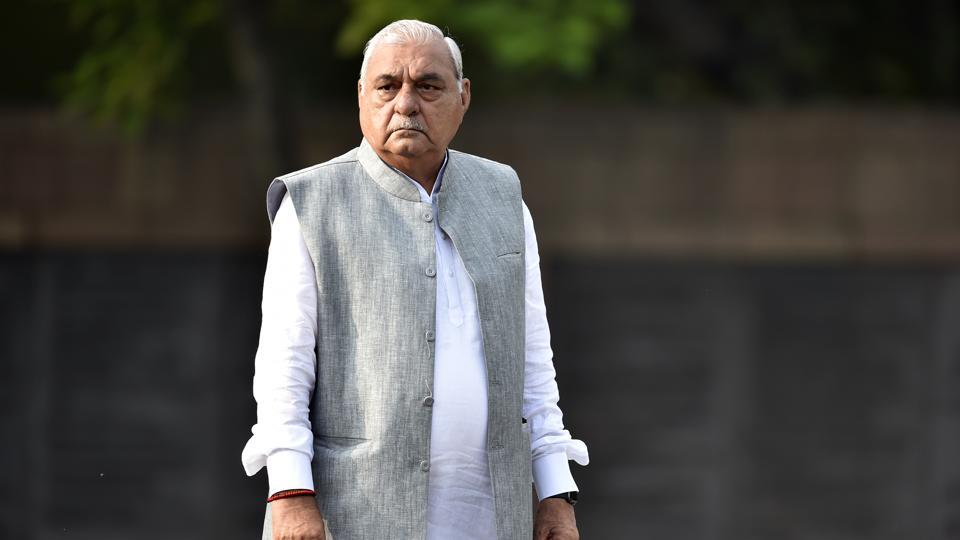
Singh’s slogan reflected what is being termed as voters’ anguish in the Jat-dominated Rohtak-Sonipat belt of Haryana that goes to polls on October 21. Once a Congress bastion, the power equation in the region changed after the 2014 assembly polls when the Bharatiya Janata Party (BJP) won the election riding on the Modi wave.
Out of total 90 seats, the BJP won 47 seats, the Indian National Lok Dal 19 and the Congress secured only 15 seats, down from 40 it won in 2014.
Manohar Lal Khattar, also a native of Rohtak, opted for Karnal to start his electoral innings, and become Haryana’s first non-Jat CM in the past four decades.
While Rohtak in central Haryana symbolises the power of Jats, Karnal, a town dominated by Punjabis and Banias [trader community] in the eastern part of the state, has emerged as the focal point of non-Jat politics in the past few years.
In 2014, the BJP gained support in non-Jat dominated assembly segments in Panchkula, Ambala, Karnal, Panipat and Yamunanagar, according to a survey by Centre for Studying of Developing Societies (CSDS). According to this survey, Jats constitute about 25% of Haryana’s 20.5 million population, and are electorally significant in nearly half of the state’s 90 assembly segments. And the BJP’s opponents are counting on them to make a difference.
Some residents in Kasranti village accused chief minister Khattar of stalling key projects in Rohtak that were launched when Hooda was CM (2005-2015).
“Our railway coach factory which would have provided jobs to 10,000 youth was taken away. Even the road repair and other works in our villages have stopped,” said Roop Kumar
from the backward Ahirwal
community.
Northern Railway spokesperson said there is no plan to shift the factory and it would be commissioned by 2020-2021. A BJP leader from Rohtak, Manish Grover, termed Kumar’s claim as false propaganda of the Congress.
In village chaupals [a community space in a village] in Rohtak-Sonipat belt, once considered a bastion of the Hoodas, residents say they were feeling powerless.
“Anyone from here (Hooda’s constituency) could walk into any government office and get his or her work done when Hooda sahib was the chief minister. Now nobody listens to us,” said Shri Krishan. He, however, added that better days were ahead.
This resentment did not seem to affect the way people voted in the national elections earlier this year. The BJP made a clean sweep in the state during the Lok Sabha elections, winning all the 10 seats. Among the heavyweights who lost were Hooda, 72, who fought from Sonipat, and his son and three-time MP Deepender Singh Hooda, who contested from Rohtak.
To be sure, analysts say people vote differently during local elections.
Around 120km east, in Karnal, there is a sense of jubilation with people saying that Khattar, 65, has developed the town.
“Though our city was on the national highway (NH-1 connecting Delhi to entire north India) we never got our due. Everything was done in Rohtak. Here, only land scams happened during Hooda’s regime. Now, we can see winds of change,” said Rajesh Kumar, a tea-seller in Karnal town.
Hooda is facing investigations by the CBI and the Enforcement Directorate (ED) for allegedly granting approval to a land deal of Congress leader Rahul Gandhi’’s brother-in-law Robert Vadra in the fag-end of his second stint as the chief minister.
Mahesh Agarwal, another resident of Karnal, said Khattar has introduced many new projects in the city, including the Smart City project. “My only grouse is that CM sahib [Khattar] is not very accessible to the Karnal residents,” he said.
Renu Bala Gupta, BJP leader and Karnal mayor, claimed the entire city has been covered by surveillance cameras to check crime; three new parks have been created with free WiFi connectivity, among others, since the BJP came to power. “We have spent Rs 2,000 crore in Karnal in the past five years as compared to Rs 1,200 crore in the previous five years of the Congress government,” he said.
That’s exactly what Hooda did for Rohtak, his supporters and residents of the district claim.
Satish Tyagi, a physician turned journalist, said that prior to 2005, the place was like a “village town” with a single-lane road passing through it; there were a few shops around the railway station, besides the old bus stand. But all those changed after Hooda became chief minister in 2005, he said.
“He got us a six-lane highway connecting Rohtak with Delhi, linked Rohtak with other districts with four-line highways, upgraded the medical college, brought industries to Rohtak, renovated all old school buildings, gave Rohtak an Indian Institute of Management and a campus of All India Institute of Medical Sciences in Jhajjar.”


