Have you ever been to a party where everyone is at pains to avoid one particular subject? They will go round and round the mulberry bush as though the very mention of it would break up the proceedings and the person from whose lips the subject might ensue would have rained on everyone’s parade. Every other subject, howsoever inconsequential will be discussed in order to avoid that which must not be spoken about. I got that feeling as I have been watching these elections. Those in the fray have touched on all sorts of issues, taking care never to drop that clanger — women’s issues.
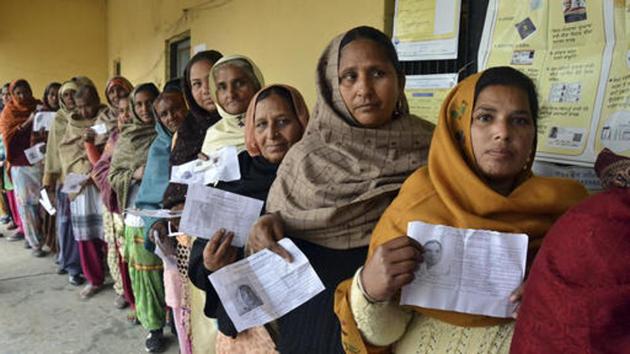
So we have politicians talking of donkeys, crematoriums, graveyards, property, lights for Diwali, eunuchs and rhinos. And of course, the surgical strikes on Pakistan but taking care never to utter a squeak about women as if to do so would evoke some beast from under the bed or things which go thump in the dark. I am being facetious here, but surely what is being billed a make or break election for the ruling party, and everyone else and his uncle could have at least referred to women and their concerns in passing. Day after day, we had rather objectionable references of women politicians as bahus and betis, even buas with reference to the formidable BSP chief Mayawati all of whom are slugging it out in Uttar Pradesh. As if to suggest that this is all they are and nothing more. Women are coming out in huge numbers to vote, said breathless anchors.
Not to be a killjoy, but surely the states which are going to the polls have several pertinent issues relating to women, ranging from maternal mortality, illiteracy, lack of access to basic amenities and safety. But to hear the political discourse, you would think that none of these existed. In the byzantine world of alliances, shifting political loyalties and calculations, the fact that half the electorate is women seems totally forgotten. I am not expecting that everyone will suddenly start talking about things that really matter. Few elections barring the last Lok Sabha one, which brought the BJP roaring to power, ever bothered about issues that really affect people. But let us not blame politicians alone for this. The people who throng the election rallies are quite happy to hear insults being traded and non-issues being discussed.
{{/usCountry}}Not to be a killjoy, but surely the states which are going to the polls have several pertinent issues relating to women, ranging from maternal mortality, illiteracy, lack of access to basic amenities and safety. But to hear the political discourse, you would think that none of these existed. In the byzantine world of alliances, shifting political loyalties and calculations, the fact that half the electorate is women seems totally forgotten. I am not expecting that everyone will suddenly start talking about things that really matter. Few elections barring the last Lok Sabha one, which brought the BJP roaring to power, ever bothered about issues that really affect people. But let us not blame politicians alone for this. The people who throng the election rallies are quite happy to hear insults being traded and non-issues being discussed.
{{/usCountry}}Would it have made a difference if more women had stood for elections? Would they have raised issues which concern women? I really doubt it given the track record of our women leaders. There are many reasons given for the lack of women in the fray. One was spelt out by a popular columnist recently. Women can’t play dirty, said the columnist, they are no match for men when it comes to machinations. Well, that’s news to me. J Jayalalithaa must be turning in her grave to hear this, Indira Gandhi was no slouch in cutting the ground from under her opponents’ feet, Sheila Dikshit did not get three terms by being a little old lady knitting socks, Mayawati did more than sock her rivals with that metaphorical bag and Mamata Banerjee has a clever way of tripping up any opposition even as she vociferously shuns all the trappings of power.
So no, women are no less ruthless, clearheaded and ambitious when they enter politics. In fact, they too play by the rules and the rules dictate that women’s issues don’t matter. The problem is that women are fragmented, they are marginalised in every caste, class and religious grouping and they are not likely to vote en masse to secure their rights. They also don’t have the capacity to mobilise and demand that their concerns be taken note of.
Which is precisely why political parties don’t think that they need to talk about women’s issues. They don’t have the collective might to harm any political formation, their vote is scattershot. Given their vast disparities, women in different areas and rubrics identify with different issues so political parties just take the easy way out — they don’t bother with an agenda for women.
Of course, we have the tokenism about women being mothers and sisters, about how alcohol will be abolished so women will be happy. But, what about schools so women can educate their children, street lighting so women can be safe, toilets so that women are both safe and healthy, clinics so that women get treatment on time, jobs so that women don’t have to rely on men economically? Maybe, next time, political parties could try this, it might just lead to a consolidation of the women’s vote. That would be a turn up for the books, wouldn’t it?
lalita.panicker@hindustantimes.com