The long-suffering mother embodied by actor Nirupa Roy, the wicked stepmother/mother-in-law played by Lalita Pawar, the tragic courtesan with a heart of gold played by Meena Kumari, or the cosmopolitan Indian woman portrayed by Zeenat Aman. These are some of the representations of women in Hindi cinema, in the years following India’s independence. The characters reflect the common perception of women in those times.
Read: DDLJ to Piku: How feminism changed the on-screen father
Gallery: Iconic actresses of Bollywood from the ’50s to the ’80s
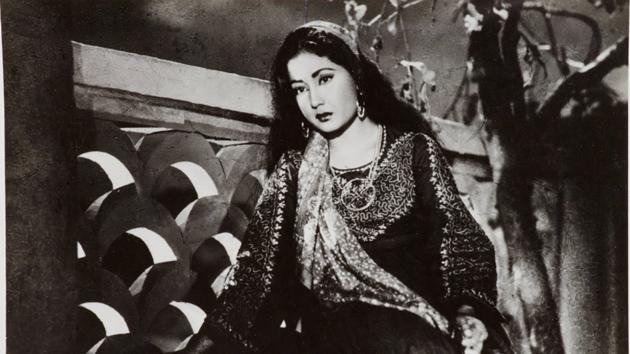
To mark International Women’s Day (March 8), The Museum of Art & Photography (MAP) in Bengaluru and Google Cultural Institute curated an archive of women in Indian cinema: from 1949 to 1984.
Titled Faces that Launched a Thousand Films, the exhibits include lobby cards (publicity material displayed in cinema lobbies) and stills of iconic actors, such as Meena Kumari, Sadhana and Madhubala. The accompanying text — written by Shilpa Vijayakrishnan, research and curatorial associate at MAP — explains the characterisation of women over four decades.
For instance, in the ’50s, women were represented as the cornerstones of the family in a patriarchal society. It led to films being titled on the basis of the relationship. Examples include Mousi (1958), Majhli Didi (1967), and Suhag Sindoor (1953). On the other hand, there were vamps (often portrayed by actors such as Helen and Aruna Irani) in early Hindi cinema who performed song and dance sequences and were the precursor to the modern ‘item girl’.
{{/usCountry}}For instance, in the ’50s, women were represented as the cornerstones of the family in a patriarchal society. It led to films being titled on the basis of the relationship. Examples include Mousi (1958), Majhli Didi (1967), and Suhag Sindoor (1953). On the other hand, there were vamps (often portrayed by actors such as Helen and Aruna Irani) in early Hindi cinema who performed song and dance sequences and were the precursor to the modern ‘item girl’.
{{/usCountry}}While there was a demarcation between what constituted a ‘good’ and a ‘bad’ woman, the lines began blurring in the ’60s, when heroines started playing both roles. For instance, Sharmila Tagore in An Evening in Paris (1967) plays the heroine and the vamp. In the ’70s, Zeenat Aman played ‘liberated’ modern women (Satyam Shivam Sundaram, 1978; Qurbani, 1980). As the text that accompanies the picture mentions, they showed that “good girls could be unashamedly sexual while fulfilling all the requirements to ultimately become wife to the hero (sic).”
The exhibition’s reason for using lobby cards is to highlight a historical form of publicity that no longer exists. “Their distribution and circulation were carefully monitored at the time. Unlike posters, they were often produced by some of the best photographers and art designers, making them fairly exclusive artefacts,” says Vijayakrishnan.
Faces that Launched a Thousand Films can be viewed on google.com/culturalinstitute
Get more updates from Bollywood, Taylor Swift, Hollywood, Music and Web Series along with Latest Entertainment News at Hindustan Times.
Get more updates from Bollywood, Taylor Swift, Hollywood, Music and Web Series along with Latest Entertainment News at Hindustan Times.