How did you choose the violin or how did it choose you? Tell us about your training and early years in music.
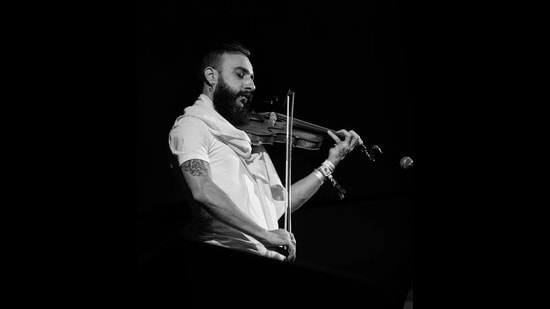
I feel the violin chose me as much as I chose it. Growing up in a traditional Palestinian village, music was part of my daily life, especially at family gatherings. I started with rhythm first – learning darbuka with Atteya Abdulhalim, one of the masters of the instrument in Galilee. With the help and direction of my uncles
How did you choose the violin or how did it choose you? Tell us about your training and early years in music.
I feel the violin chose me as much as I chose it. Growing up in a traditional Palestinian village, music was part of my daily life, especially at family gatherings. I started with rhythm first – learning darbuka with Atteya Abdulhalim, one of the masters of the instrument in Galilee. With the help and direction of my uncles Foad and Mowaffak and father Mohammed, I was able to accompany them and learn the basic rhythms, maqams and some oud techniques. The oud was constantly being played around me. That early exposure shaped my music language. After two years, I moved to study Arabic violin, and later, western classical violin.
As a teenager, I began composing and performing more seriously. I had the opportunity to study and perform abroad. Working with master musicians pushed me to explore different musical worlds while staying rooted in Palestinian and Arabic traditions. I founded a quartet – an important step into the performing world. It taught me how to listen, collaborate, and shape a collective sound. Though it was not a permanent project, it played a key role in my development as a performer.
Why is the violin is called the queen of musical instruments? How does it connect with Arabic music? Please tell us about the maqam and its connection with the violin.
I think it’s because of its extraordinary expressive range. It’s one of the most recognizable instruments in the world, shaped by thousands of years of musical evolution. While the modern violin has a relatively recent form, its voice has been adopted across countless cultures and musical traditions. The violin can lead, accompany, whisper, or cry.
In Arabic music, the primary reference has always been the human voice. Singing is the heart of the tradition and instruments are expected to imitate and support that vocal expression. The violin is uniquely suited to this role because it is one of the instruments closest to the human voice. Its ability to sustain sound, play legato and “sing” a phrase makes it a natural carrier of Arabic musical expression.
The violin fits so well into Arabic music also because it is fretless. This allows the player to produce microtones – notes that fall between the pitches used in Western music. They are fundamental to the maqam system, which is the modal framework of Arabic music. It is not just a scale but a musical language with its own emotional character, rules of movement, and sense of tension and release. Each maqam carries a distinct mood and identity.
Where did you grow up and where do you live? Tell us about your journey into full-time music making and its challenges.
Currently, I live and work in Palestine. Though I was born in the United States, I grew up mainly in Northern Galilee, in Kawkab Abu El-Hija, where my musical foundation and connection to culture, community and sound took shape.
My journey into full-time music began early. In 2009, when I was 19, my work started gaining wider recognition. I formed Awan, the youngest Palestinian musical quartet at the time. It was a platform for experimenting with sound and presenting an unconventional musical vision. Winning national competitions alongside graduating with excellence from the Jerusalem Music Academy gave me the confidence and momentum to commit to music as a profession.
Between 2009 and 2013, I was performing constantly, participating in major Palestinian projects, collaborating with leading musicians and touring internationally. Those years culminated in a tour as a violin soloist with Mohammed Assaf while also composing and recording Awan’s first album.
Being a full-time musician comes with real challenges. The work requires constant movement, adaptability and creative reinvention, often without long-term stability. In my context, there are also political, logistical, and economic obstacles that affect travel, funding and continuity. Still, the ability to create, perform and connect across borders makes those challenges worth facing. Music remains both my profession and my way of navigating the world.
At the concert you said that “in a world that is getting madder and madder, hopefully music will bring some healing.” What is a musician’s role in today’s world?
I genuinely believe that music can reduce alienation and bring people together, even when language, politics or identity divides us. If represented with integrity, music may be one of the last remaining spaces where people of different religions, races, genders, ages and backgrounds can meet on equal ground.
We’re living in times when the world feels increasingly fragmented, fanatical and polarized. Music can slow us down, soften us and remind us of our shared humanity in these times. When I spoke about healing at the concert – that’s what I meant: not healing as an abstract idea, but as a real emotional and human necessity.
I work toward these values by focusing on instrumental music as a universal language; through cross-cultural projects and multinational bands; by carrying Palestinian culture, folklore, and musical heritage into global spaces with respect and openness. I believe cultural exchange is essential for music to keep evolving. I try to allow different influences to meet naturally in my work without erasing where I come from.
As artists today, we carry a responsibility. Music and art should not only entertain. A musician has to stay connected to higher intentions and deeper causes, listen carefully, create honestly and offer something that helps guide people towards empathy rather than division.
How do you cope with how your musical career is enmeshed with the conflict around you?
My musical life has always existed alongside conflict and violence. They’re part of the histories and realities I grew up with. From a young age, I was surrounded by stories passed down through my grandparents – stories of loss, survival and repeated attempts to erase the culture I come from. That history is not distant – it lives in the present and it inevitably finds its way into how I hear, feel and make music.
Music became my way of staying sane in the middle of that. It was never an escape from reality but a way to process it. Music has been a form of therapy, a space where pain could be transformed into something meaningful, into something that could be shared rather than carried alone.
What keeps me going is a sense of responsibility to myself and to the Palestinian music scene as a whole. I feel a duty to represent my culture with care, love and in the highest quality I can offer. Creating music with integrity is how I protect my inner world and push back against erasure. Music continues to give me strength and purpose.
Please tell us about the Sirat Trio and its intent.
The Sirat Trio grew out of a long, intentional journey toward cross-cultural collaboration.
My long-standing admiration for Indian classical music, particularly for Carnatic violinist L Shankar, led me to India in 2018. That journey was transformative. It allowed me to deeply engage with Indian musical thinking and to explore the natural dialogue between Arabic maqam and the Indian raga systems. Through this process, I collaborated with several Indian musicians. Those encounters led to the formation of the Sirat Trio in 2019 with tabla player Rupak Dhamankar (Mumbai) and Mandola Joy (Kolkata).
Through the Trio, we wish to create a sincere musical dialogue between Arab and Indian traditions – a meeting of philosophies, emotions and shared human histories. This project is about honouring differences and co-existing in harmony. At a time when global powers and systems are actively trying to divide us, isolate cultures and reduce identity to borders – this kind of artistic dialogue becomes both meaningful and necessary.
Charumathi Supraja is a writer, poet and journalist based in Bengaluru.
One Subscription.
Get 360° coverage—from daily headlines
to 100 year archives.
Archives
HT App & Website