You begin with a “golden rule” in this novel. What are the golden rules you’ve set for yourself as a writer?
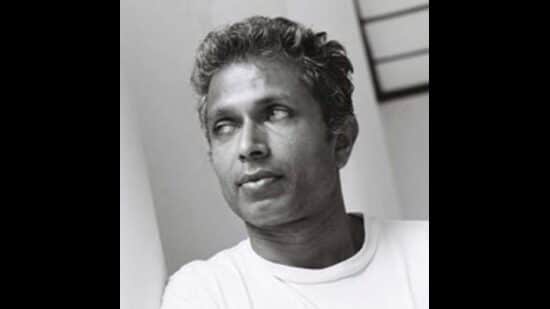
Perhaps the most important “golden rule” is that a novel, like a house, must be designed or written from the inside-out, never outside-in. You can’t just sit down and say you will write the definitive work on the Sri Lankan Civil War, for instance. Rather, you might start with the smallest inciting incident or fact, which might trigger in
You begin with a “golden rule” in this novel. What are the golden rules you’ve set for yourself as a writer?
Perhaps the most important “golden rule” is that a novel, like a house, must be designed or written from the inside-out, never outside-in. You can’t just sit down and say you will write the definitive work on the Sri Lankan Civil War, for instance. Rather, you might start with the smallest inciting incident or fact, which might trigger in you something larger. The process has to be organic, or the insincerity and artifice will shine through.
Both you and your protagonist in Hot Butter Cuttlefish are personal trainers, but you’re a writer, too. What was it like being in the mind of Malik, making him the storyteller and formulating his theories, the boundaries within which a personal trainer operates and the situations when they become flexible?
Malik is the personal trainer I was 20 years ago. Prudish, a little holier-than-thou, naïve, but on the whole well-meaning. At that young age you are quite able to lie to yourself: this makes Malik a somewhat unreliable narrator. To write his personality I simply had to revisit my past. The change I have noticed over the years is that now people come to you as much for counselling as for physical training. This changes the boundaries and rules — of confidentiality, for instance.
Covid drives a significant part of the novel and in the beginning you equate love with virus. We may have had a cure for the coronavirus but is there a cure for love?
Ha, sadly no! Just take heart that (as for the virus) you just need to sit it out; it will go away if you wait long enough!
Love is something societies the world over take special interest in. In juxtaposing our attitudes towards love — both in its manipulative form as we witness between various characters in the novel and in one that could attract a sympathetic response — and medicine (through the Kalabola Water theory), were you attempting to take on institutional failures during crises?
Absolutely. We felt at the time that the State had abandoned us. The truth is, we think of the State as some marvellously shiny, multi-purpose, know-all machine. What we found instead was a cabal [that] knew just as little as we did, that delighted in taking whimsical, arbitrary decisions. So, for instance, exercise was banned (till suddenly one day it wasn’t). Naturally, drinking was bad for you too. (They never revised that one.) Curiously, they never banned sex… Or perhaps I never got the message?
How challenging or fun was it to render a Covid story comically?
A huge challenge, which I loved! Nobody here in Sri Lanka had tried it: and there was certainly lots to laugh about, though often the comedy was way too black to put down on paper. The trick was to bring out the comedy without trivialising the earth-shattering implications of the disease. And no, the disease hasn’t really gone away: it’s like that unwelcome relative waiting patiently outside your front door till you come home from work.
One witnesses how befuddled Malik is by technology (Scythe/Skype), much like you, who was hesitant to have this interview done over Zoom. What is your “Ferrey Lite” view on technology and AI-centric conversations regarding writing?
You may know I was once a mathematician, so I think back to when the calculator first appeared, in the 1970s. Over-dependence on the calculator led to us losing our arithmetic; but hey, who cared? We had the machine to work it out! Nowadays, AI is taking on another branch of human knowledge, language, and it’s a battle to the death.
We mustn’t laugh at AI because it brings us all up to a certain standard, say 70 percent. But it kills originality and true creativity, which reside in the balance 30 percent. So, it is for the greater good of the greater number of people, but destructive for those very few. Does this sound elitist? (I suppose creativity and originality are by their very nature elitist.) I do worry though that we humans will ultimately lose language — AI will be like that bossy overbearing spouse at the dinner table who loudly answers all those questions people direct at you.
“The gayer I got, the more exciting they became.” Seemingly straight people in South Asia gazing at gays appears as much a universal truth as the one noted in an Austen novel. Have you seen such scenarios play out, especially in a gym? How gendered are conversations, gaits, and interactions, and what made you reflect on one in the novel?
In Sri Lanka it has always been: Don’t ask, don’t tell. There have been many times in the past when pretty much every other person in the cabinet has been gay, a fact never acknowledged but universally understood. At the same time, the accompanying security detail has been the most macho imaginable, never mind what their extra-curricular duties might be. So, in this instance, I was taking a shot at the hypocrisy of it all!
You note Fritzi having no idea where Indonesia is. I’m sure Fritzi has no idea he’s a dog.
Oh, you’re so wrong there! Fritzi definitely knows he’s a dog. His spelling has always been a little backwards, so, in fact, he actually thinks he’s a god. Meals are frequent, choice and nourishing; the world revolves around his needs, as they naturally must with any god. He’s at my feet as I write this, wondering why I can’t get off my lazy backside and serve him his mid-morning snack.
In relation to Arthur and Chanchala’s affair, you use the word “benefactor”. Was this a conscious choice? It has a tinge of the Victorian philanthropist as well as the new-era Daddy factor.
Life in a Sri Lankan village is very much like life in a Jane Austen or Henry James novel. All our customs and mores are borrowed from Victorian England. It is a world where the marriage between an old man and a young girl is considered normal. (He is there to look after her, providing the money; she is there to be decorative, providing the looks.) Is this so very different from those haggard US tech-billionaires with their much younger botoxed wives? I feel the word benefactor is accurate.
Tell us more about the alliterative phrases that Kamala uses to describe Arthur: terpsichorean termite, cretinous coot, and libidinous leech.
Oh, I just love my little word games! One of the delights of writing this book was to think up alliterative phrases for Arthur. I am also a real sucker for puns and double-entendres, some of which are in a combination of English and Sinhalese: like the name ‘Kalabola’ for instance (which loosely means “in a mighty hurry” or “in full headless-chicken mode”); so, you won’t get it unless you know a few words of Sinhala. Do I care? Hell, no!
Like Kalabola Water, were there other cures you ended up finding during your research on the novel? Which bizarre Covid-related news stories made you think the stuff of fiction has entered journalism?
One of my personal trainees at the time, a very distinguished doctor and one of the cleverest people I know, strongly advised me, never, ever to take the Covid injection — because Bill Gates had a plan to infiltrate our blood circulation and take over our minds. Did she mean Trump? She’s no longer my trainee so I’m shy to ask. Did she take the injection herself? I don’t know. But she has orange hair now.
Karma is uniquely positioned in the novel. I can’t help but notice how it interacts with caste. Those with means are quick to attribute their successes to their hard work, while those who toil every day without making much console themselves by blaming it on karma. What role did you want karma to play in the novel?
Karma is the true heroine of this book. We Sri Lankans are great believers of karma. As paradise islanders, we’re much inclined to sit under a coconut tree waiting for lunch to fall. (It’s hard work, I assure you.) In such instances, karma is extremely helpful. If lunch falls, that is karma. If lunch fails to fall, that too is karma. If lunch falls and cracks your head, that’s definitely karma. Whatever you achieve or don’t achieve in your life, karma is responsible. It is never your fault. Just remember that, and you won’t go wrong.
On several occasions in the book, you note how articulating a particular Sri Lankan viewpoint is difficult. Most South Asian writers connected to their landscape would relate to this. What does “doing” language help a writer achieve, given that they must present nuance. Doesn’t this make a writer a translator too?
In any “multi-cultural writing” there is a great gap — between what is written and what is understood — a no-man’s land, where meaning is fluid, sometimes even non-existent. As an author, I love to exploit such spaces. Sri Lanka is particularly complex: there are so many levels — from native English speakers who speak it at home, to those who learnt it at school, to non-speakers. (The same applies to Sinhala and Tamil.) In addition, the English we speak here is quite different to the English spoken in the UK. All this is very fertile ground for humour: we can all laugh at each other, at the misunderstandings that ensue. I have been writing (in English) for a quarter of a century. I still have not found a translator who can do justice to the books in our other two languages. A bad translation lacking the nuances is far worse than no translation at all. So, I think it best to leave it in the original, and let the reader figure it out: the humour will hopefully pull you through. As an author you have to be resigned to the fact that no single reader will get all the nuances. Often, foreigners will not get the subtext till they read the book a second time, or live in Sri Lanka for a while. It doesn’t matter: the beauty (as with all things Sri Lankan) is in the peeling back of the layers.
Saurabh Sharma (they) is a nonbinary, queer writer, essayist, and culture critic. On X: @writerly_life; Instagram: @writerlylife.
One Subscription.
Get 360° coverage—from daily headlines
to 100 year archives.
Archives
HT App & Website