It is generally advisable to lower expectations when a beloved book is adapted into a big-budget feature film. There’s only so much of a dense, deeply internal reading experience that can survive the transition into a medium driven by visuals and dialogue. And when the book in question runs to 500 pages, with crucial details on nearly every page, that advice feels less like caution and more like inevitability.
Andy Weir is no stranger to this territory. The Martian (2015)
It is generally advisable to lower expectations when a beloved book is adapted into a big-budget feature film. There’s only so much of a dense, deeply internal reading experience that can survive the transition into a medium driven by visuals and dialogue. And when the book in question runs to 500 pages, with crucial details on nearly every page, that advice feels less like caution and more like inevitability.
Andy Weir is no stranger to this territory. The Martian (2015) proved that his brand of problem-solving, science-forward storytelling can translate effectively to the screen without losing its sense of urgency or humour. Project Hail Mary (2026) arrives with similar expectations — and perhaps even greater pressure. The novel is bigger, denser, and far more dependent on the process. It follows Dr Ryland Grace, a scientist-turned-schoolteacher who wakes up alone on a spacecraft, with no memory of how he got there, and only the slow, creeping realisation that he might be humanity’s only hope.
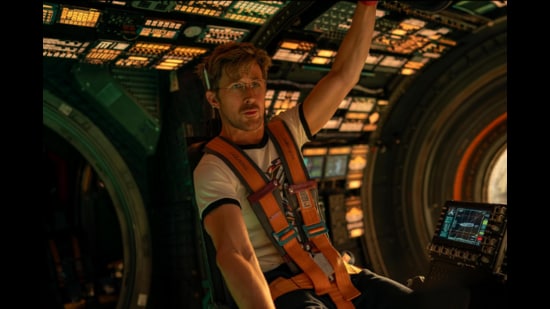
Leading the film is Ryan Reynolds — who notably acquired the rights to the project even before the book was published — as Grace. That early involvement shows. This is not a detached casting choice; it feels like a performance shaped from the ground up to fit the tone the film ultimately embraces. Reynolds’ Grace is wry, self-aware, and likeable, carrying over the intelligence and problem-solving instincts from the book while leaning more openly into charm. There are moments where his familiar screen persona slips through — a kind of post-Barbie (2023) “Ken-ergy”, playful and just a little self-aware — but instead of feeling like a mismatch, it enhances the character. This Grace feels lighter, more accessible — and crucially, more aligned with the film’s tone.
That tone becomes fully apparent once the story reaches its emotional centre: Grace’s encounter with an alien, whom he names Rocky. What begins as a high-stakes, solitary narrative of a one-way journey expands into something far more intimate. Two lone, brave beings, from entirely different worlds, working together to solve a shared, existential problem.
This relationship — the bond, the banter, the gradual building of trust — is where the film truly understands the novel. Screenwriter Drew Goddard, who previously adapted The Martian, preserves the emotional spine of Weir’s story with care. Rocky, voiced by James Ortiz, in particular, is brought to life in a way that makes the connection feel immediate and real, grounding even the film’s more fantastical elements in something recognisably human, or more so… alien. Their interactions carry warmth, humour, and a genuine sense of companionship that anchors the narrative.
But in choosing to foreground that relationship, the film also makes a clear trade-off.
What defines Project Hail Mary as a novel is not just its premise, but its process. The science in the SFF (Science Fiction and Fantasy) isn’t decorative — it is the story. Every breakthrough is earned through cycles of trial, failure, recalibration, and persistence. The tension comes not from external threats alone, but from watching Grace think — slowly, methodically — his way through problems that seem impossible.
The film, by comparison, streamlines that process to a large extent. The key beats remain intact, but the intricate build-up — whether it is the mathematics of fuel consumption or the trial-and-error of xenobiology — is noticeably condensed. Solutions arrive faster. Obstacles feel less insurmountable. The narrative moves with a smoother, more continuous momentum.
And that shift affects the tone.
Where the book balances hope with sustained, almost suffocating tension, the film leans more into “hopecore” optimism. It becomes less of a process-driven survival story and more a feel-good (if still high-stakes) space adventure — one where challenges exist, but rarely linger long enough to fully weigh on the viewer. The sense of earned resolution — of having worked through each problem alongside Grace — is softened.
Reynolds’ performance plays into this as well. His version of Grace doesn’t just solve problems; he moves through them with a certain ease, a conversational rhythm that keeps the film engaging but makes its texture lighter. The humour lands effortlessly with great timing, the emotional beats hit, but the edges feel smoother.
None of this makes the film ineffective — far from it. On its own terms, it is a fantastic piece of filmmaking. The visuals are expansive, stunning and unbound by real-world limitations, embracing the freedom that science fiction offers. Rocky, and his journey on screen, is particularly remarkable — a five-appendaged being whose presence feels tactile rather than digital. Directors Phil Lord and Christopher Miller lean into physical effects and controlled movement where possible, rather than relying purely on green screen CGI, giving the film a texture that makes its most improbable elements feel grounded.
But the experience is undeniably different.
If the book is built on immersion — on understanding how each piece of the puzzle fits together — the film is built on immediacy. It prioritizes emotional clarity over intellectual density, momentum over method, connection over complexity.
And that choice defines the adaptation.
The film does not replace the book, nor does it attempt to replicate it in full. Instead, it offers a parallel experience — one that captures the story’s emotional core while simplifying the mechanism that powers it. Something is lost in that translation, particularly for readers who found the novel’s scientific depth to be its most compelling feature. But something is also gained: accessibility, warmth, and a version of the story that unfolds with ease and cinematic fluidity.
In that sense, the film and the book don’t compete — they complete each other.
For viewers who come to the story through the film, the novel offers a deeper, more intricate version of the same journey, one where every solution feels hard-won. For readers, the film provides scale, movement, and excellent visual rendering of a story they already know, along with an emotional payoff that still lands, despite some of its complexity being stripped away.
Rutvik Bhandari is an independent writer. He lives in Pune. You can find him talking about books on Instagram and YouTube (@themindlessmess).
One Subscription.
Get 360° coverage—from daily headlines
to 100 year archives.
Archives
HT App & Website