How to win friends and influence people
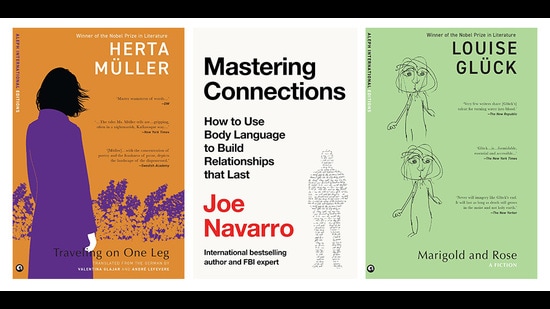
Drawing on unique expertise gained over his 25-year career as an FBI counterintelligence officer, Joe Navarro shows how to use simple body-language tools to transform relationships in everyday interactions, both personally and professionally. With the help of Navarro’s easy-to-grasp insights and practical advice, he will help you to master the art of the first impression, build trust and rapport with someone new, handle workplace negotiations with ease, defuse tension and conflict, be prepared for a first date, and foster positive life-long relationships.
Navarro’s body-language insights and tools aim to give the individual a better life by making them capable of building more meaningful friendships and relationships.*
Of exile, homeland, and identity
The protagonist of Herta Müller’s Traveling on One Leg is Irene, a fragile woman, born to a German family in Romania, who has recently emigrated from Romania to Germany. The novel focuses on Irene’s relationship with three men: Franz, whom she met in Romania and who is unwilling to respond to her love for him; Stefan, a friend of Franz’s; and Thomas, a bookseller in perpetual crisis about his identity.
Despite her being born to a German family, Irene’s place in Germany is as a recent émigré and an unassimilated Romanian German. She feels neither longing for Romania nor any comfort in her newly adopted Germany. Politically and socially isolated, she moves within the emotional orbit of these three men, while at the same time moving between West Berlin, Marburg, and Frankfurt, taking a dissonant journey within strange yet familiar territory. Characterized by a sense of profound isolation, Traveling on One Leg is a poignant exploration of exile, homeland, and identity.*
{{/usCountry}}Despite her being born to a German family, Irene’s place in Germany is as a recent émigré and an unassimilated Romanian German. She feels neither longing for Romania nor any comfort in her newly adopted Germany. Politically and socially isolated, she moves within the emotional orbit of these three men, while at the same time moving between West Berlin, Marburg, and Frankfurt, taking a dissonant journey within strange yet familiar territory. Characterized by a sense of profound isolation, Traveling on One Leg is a poignant exploration of exile, homeland, and identity.*
{{/usCountry}}A meditation on childhood
Nobel-winning poet Louise Glück’s only published piece of fiction, Marigold and Rose, is a hypnotic novella about the eponymous twins’ first year in the world. In deceptively simple, tender prose, Glück portrays the pre-linguistic inner lives of Marigold, who is ‘the thinking one’, and Rose, who is ‘everything else’.
Even in infancy, Marigold longs for adulthood with its ‘vast cargo of words’. She has already started writing a book in her mind; she needs ‘something that [stands] for herself as Rose [stands] for Rose’. Rose, on the other hand, is sociable, curious, and self-assured. She is the twin who learns to breathe first, so she can teach her sister.
In one year, the twins go from being ‘tadpoles’ to ‘actual miniature people’ who can babble, crawl, and drink out of cups. As Rose learns to talk, Marigold learns to watch. Meanwhile, Mother and Father have their own qualms about work and house-buying, Grandmother dies; by and by, the safety of infancy disappears, and the twins must grapple with the ‘chaos and imprecision’ of the world of grownups.
Marigold and Rose is a profound meditation on childhood, language and its limits, individuality, and wholeness, by a writer of prophetic vision.*
*All copy from book flap.