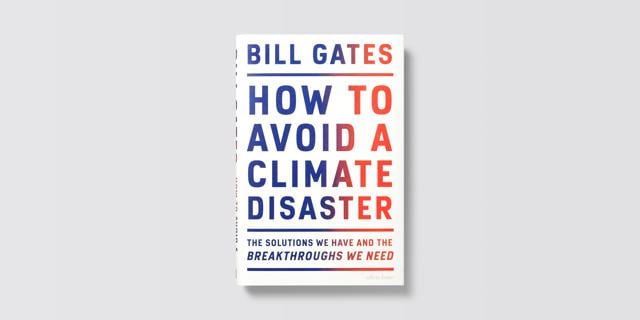
Reading How to Avoid a Climate Disaster, Bill Gates’ new book, you are struck by his belief that the world can be changed for the better, perfected, saved; that humankind can stop climate change if we sincerely tried. Not for him a horrified paralysis as the world ends in fire or ice. Approaching the monumental crisis as a problem to be solved, he provides us with a plan to bring carbon dioxide emissions down to zero by the year 2050.
“When people think about climate, they think about making electricity and about passenger cars mostly. They aren’t aware that there are many other sources of CO2 emissions including when we make cement or steel or when we grow cows -- in some countries to eat beef. Electricity, transport, food, buildings and manufacturing are the biggest areas of emissions. The challenge to get to zero is you can’t skip any of these areas of emissions. You have to do even the hard ones,” he said during a video interview.
To achieve that goal requires much innovation, and a shift to new ways of doing things. “The younger generation more and more is going to demand progress, it will be the moral cause of their generation across religions and countries and so they deserve a plan. And yet this movement doesn’t really have a plan. So my book is to suggest the elements of a plan,” he says adding that battling climate change is the hardest thing humanity has ever done. “Unlike the pandemic, you won’t be able to get out o f it with just a single tool like a vaccine. The fact that it accumulates slowly and just gets slightly worse can’t fool us into not taking early action,” says Gates who is enthused about the possibilities of everything from plant-based and cellular meat to electric vehicles and the use of nuclear power instead of coal to generate electricity.
“About the artificial meat, if you’d asked me five years ago, I would have said that was going to be very difficult but a lot of new companies like Impossible Foods and Beyond Meat are selling their ground beef and some other products in the US market and are getting quite a bit of good acceptance. Over time, those companies may have many competitors and work on different food areas and the price of those things will come down and the quality will go up, and at some point, it may be a superior way of doing things and the whole market will shift even if the government doesn’t say, ‘OK we are going to tax the stuff that causes emissions’,” he says pointing out that all the areas that are the biggest sources of CO2 emissions need innovation.
{{/usCountry}}“About the artificial meat, if you’d asked me five years ago, I would have said that was going to be very difficult but a lot of new companies like Impossible Foods and Beyond Meat are selling their ground beef and some other products in the US market and are getting quite a bit of good acceptance. Over time, those companies may have many competitors and work on different food areas and the price of those things will come down and the quality will go up, and at some point, it may be a superior way of doing things and the whole market will shift even if the government doesn’t say, ‘OK we are going to tax the stuff that causes emissions’,” he says pointing out that all the areas that are the biggest sources of CO2 emissions need innovation.
{{/usCountry}}“We need great innovators, great research, great policies that will radically change all five of those areas in order to get to this very ambitious goal of zero emissions. That’s the only thing that will stop the temperature from continuing to rise,” says Gates. He believes rich countries will ban the sale of gasoline cars within the next 15 years.
“The reason is that the cost of electric cars will go down and as those batteries get cheaper, their range will go up as they have more power storage and you’ll have more charging stations and the time it takes to charge will go from hours to 15 to 20 minutes. So even though, today, if you get an electric car, you pay a premium - what I call the green premium - over time, that premium will drop to zero,” he says adding that much of the terrible air pollution in Indian cities comes from cars and coal plants.
“It’s another reason you want to move the cars to electric and the power generation away from coal. Coal has a lot of health effects. Coal kills a lot of people and not just in mining accidents. And yet, India has a lot of domestic coal and a lot of jobs in coal so that will be a very fraught transition to move away from that,” says Gates who thinks improved nuclear reactors could be the best source of clean energy.
“Nuclear reactors have been generating power for a long time. Even so, I don’t believe in that generation. It’s too complicated, too expensive, requires human operators. We want a reactor that no human has to ever push the right buttons; it is totally safe by pure physics; there’s no overheating scenario.” It sounds too good to be true but a company called TerraPower -- that Gates founded -- is already working on it. “They are building a demonstration plant to see if this new generation can work and be cheap. If so, then maybe it can help with the climate problem,” he says.
Gates believes 2021, the year of the COP26 (2021 United Nations Climate Change Conference) to be held in Glasgow this November, “is a big year for climate to get a plan”. Currently, the third richest man in the world, he is aware of the limits of philanthropy. “This is not something that I, even with all the resources I have, can do a meaningful percentage of. It’s such a big thing and it involves governments and big private sector companies,” he says. “You know philanthropy can help invent the meningitis vaccine -- that’s a few hundred million dollars type project. The energy industry is many trillions and once you add other industries like steel and cement you have a meaningful part of the world’s 80 trillion dollar global economy. So my goal, although I’m doing my best and I’m putting 2 billion of my money over the next five years into this, it’s really just being catalytic and speaking out about how all the resources might come together to get us to zero,” he says.
For the sake of the world’s young people, you hope Gates’ plan works.