What inspired you to become a writer?
While pursuing my studies at Mar Athanasius College of Engineering, Kothamangalam, I indulged in some writing experiments. However, what made me take up writing seriously and attempt a novel was the chance visit to an isolated isle near Cochin to attend a friend’s sister’s wedding.
The geography of the island, the unique way of life of the natives, and the ancient traditions surrounding the place were enchanting, paving way for my first book, Purappadinte Pustakam aka The Book of Exodus.
Could you describe your latest novel, Anti-clock? How did the idea for the story take shape?
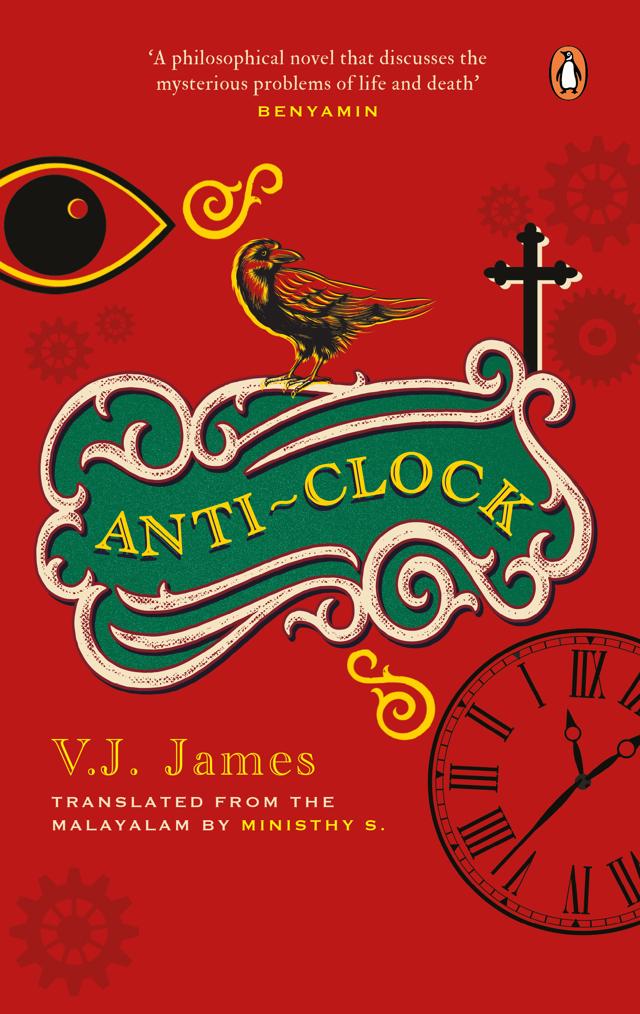
Anti-Clock is a book that confronts the age-old enigmas befuddling mankind: birth, life and death. It can also be viewed as an exploration of Time which links the trio of past, present and future.
The main protagonist of the novel is a coffin maker. The coffin shop near Palayam church, which caught my eye when I newly joined VSSC (Vikram Sarabhai Space Centre), became the stimulus for the book.
{{/usCountry}}The main protagonist of the novel is a coffin maker. The coffin shop near Palayam church, which caught my eye when I newly joined VSSC (Vikram Sarabhai Space Centre), became the stimulus for the book.
{{/usCountry}}The driving force behind Anti-Clock was the search of how “the needles of time” inevitably trounce the egoistic ‘I’ reigning over every human being.
Anti-clock was written after the publication of six novels. What have you learned from past success? How has it helped shape the novel and also, the writer in you?
Every novel can be viewed as an inscription of a writer’s philosophical sojourns. Approaching a subject merely from an emotional or sensory perspective is the most primitive level. When one attempts an intellectual analysis, it forms the second level. The third level is to transcend the intelligence and reach the mysterious source which engenders it.
While journeying from Purappadinte Pustakam to the seventh book Anti-Clock, one finds oneself travelling simultaneously through scientific and philosophical pathways to comprehend Life, Time, and the ‘great knowing’ called Nature.
Truly, writing is also self exploration. It is a journey to one’s own self, which eludes any external understanding. Consequently, during the writing process, I have witnessed many rare ideas stepping in, which one had never contemplated before.
You present the quaint setting of a Kerala village and the many intrusions it faces quite vividly in Anti-clock. What research has gone into the work?
I am an ordinary person, born in a remote village of Kerala, who studied in a Malayalam medium school. Anti-Clock is set in surroundings that are very familiar to me. However, to understand the ambience of a coffin shop, the construction of coffins, and the lives of coffin makers and gravediggers, I had to spend time with them.
While studying at the church-run school at Changanassery, as a first standard student, I had explored the cemetery and even clambered atop the well of bones! All those experiences came in handy while writing Anti-Clock. The research part of a novel relies mainly on one’s own life. Of course, historical aspects of the novel, including INA, Subhas Chandra Bose, and the early Communist history of Kerala were gathered through different sources.
Is the idea of Anti-clock, of turning back time, an allegory for a return to a rose-tinted past, or to nature?
Our understanding of time is severely limited by the constraints of time-space connected with our existence. Anti-Clock arises from the concept that time is relative. Where past, present and future samlessly merge into a continuum, only in such a space, shall we find the answer to this question. Of course, returning to nature is the path to reach the answer.
Anti-clock’s Hendri is unlike your usual protagonists. He is devoid of ambitions, follows routines out of habit, and intends to murder his arch-nemesis Satan Loppo. Yet, the reader empathizes with him and wants him to succeed. How have you managed that, and quite effortlessly?
Inside every man dwells a Hendri, who holds ever-changing views on truths and falsehoods, on rights and wrongs. There is an innate wish for good to triumph, inside all of us. Most of us observe various manifestations of Hendri’s helplessness and the overarching arrogance of Satan Loppo in our surroundings and are rendered silent. Perhaps that is why we are cheering for Hendri’s vendetta.
As a writer, my wish was to elevate Hendri from the burden of his own self. I wanted to make him part of Nature’s law, which exists much above a human being’s selfish interests.
Your work as an engineer at VSSC must demand precision and planning. Now, we know writing is a messy affair. Did the engineer in you ever try to enforce a plan or routine when it came to writing? Did it succeed? Not just engineering, every profession demands a schedule and discipline. However, for me, writing is not a mechanical process that can be completed in a timebound manner. If one decides that a story or novel should be completed in a few months or even a year, there is no guarantee of such a thing.
I do not write as per the dictates of a clock or a timetable. For me, writing is fraught with extreme uncertainty. I am the sort who sits down when I feel the call, a gracious presence of writing!
But the engineer inside me has helped tremendously, unwittingly or otherwise, in evaluating the precision and conciseness of a story or novel, and in making the necessary corrections. To me, writing and engineering are complementary to each other.
After 20 years of writing stories, do you think you have finally tamed the muse?
It has been 20 years since my first book got published. But my writing began 12 years before that. One cannot survive just on writing, especially in a small language like Malayalam. One has to first engage in a job for a living and find opportunities for writing during one’s spare time.
My opinion is that “taming the muse” is meant more for those who are writers by profession. Even now I continue to be an ordinary person who attempts to write only when the calling comes and otherwise restrains himself. If I may dare to explain further, I would say that my writings are failures of my attempts ‘not to write’.
Well, if the muse still managed to make me write seven novels, six short story collections, and four children’s books, why should I dream of taming her?
What are your most precious possessions?
My mother lost her ability to speak in her later years. Till she passed away, Amma communicated by writing on a slate with kallu-pencil. I have kept that slate with me. Apart from that, my most precious possession is the awareness that one’s true possession lies within oneself.
Just as the coffin shop traps Hendri, is regional writing (not just in Malayalam) too trapped within the barriers of language and its limited readership? How pleased then are you that Anti-clock has been translated into English, a language with a wider audience. Or are you of the opinion that no single language holds more sway than another?
When books travel beyond the borders of languages, human beings enter into a give and take relationship. That interaction contains nuances of philosophical, cultural and human values in its ambit.
The world has become a global village, many books in regional languages are getting translated into English and acquiring a wider audience.
Chorasastra: The Subtle Science of Thievery, published by Westland in 2020, was my first translation. While browsing through comments on Instagram and other media, one gets to know how non-Malayali readers are discussing one’s book and engaging in conversations about regional literature. I am hopeful about the bright future of translated works.
If Pundit (a character in the novel) presented you with an anti-clock, what point in your life would you move its handles to?
Undoubtedly, to the state before the beginning of time!
Writers in Kerala have been very political. Your work is also littered with hues of politics. What’s your comment about the current political situation in Kerala?
It is not just in Kerala, but a worldwide phenomenon that politics has become a belief system, just like religion. For each person, only his politics appear right. The rest are wrong. Watch our TV channel discussions to observe how we have become a society lacking political solvency.
KX Ronnie is a writer who lives in Kochi.