Over the three decades of your career, TV news has shifted from bulletin-style reporting to high-decibel, opinion-led programming. How has this eroded public trust in television news?
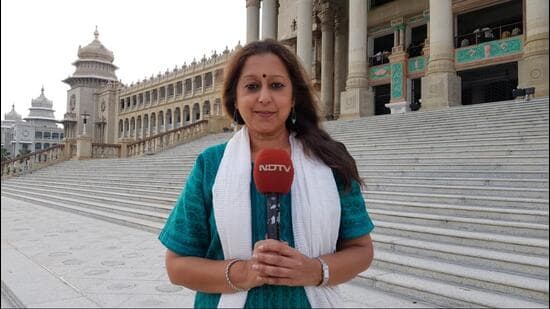
In recent years, I have lost count of the number of times I have heard people say, “I don’t watch TV news anymore.” People used to turn to TV news as a matter of course. But all that has changed. Talking (or shouting) heads replaced visual stories in prime time. The bias on
Over the three decades of your career, TV news has shifted from bulletin-style reporting to high-decibel, opinion-led programming. How has this eroded public trust in television news?
In recent years, I have lost count of the number of times I have heard people say, “I don’t watch TV news anymore.” People used to turn to TV news as a matter of course. But all that has changed. Talking (or shouting) heads replaced visual stories in prime time. The bias on display on many English TV news channels in our country today means that we cannot always hope to see measured, balanced and all-round coverage of issues that might be considered controversial. As a result, viewers who want a fuller picture have turned to other news sources.
The news channels do still have their viewers -- people who are happy with the point of view being expressed perhaps and who do not realise or do not mind that they are in an echo chamber. But millions of thoughtful news consumers have switched off due to this lack of trust.
As for the young -- most of them really don’t have a TV news habit at all. I asked a group of students at a college recently if they watched TV news. Very few did. I asked ‘why not’ to those who didn’t. ‘Because the news is not reliable and it is biased’ was the gist of the replies. Some independent journalists are still respected - but every journalist has to work to earn and keep that trust.
You argue that reporters should not become PR for any government or party. What would a healthy boundary look like, in practice?
This has always been a tricky line to walk for journalists. A journalist needs access to newsmakers – which implies a level of closeness. If a politician trusts a journalist, they are more likely to grant an interview or share off-the-record or behind-the-scenes information. This is important. But if this closeness only exists because the journalist never criticises the politician in order to gain and maintain that closeness, then we have a real problem. The thrill of access cannot or should not trump the need to ‘speak truth to power.’
You’ve consistently avoided overt political bias, which now seems rare on mainstream TV. How does this damage the credibility of individual journalists and the profession?
One unfortunate point to think about here is whether or not credibility is still considered important for many journalists in the profession today. It has always been important to me. I’ve always felt that it is better to be right than be first. There was a lot of pressure to be first, of course. But I would want viewers to believe something if it came from me.
I also try to be unbiased when it comes to political reporting. Leaders from all political parties in Karnataka continued to give me interviews and information even in an increasingly polarised environment – which I think is a good sign.
If journalists are very obviously identified with a political party or ideology, it is hard to consider them credible when it comes to what they report. They are wearing their bias on their sleeve. And this definitely damages the credibility of individual journalists -- and sadly, the profession too.
You point out that politics remains largely a “men’s club”. Do women still face hurdles in the newsroom?
I believe that women do still face greater challenges – not just in journalism but in all fields. We still don’t have a level playing field. Sexual harassment in the workplace is a harsh reality -- and newsrooms are no exception. For field reporters, this harassment may also be faced while on the job out of office. The safety of women is an issue across the board, across the country. Basic challenges continue – access to clean toilets is not guaranteed and I am not the only woman reporter to have sipped water carefully on a hot, summer day while on the field for hours.
Politics is still overwhelmingly male. This does make access for a woman journalist more difficult in many ways. Look at the percentage of women elected representatives. The Karnataka cabinet has no women in it at all.
Where matters may have improved for women journalists is that they now have more women role models who have risen in the profession -- proving that such growth is possible. There are women journalists who have taken on abusers – filing complaints and legal cases – which also serve as examples to other women that this too can be done. There is, of course, a very long way still to go.
Please talk about the need for more diverse newsrooms.
TV newsrooms are staffed largely by people from a background of privilege. And while one would hope that a good journalist would have the understanding and empathy to report stories from outside her own personal experiences and environment, it cannot be denied that lived experience matters. A person who has been sexually harassed – which is, sadly, just about every woman in India – would have a different approach to reporting on such crimes than someone who has not faced such assaults. Stories on caste discrimination, religious bigotry, persecution of sexual minorities would more likely be selected for coverage in the first place by those who personally understand what that is like. A greater knowledge and empathy would be brought to coverage of diverse issues if those calling the editorial shots were from diverse backgrounds themselves.
The ‘South’ is often seen as an almost homogeneous block by many editors based in Delhi. And the north-east of our country? Barely a blip on the news rundown even at a time when a state in the region was on fire. Would words like ‘love jihad’ or any of the many other ‘jihads’ that make it on air be used quite so casually if there were more representatives of minority communities in the news room? Would there be more coverage and questioning of harassment of Christians during religious celebrations?
Hindi bites are often played on English news channels without translation supers. That would not be the case with any of the other languages of India. There are allegations that attempts are being made to quash our country’s amazing diversity. A newsroom should resist any such attempt by looking inwards as well.
Please share examples where the pressure for ratings clearly undermined objectivity and balance in TV news channels.
One story that immediately comes to mind is the coverage following the death of actor Sushant Singh Rajput in 2020. It was a story the public was interested in – and to keep the news cycle filled with ‘fresh’ material, channels gave in to airing speculation, gossip and the strangest of conspiracy theories. His partner, Rhea Chakraborty, was trailed by camera units and hounded by TV channels who decided that Sushant had been murdered. It was certainly not the finest hour for Indian TV news.
Do you remember the scenes outside Parliament in 2023 – the day that saw a security breach with smoke canisters released in the building? Reporters from rival channels pushed and tussled to get their hands on a canister said to be one of those used. It showed the pressure reporters are under to get what the other channel has. It would have been funny – if it weren’t so sad.
What corrective measures can news channels themselves take? Is there a role for an independent body to regulate content?
The question of regulation – and its close cousin, censorship – is a tricky one. There is no doubt that our TV channels have spread hate and bigotry. They have done this by carrying the voices of the bigoted without challenging them and by reporting only parts of many stories. Anchors themselves have also added their bit with obvious bias in their own words. The supers on a TV news screen are often totally one-sided. Words like ‘love jihad’ and ‘anti-national’ are thrown around almost casually.
Fake news is another major issue. Independent fact checkers are a whole industry now – and the legitimate ones are doing their best to clean this Augean stable. The showing of violence, dead bodies, private moments is frequent despite guidelines against such voyeuristic content.
All this needs more regulation for sure. And TV channels aren’t doing a brilliant job of it themselves. But an external regulator would open up a whole new set of problems. Who would watch the watchdog?
It has to be self-regulation. But without the involvement of all media houses, there may not be enough compliance. The bigger challenge is the editorial mindset that allows content to air that is not in the interest of society. But who decides what is in the interest of society?! It is a very complicated issue - but an external body regulating content would probably not be the answer.
You write that the devaluation of the field reporter has been a major blow to Indian TV news, with studio anchors now setting much of the agenda. How can channels re-prioritise ground reporting?
There first needs to be a recognition that what made TV news special was the images and voices that were brought directly from the ground by the field reporter and production team. When that kind of directness is no longer prioritised, the images we see on TV news become a series of talking heads in a bland studio. It may be easier to do this kind of studio programming. It is certainly cheaper - sending a crew to a location to shoot a story costs money. But it is money well spent in the service of journalism in our colourful and diverse country. It is also true that many TV channels are owned by people for whom such funding is not a problem. So there needs to be the will to bring back that kind of TV journalism in addition to the funding. We also need journalists who are ready to go out there and get hot and tired and dusty. TV reporting is not always a glamorous enterprise – far from it. I have worked as an anchor for studio news bulletins and audience shows. While I thoroughly enjoyed the whole process of anchoring, the memories that stay with me are from my field reporting. That, for me, is where the heart of TV news beats.
Majid Maqbool is an independent journalist based in Kashmir.
One Subscription.
Get 360° coverage—from daily headlines
to 100 year archives.
Archives
HT App & Website