When I walked into the Amon Papyrus Museum on the outskirts of Cairo on Abo el Houl Street, near the Giza plateau, I expected a quick tour and perhaps a souvenir or two. What I didn’t expect was to be completely transported into the ancient workshops of Egyptian craftsmen, into the mythology surrounding the Nile, and into the material that carried the world’s first written stories. A warm, intimate and bright space punctuated by moments of deliberate darkness when paintings
When I walked into the Amon Papyrus Museum on the outskirts of Cairo on Abo el Houl Street, near the Giza plateau, I expected a quick tour and perhaps a souvenir or two. What I didn’t expect was to be completely transported into the ancient workshops of Egyptian craftsmen, into the mythology surrounding the Nile, and into the material that carried the world’s first written stories. A warm, intimate and bright space punctuated by moments of deliberate darkness when paintings come alive with an otherworldly glow, the museum’s significance is monumental. “Following the age of the Pharaohs, the Qaramos community remains the world’s sole producer of papyrus,” says Walid, the owner of the museum.
Rahma, my guide, took me toward a basin containing the tall green reed that changed the course of human civilisation — the papyrus plant. The stalks rose from the water like slender pillars, their feathery tops fanning out like fireworks. I asked her if this was the setting where the famous papyrus process begins. “Yes,” she replied, “I also have a double view.” She lifted a stalk and sliced through it, revealing a perfect triangular cross-section.
“This stem has a pyramid shape,” she said, adding that according to ancient Egyptian mythology Amun-Ra, the god of the sun, believed the plant’s flowers look like sun rays. It was astonishing to see how the plant seems crafted for symbolism. The ancient Egyptians didn’t choose it randomly; its very geometry felt divine. I look at the dozens of bright papyrus artworks on the wall — scenes of Isis and Osiris, the weighing of the heart, Pharaohs receiving the ankh of life, lotus flowers, desert caravans — each one humming with colour and history. Rahma then proceeded to show me how the first paper in the world was made by cutting a fresh stalk on a glass table. “They cut it into small or medium or large according to the size they wanted the paper to be. I’m going to cut it into small one,” she said, her hands working swiftly, “I will now remove the green outer layers,” her voice softened as she focused on the delicate white pith beneath the rind.
Spanish philologist and historian Irene Vallejo, in her best-selling book Papyrus: The Invention of Books in the Ancient World, describes how Egypt, nourished by the Nile, became immensely wealthy. Grain harvests were abundant and the country’s goods dominated ancient markets. Among them was papyrus, the most widely used writing material of the time. Vallejo explains that the reed has a stem as thick as an arm and rises between three and six metres in height. Thanks to its flexible fibres, it was used by ordinary people to craft everyday items like cord, mats, sandals, and baskets. Indeed, in the Bible, the infant Moses was placed in just such a basket, woven from papyrus and sealed with pitch and asphalt, to drift on the Nile.
By the third millennium BCE, Egyptians had learned to transform the reeds into writing sheets, a discovery that spread across the Near East by the first millennium. For centuries, Jews, Greeks, and later Romans relied on papyrus scrolls to record their texts, ensuring the material’s central role in the literary cultures of the area.
Academic papers describe papyrus as one of humanity’s earliest biotechnological breakthroughs. Researchers such as Antonia Sarri and Joachim Quack explain that the pith strips were soaked in Nile water rich in microorganisms that helped break down the fibres just enough to make them sticky. Once softened, the strips were laid in two perpendicular layers and pressed — without any glue. The plant’s natural sap bound the sheet, and the Egyptian sun cured it to the perfect hardness. This process, although simple, was ingenious. But all of that academic knowledge felt abstract until I got the chance to watch Rahma lay out the strips in a miniature lattice of white, pressing them gently under a wooden block as she explained how the ancients did it.
The significance of papyrus cannot be overstated. The other great civilisations of antiquity, the Greeks and Romans are also remembered because they wrote, recorded, documented, and illustrated their worlds. And they all did it on papyrus. Papyrus was the basis of writing culture in the ancient Mediterranean. Without it, that world would have been silent; without papyrus, much of human history might never have been recorded at all.
For me, this realisation transformed the Amon museum into something more than a tourist attraction. The paintings on the walls were no longer just souvenirs — they were extensions of a tradition that built civilisations. Walking down a hall, Rahma gestured toward a framed painting under a special lamp. I was startled to see that it glowed and the colours seemed to change from moment to moment. The guide explained that modern papyrus artworks often incorporated luminous pigments that glow under blacklight.
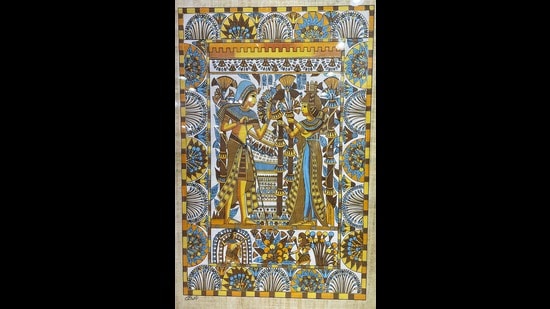
“Contemporary papyrus artworks achieve their nighttime glow through luminous pigments — modern compounds that absorb ambient light and release it slowly in darkness,” says Walid, “Our artists apply these paints or dyes onto traditional papyrus sheets, creating a layered effect where the ancient fibre base meets modern light-reactive technology.” Turns out, the effect is the result of simple physics: the pigments absorb photons and later release that stored energy as visible light. “Under UV, the fluorescent pigments intensify dramatically, turning colours almost electric,” he adds. The museum’s extensive collection includes reproductions of famous scenes from the tombs of Seti I, Tutankhamun, and Nefertari, zodiac charts from the Dendera Temple, vivid representations of the afterlife from the Book of the Dead, and intricate geometric artworks inspired by Coptic and Islamic motifs. There are scrolls, wall-sized sheets, bookmarks, and miniature pieces perfect for framing. Many are signed by artists who have spent years mastering the techniques.
They stand in sharp contrast to the cheap imitations sold across Egypt that are machine-printed on regular paper or that made from banana fibre. In the end, I splurged on three papyrus paintings which now remind me of the wonders of Egypt every time I look at them.
Veidehi Gite is an independent journalist.
One Subscription.
Get 360° coverage—from daily headlines
to 100 year archives.
Archives
HT App & Website