
 E-Paper



Report: The Sacred Amritsar 2026
With thought provoking sessions and hi-energy musical performances, the event presented the possibility of healing through literature, music, and poetry

 Prefer HTon Google


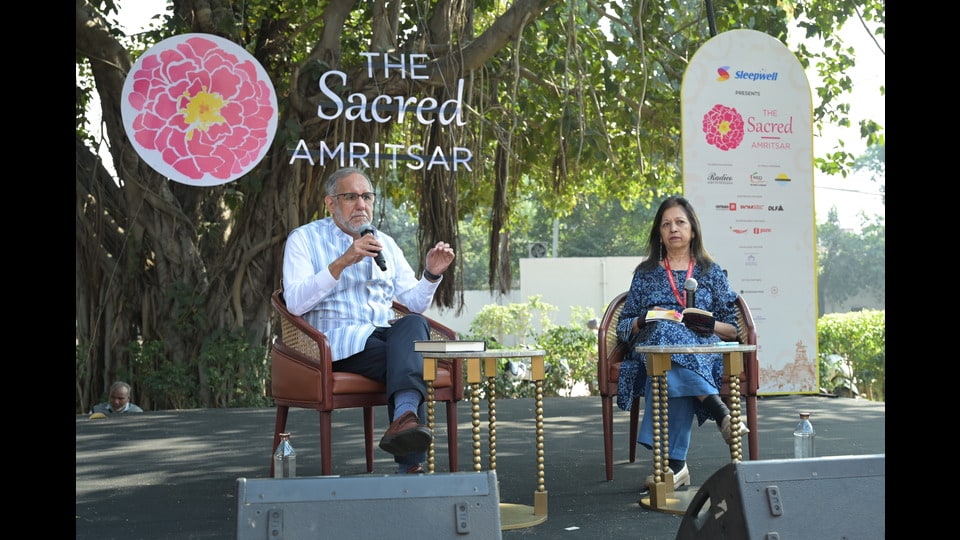
If this reporter were to pick a moment that set the tone for the fourth edition of The Sacred Amritsar festival held from February 20 to 22, it would be veteran journalist Harinder Baweja recounting the days of militancy in 1980s Punjab. In a mid-morning session with diplomat Navdeep Suri titled Reporting Conflict: Punjab and its Traumas, the author of They Will Shoot You, Madam, spoke about visiting the Golden Temple after separatists led by Jarnail Singh Bhindranwale, who had occupied the place, were killed during Operation Blue Star in 1984. She was appalled at the sight of human faeces and hair in vessels used for holding kadha prashad. A sense of great unease enveloped the audience as they listened to Baweja recall a time when, fearing reprisals, police officers in the city refused to testify against terrorists in court unless they were presented blindfolded.
Later, after lunch at the Partition Museum, attendees joined a guided tour of the holiest shrine of the Sikh faith, the Golden Temple, that now looks overwhelmingly serene, calming anxious hearts and soothing wrecked nerves. As I undertook the sarovar parikrama and circled the Harmandir Sahib, I thought of how different everything looked compared to the pictures presented by Baweja’s memories.

“There is a memory of trauma in most cities. Especially in Amritsar — be it Jallianwalla Bagh or the Partition Museum,” says Sanjoy K Roy, Managing Director of Teamwork Arts, organisers of the event. He believes cities can heal through literature, music, and poetry and emphasized the importance of using festivals to combat hate. “Some forces are trying to make us a unipolar society, which we are not. We need to collectively build on the idea of a diverse India,” he said.
Later, at a session titled Afterlives: the Ghosts Around Us during the festival’s opening dinner at the Sarovar Premiere, Roy, who is also the author of There’s a Ghost in My Room spoke to writer and podcaster Eric Chopra about all manner of things that go bump in the night! Ghosts, apparently, are best summoned at the witching hour of midnight. Despite my scepticism, I found myself intrigued, especially when Chopra recalled his nani calling the ghost that was believed to be living in a nearby peepal tree, a djinn. How was a Hindu Punjabi household being haunted by a djinn rather than a bhoot? Chopra wondered. “Do you think borders can take ghosts away from the land they are bound to?” his nani replied almost dismissively. The line lingered. It felt like a reminder that while nations may be partitioned by ink and blood, the other world, strangely, is perhaps still tethered to the same soil.

Next, the action shifted to Qila Gobindgarh where the Anirudh Varma Collective and Usha Uthup performed. Ever the entertainer, Uthup peppered her act with hilarious tidbits and memorable anecdotes from her illustrious five-decade-long career, even recalling the time when the lyrics of one of her songs caused a furore. “I am the original item girl,” she announced to thunderous applause before launching into a spirited rendition of Darling from Saat Khoon Maaf.
The Kutle Khan Project and Kailash Kher took the stage on the second day with the latter performing a medley of his biggest hits as the festival’s penultimate act. Backstage, I asked him about the importance of artists taking political positions. “Gaayak saadhak hote hai (A true singer is a seeker, engaged in spiritual discipline),” he replied, implying that an artist’s politics and art needn’t necessarily intersect. His own act, which clearly endorsed a syncretic inheritance, included both Allah ke Bande and Shiv Shambhu.

“Thank you for visiting Amritsar” reads a sign on the way to the airport, and for some reason I think of Baweja’s words on Operation Bluestar: “It was a big wound on the psyche of the community. It still has reverberations.”
In the end, The Sacred Amritsar Festival felt like a salve on unseen but unforgotten wounds, a way to soothe savage memories with music, poetry and intelligent conversations.
Deepansh Duggal writes on art and culture. He tweets at Deepansh75.


