The last I picked up a book on Africa was in 2014, an edited volume brought out by the Institute of Defence Studies and Analysis (IDSA). At the time, there was growing enthusiasm about things related to Africa. Waka Waka, the resounding number by Shakira, had lingered on in people’s minds. The India-Africa Forum Summit (IAFS), which institutionalized the bilateral relations between the two countries in 2008, was being planned for its third round. Representatives of 54 African countries, present at the Indira Gandhi Stadium in New Delhi on 29 October 2015, making power-packed speeches, reflected the best of India-Africa relations.
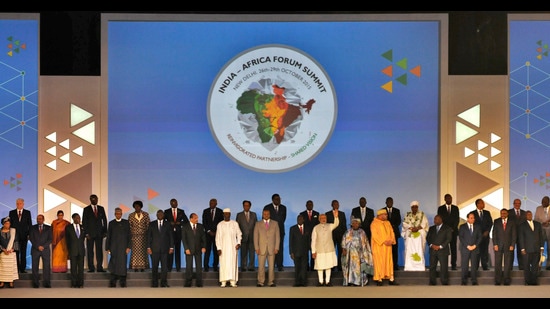
Much has been attempted since but India-Africa relations have not realized their full potential and remain short of predicted expectations. Further, the COVID-19 pandemic stalled the fourth IAFS from taking place. Meanwhile, China, despite its growing wolf-warrior diplomatic style elsewhere, continues to strengthen its relations with African states, through increasing trade and ‘palace diplomacy’. At such a time, India cannot afford to let Africa slip away from its international vision.
These are some of the points made in Rajiv Bhatia’s India-Africa Relations: Changing Horizons. Bhatia is a former Indian High Commissioner to Kenya, South Africa and Lesotho.
{{/usCountry}}These are some of the points made in Rajiv Bhatia’s India-Africa Relations: Changing Horizons. Bhatia is a former Indian High Commissioner to Kenya, South Africa and Lesotho.
{{/usCountry}}The meticulously-detailed book begins by telling us why Africa matters to India so much. One reason is that Africa has transitioned. Chapter 1 looks at how the newly independent states that emerged from colonial clutches brought in the “Age of Hope” in the 1960s. The establishment of the Organization of African Union (OAU) in 1963 was a watershed moment in the continent’s history. But the “Lost Decades” of the 1970s to 1990s, which were marked by poverty and genocide, turned Africa into “The Hopeless Continent”, as one cover of The Economist in 2000 put it. In 2011, another cover in the same publication applauded “Africa Rising” as a reality, acknowledging another transition. The attempt of this book, however, is to tell why and how the positive momentum of the India-Africa relationship should not be lost now.
Bhatia enumerates the essential developments in India-Africa relations through thematic chapters. The chronology of the relationship is navigated through Prime Ministerial phases, from Jawaharlal Nehru to Narendra Modi. The developments from 2002, when the OAU reimaged itself as the African Union are particularly analysed. Three examples – the Techno-Economic Approach for Africa-India Movement (TEAM-9), Pan-African e-Network and Network Partnership for Africa’s Development (NEPAD) are cited as projects that have enabled a meaningful engagement between India and Africa.
At the continental level, the idea of Pan-Africanism has become robust with the announcement of Agenda 2063. India has attempted to align its engagements accordingly. At the regional level, the eight Regional Economic Communities (REC) are discussed, providing useful insights from a policy perspective. At the bilateral level, the book looks at India’s relations with 15 states. Here, despite some rationale provided, arbitrariness creeps in, in terms of picking selectively among 54 countries in Africa. In the interests of altering perspectives and analytical depth, there is also some repetition in a few sections. This can tire the non-expert on Africa. Personal anecdotes and stories may have added more to the narrative.
The author presents some good suggestions on how the India-Africa relationship should be enhanced and pushed ahead. One of them, the idea to set up a “Network of India-Africa Think Tanks”, is loaded with potential, given the success of such efforts with ASEAN earlier.
A book on India-Africa cannot be complete without discussing others international players. In this context, Rajiv Bhatia explicates Africa’s relations with the EU, US, Japan and even Turkey and UAE. But his concerns are regarding China, to which a whole chapter entitled Africa-China Tango is dedicated.
There is not much about Africa that excites the contemporary Indian. Even the brother-sister duo, Kili and Neema Paul from Tanzania who lip-sync and dance to Bollywood numbers, have a limited audience. But their success is a great example of how people-to-people relations work, a subject that is discussed in Chapter 9 of the book. Without people there is no policy, no connection. The reality is, as Rajiv Bhatia writes, “one in every five persons on the planet will be an African” by 2030. Therefore, waka-waka or not, it’s time for Africa.
Srabana Barua is an assistant professor with the department of political science at Hindu College, New Delhi.