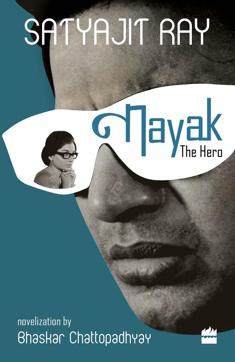
A superstar from the movies gets on a train and sees his life unravel. The Satyajit Ray classic made in 1966, starring Uttam Kumar and Sharmila Tagore is a psychological drama with all the characteristics of a Ray masterpiece. Tucked away into the folds of the story are some searing and very funny observations of Bengali society in transit. The aspiring and impatient middle class and their constant struggle with money and Marxism. The confined space of a train journey is the perfect setting for a close look at what was happening to people not just in Bengal in fact, but in India in the 1960s. So it takes a brave writer with a very thick skin to turn this classic into a book. For one, there are Ray fans and fanatics all over the world (not to mention Bengal) who will instantly compare the book with the film to see if it delivers on the layers and story as Ray does. And it is a wonderful read.
I read it without having seen the film and decided to dive into the book as if it were just another story. Does it hold? On that score, there is no question about it. Even if we were to assume that the writer has very limited skills and that is not the case here; the story Ray originally wrote is so powerful and so tightly woven that even a literal transcription would make for a riveting read. But Bhaskar Chattopadhyay is an accomplished writer and translator and a serious Ray aficionado. So he delivers what is expected of a novel when reverse engineered from a film. For instance, the film opens with a sequence of the actor Uttam Kumar putting on a clean white shirt and combing his hair into an Elvis Presley style puff. What Bhaskar does it to set that scene in its time and place without deviating from the impact of the opening. He opens with the following, “According to an article in Life magazine, the average man spends more than eighty minutes every day on personal grooming.” And he goes on to add, using the artistic license of a writer to extrapolate from the opening scene, “Arindam himself wasn’t surprised by the statement. Grooming was after all an important part of his life.”
The opening out of the screenplay in order to explore its full potential as a novel requires considerable dexterity. When to hold back and when to expand on what is in the film. The one place where Bhaskar gets it absolutely right is the build up to the film’s most talked about dream sequence. Or nightmare to be precise. Instead of giving the reader a cue that the actor or Nayak is slipping into a nightmare, he leads the reader into it without any clear warning and delivers a much more powerful narrative in the process. In the film, the camera closes in on Uttam Kumar’s sleeping face. His muscles twitch indicating he is in a dream-state. There is a musical cue that starts to build and the shot slowly dissolves into heaps of notes flying in the air. You know you are watching a dream. In the book, Bhaskar deliberately leads you in from a seemingly ordinary sequence of the actor looking for the dining cart and wondering where everyone has disappeared. “Rubbing his eyes and yawning, Arindam stepped out of the cabin and looked outside. There was no one in the corridor. It was too early for lunch.” Later in the paragraph when you’re still wondering what’s going on, Bhaskar leads you on cleverly with this. “Rows of tables and chairs, with cups of coffee, bottles of cold drinks, plates of sandwiches and cutlets on them… A doll sat on a table at the far end, resting its back against the glass window…” A darkness appears on the horizon ever so slowly, very much like a sinister device Gabriel Garcia Marquez would use here. And it fits perfectly since this is a surreal, nightmare sequence that lends itself to exactly that sort of writing. The gentleness in the build-up is worth applauding.
{{/usCountry}}The opening out of the screenplay in order to explore its full potential as a novel requires considerable dexterity. When to hold back and when to expand on what is in the film. The one place where Bhaskar gets it absolutely right is the build up to the film’s most talked about dream sequence. Or nightmare to be precise. Instead of giving the reader a cue that the actor or Nayak is slipping into a nightmare, he leads the reader into it without any clear warning and delivers a much more powerful narrative in the process. In the film, the camera closes in on Uttam Kumar’s sleeping face. His muscles twitch indicating he is in a dream-state. There is a musical cue that starts to build and the shot slowly dissolves into heaps of notes flying in the air. You know you are watching a dream. In the book, Bhaskar deliberately leads you in from a seemingly ordinary sequence of the actor looking for the dining cart and wondering where everyone has disappeared. “Rubbing his eyes and yawning, Arindam stepped out of the cabin and looked outside. There was no one in the corridor. It was too early for lunch.” Later in the paragraph when you’re still wondering what’s going on, Bhaskar leads you on cleverly with this. “Rows of tables and chairs, with cups of coffee, bottles of cold drinks, plates of sandwiches and cutlets on them… A doll sat on a table at the far end, resting its back against the glass window…” A darkness appears on the horizon ever so slowly, very much like a sinister device Gabriel Garcia Marquez would use here. And it fits perfectly since this is a surreal, nightmare sequence that lends itself to exactly that sort of writing. The gentleness in the build-up is worth applauding.
{{/usCountry}}For the fussy reader, there are however a few off-notes that need to be ignored or tossed aside while reading. Where the writing slips. In lines like this. “The light seemed to have a life of its own, and it changed every second – waxing and waning of its own free will.” Or this. “The Rolex ticked on unperturbed, its ivory dial watching Arindam’s plight with mute objectivity.”
There is also the build up to perhaps the first crucial climax in the film, where the actor feels something stirring uncomfortably within him as he encounters the skeptical non-fan magazine editor played by Sharmila Tagore. Ray’s finesse in dealing with this scene is not matched by Bhaskar’s overwritten one. It takes the drama out of the drama in this one instance.
Read more: The filmmaker who wouldn’t bend
But I am putting these triflings out there not to deter you from picking up the book. But as a gentle warning of what you can easily skip in deference to a powerful story full of complexity and character and that deliciousness that storytelling of the best sort contains within it. Tentativeness. The ephemeral, fleeting quality of people and times in a constant flux. The human condition observed by the best. Read it as I did on a lazy Sunday afternoon or a hot Monday night. It’s a three-hour trip that is nostalgic even if you are twenty. It makes you wistful about the way stories unfolded once upon a time and the gentleness with which they made their point. It will of course lead you straight to the film, after you’re done, whether you’ve seen it before or not.
Revati Laul is an independent journalist based in New Delhi. She is the author of `The Anatomy of Hate,’ forthcoming from Context/Westland in November 2018.