Could there be any political underpinnings of the time reflected in this unforgettable song: ‘Hum bewafa hargiz na thay, par hum wafa kar na sake’ of the late 1970’s? There isn’t much to Anand Bakshi’s lyrics but Kishore Kumar’s pitch, tone and tenor of delivery made the song a timeless classic. Place it in the year of its creation and one can draw interesting social and historical lessons about the milieu that gave rise to this hit song from a flop film. Much like the short-lived Janata Party rule at the centre at that time, the much-hyped film Shalimar too flopped at the box office. The song conveyed the message that letting down the people was neither the objective nor the intention and it applied as much to the characters in reel life as to the politicians in real life.
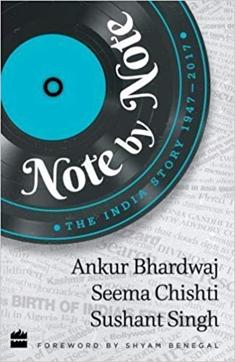
Differing in their journalistic experiences and personal interests, authors Ankur Bhardwaj, Seema Chisti and Sushant Singh teamed up to draw such parallels, one song per year, to complement the twists and travails of 70 years of post-independence India. Note by Note captures the rhythm of the country’s socio-economic and political rumblings to the beat of popular film music and the symphony it creates is imaginative, interesting and engaging albeit in parts.
There is no denying that Hindi film songs have been relevant beyond the narratives and situations unfolding in the films that feature them. Living in our collective memory, songs articulate some of our deepest desires, delights and even nightmares. Written by some of the great contemporary poets and composed by pre-eminent musicians, Hindi film songs have tended to reflect upon our everyday existential, social, national, and universal concerns. The authors argue that rather than narrowing the notion of ‘India’, popular music has continued to expand it. During the decades in which the nation was made, unmade and remade, songs captured the mood, sentiments, and consciousness of the country’s identity.
If Guru Dutt’s reaction to the persistent corruption and degradation of society a decade after independence was masterfully captured in the song ‘Jinhe naaz hai Hind par woh kahan hai’, the end of the jury system following the landmark Nanavati case was epitomized by Pyar kiya to darna kya. Without doubt, much of the 1960s and 1970s were the youthful years of the post-independence generation, the whiff of romance in the air found reflections at first in Oh haseena zulfon waali as an attempt to woo lady love, and second in Chura liya hai tumne jo dil ko, which confirmed that love had finally found its mark. With one song representing each year of independent India’s history, the book gives music to the years by picking a particular Hindi film song that was composed and widely heard in that year.
{{/usCountry}}If Guru Dutt’s reaction to the persistent corruption and degradation of society a decade after independence was masterfully captured in the song ‘Jinhe naaz hai Hind par woh kahan hai’, the end of the jury system following the landmark Nanavati case was epitomized by Pyar kiya to darna kya. Without doubt, much of the 1960s and 1970s were the youthful years of the post-independence generation, the whiff of romance in the air found reflections at first in Oh haseena zulfon waali as an attempt to woo lady love, and second in Chura liya hai tumne jo dil ko, which confirmed that love had finally found its mark. With one song representing each year of independent India’s history, the book gives music to the years by picking a particular Hindi film song that was composed and widely heard in that year.
{{/usCountry}}It must have been challenging to pick one popular song from among hundreds to mirror the development of the nation during a particular year. Some lyrics closely reflect unfolding realities whereas some need interpretation to match the situation. While the authors argue that the link between words and tunes of songs with the people has been deeper and stronger, contemporary lyricists and composers have the added challenge of generating the levels of feeling that can sustain that link.
The efforts of Bhardwaj, Chishti and Singh are commendable but midway through the book, the reader begins to wonder if this is a general knowledge book peppered with songs or a book of songs interspersed with general knowledge. However, the authors have succeeded in making modern Indian history musical by juxtaposing short analyses of songs with thumbnail sketches of development. Papa kehte hain bada naam karega bore little resemblance to the events happening in the country in 1988, but the lyrics by celebrated poet Majrooh Sultanpuri sought hope amidst all-round anxiety. The selection of songs in the book captures the overall mood of the year and the poetic sensitivity with which it was musically expressed.
Read more: Every Hindi film song by Lata Mangeshkar, in one graphic
Whether it was Jawaharlal Nehru’s drafting of the country’s future through Afsana likh rahe hoon in 1947 to the period of deaths and strife in 1993, which compelled the mourner to hum Dil hoom hoom kare, Ghabaraae, there is a song for every turn in the past seven decades. And perhaps the number Anhoni ko honi kar dein, honi ko anhoni, from the movie Amar Akbar Anthony, released in 1977, does reflect our national character of pulling ourselves out of difficult situations.
Note by Note evokes nostalgia for the era when rhythm and melody reigned supreme in conveying emotions in Hindi films. The songs of the past were part of the cultural fabric and stirred the emotional chords of its listeners. Sadly, in the predominant market culture, songs seem like products on supermarket shelves.
Sudhirendar Sharma is an independent writer, researcher and academic.