
 E-Paper



Review: Red, Green and Sometimes Beige by Kasturi Mahanta
With robust exercises, pie-chart, and diagrams with prompts, this book by a practicing therapist can be used as a guide to navigating the world of modern dating

 Prefer HTon Google


Why don’t they teach us how to do taxes at school? Or apply for a job? Therapist and relationship coach Kasturi Mahanta has another entry in this never-ending list of ‘things they should teach at school’: how to communicate in relationships.

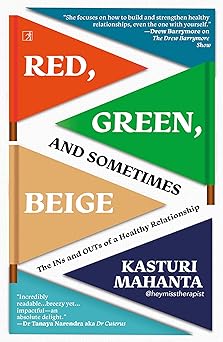
Mahanta argues that a formalized curriculum on the subject will help kids build the required skills needed to communicate their needs and be better in relationships — romantic or otherwise. Her book Red, Green And Sometimes Beige can be used as a guide to navigating the hell scape that is modern dating. The therapist uses work cases (while fully maintaining client-therapist confidentiality) to explain why GenZ and Millennial relationships are so complicated and messy (here’s a hint: it might have something to do with long-held beliefs and childhood trauma). With robust exercises, pie-charts (with catchy fonts, of course), and diagrams with prompts, Mahanta lucidly explains how readers can better manage their needs and expectations.
Each chapter has central characters — ranging from individual fictional clients to queer couples and professionals — who are in precarious situations vis-a-vis their love life. The author dives deep into their psyche, explaining what makes them act the way they do, and how they can tackle needs and wants.
The language is accessible and devoid of tiresome buzzwords and jargon. The explanations are simple, easy to follow and impactful. On occasion, the examples are glib but that doesn’t dilute the complexity of the ideas that are communicated rather effortlessly.
Mahanta addresses 10 relationship scenarios everyone has encountered, with one chapter dedicated to each. The most compelling is the chapter titled Chemistry vs Compatibility, a dynamic where the electrifying attraction between two partners is so overpowering that they fail to see that they are incompatible. Then, the fear of loneliness might lead a partner to not set firm boundaries and eventually end up negating their own needs.
Another interesting dynamic is one where partners have different ‘love languages’. This is explored via the example of a fictional queer couple. Mahanta also lists out an exercise to identify one’s love language. These can be verbal affirmations, physical touch, acts of service, time and gifts.
Another chapter lists out tools to identify trauma bonds; a relationship where one forms an intense emotional connection with those who subject them to consistent abuse.
There is also an exercise that helps identity if a partner is a ‘red, green or a beige’ flag which Mahanta (thankfully) puts out with a disclaimer that the activity is strictly for self-regulation purposes. It is important to be careful when it comes to labelling people based on their behaviour.
Mahanta also addresses how childhood trauma shapes beliefs around love, thereby affecting romantic relationships. She explains anxious, avoidant and secure attachment styles with detailed examples.

Honest confession: I found myself on the ‘self-oriented perfectionism’ spectrum and the exercises helped me understand just how unrealistic it is to expect oneself to live up to this ideal standard. Needless to say, readers will have at least one (at worst) or multiple (at best) life-changing realizations while going through this book.
A breezy, educational read, Red, Green and Sometimes Beige is to GenZ what Chicken Soup For the Teenage Soul was for Millennials, albeit with some therapy speak. Mahanta also explains that while the book can be used as a tool for self-discovery, it isn’t a replacement for real-time therapy and medical diagnosis.
Deepansh Duggal writes on art and culture. Twitter: @Deepansh75.


