I mentioned to a friend that I was writing about TM Krishna’s new book. She retorted, “Discourse Krishna?” Krishna would perhaps giggle at this but discourse, indeed, seems to be his favourite preoccupation. The word recurs multiple times in this book too. And so it is that Krishna has earned a new sobriquet - discourse. It is a much loved coinage for many of us working in the humanities or social sciences which encourage discourse – to discuss, debate, dialogue about something. The term also indicates a temperament which is largely missing in writing about the classical performing arts in India. Look at the paeans that pass as biography or at the writing on gharanas or other historical traditions. Few of these authors ask critical questions of their traditions. Do the classical arts breed subservience or humble submission? I will let you figure that out for yourself. In such a vacuum, a voice like TM Krishna’s, both as performer and writer, is of great significance. Jeer at him; disdain him for singing less, talking more; comment on his performances as you like -- I too was disappointed at the last recital I attended in Pune -- but Krishna must discourse and inspire many more to follow suit. He also destabilises the popular perception of a classical music virtuoso who might raise questions or critique tradition through practice alone. His last two books, though with their limitations, are worthy interventions by a practitioner who does not rely on archives or recorded history alone for his writing. These are books which incorporate the experience of the performer.
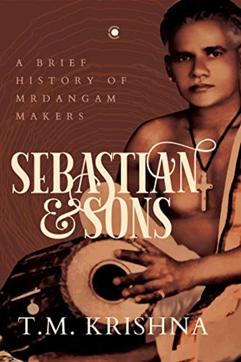
His latest, Sebastian & Sons, is a thoughtful treatise on Carnatic music and caste. Krishna presents his thesis through the history of mrdangam makers like Sevittian or Sebastian and his sons, Shengol, Parlandu and Antony, amongst many other artists engaged in the making of the mrdangam, the primary percussion instrument integral to Carnatic music. Buffalo, goat and cow skin are used to make the instrument. What is common about the makers? They are dalits and thus invisible from the gentle discourse that pervades the classical music ecosystem. We endlessly speak about the instrument, the mastery of the performers and their musical sensibilities without ever referring to the maker or creator such as Parlandu and his brothers. Who made the instrument then? Did it drop out of heaven straight into the lap of the performers? We also don’t tire of talking about the sound of percussion instruments. Is the sound created by the performer alone? Does the maker play no role in the process? Or is it the result of a collaboration, such as the one that Krishna mentions in the book between the celebrated mrdangam maestro Palghat Mani Iyer and Parlandu? Krishna informs the reader that there are no retirement benefits for these artists. Most suffer from back problems. Some, who attempted to perform, were shunned and told to concentrate on making the instrument. Many are routinely troubled by the police on suspicion that they are dealing in illegal animal skins. While we have numerous stories about the performers, the makers are conspicuous by their absence. Krishna tries to correct this historical wrong and wonders where the performers would be without the makers.
Based on observations, interviews, discussions and findings from extensive field work across parts of Tamil Nadu, Karnataka, Kerala and Andhra Pradesh, he admirably unravels the history of the instrument, its makers, their lives, different styles, traditions of making, and the perennial invisibility of the maker owing to his caste and associated notions of purity. There is a particularly moving account of the author’s visit to an abattoir to see and understand where the animal skin used in making mrdangams comes from. How many performing artists, even in the course of writing a book, would do something similar? Throughout these visits and interactions, the author is acutely aware of his Brahmin upbringing and caste privilege.
{{/usCountry}}Based on observations, interviews, discussions and findings from extensive field work across parts of Tamil Nadu, Karnataka, Kerala and Andhra Pradesh, he admirably unravels the history of the instrument, its makers, their lives, different styles, traditions of making, and the perennial invisibility of the maker owing to his caste and associated notions of purity. There is a particularly moving account of the author’s visit to an abattoir to see and understand where the animal skin used in making mrdangams comes from. How many performing artists, even in the course of writing a book, would do something similar? Throughout these visits and interactions, the author is acutely aware of his Brahmin upbringing and caste privilege.
{{/usCountry}}Read more: T.M. Krishna, the artist as a maker of social change
In the book, a mrdangam maker speaks of not being allowed inside the house of a performer while the instrument he made was worshipped in the puja room. Another wonders if performers ever think of the makers during their performances. The instrument, which connects the performer and their audience to divinity, is made by people who are invisible in their music. Through many such anecdotes, reminisces, accounts and memories, Krishna presents a story of oppression validated through the rigid structures of Carnatic music and society. “As a practitioner of vocal music, I have met some of them over the years and have heard folklores of their abilities. But they were not an integral constituent of Karnatik music’s history or mythology. We knew very little about the people, their lives, struggles or indeed, their creativity and workmanship,” Krishna writes. “Little did I realise then that this was going to be a far more complex and messy investigation that I had envisaged.”
The book is crowded with characters and laborious details about the making of the instrument. The intention is to document and archive. There are also parts that read like a field journal, which could have been further polished. Nevertheless, these are minor concerns. TM Krishna deserves applause for his attempt to move mrdangam makers from the margins to the mainstream of Carnatic music discourse.
Kunal Ray is a culture critic. He teaches literary & cultural studies at FLAME University, Pune