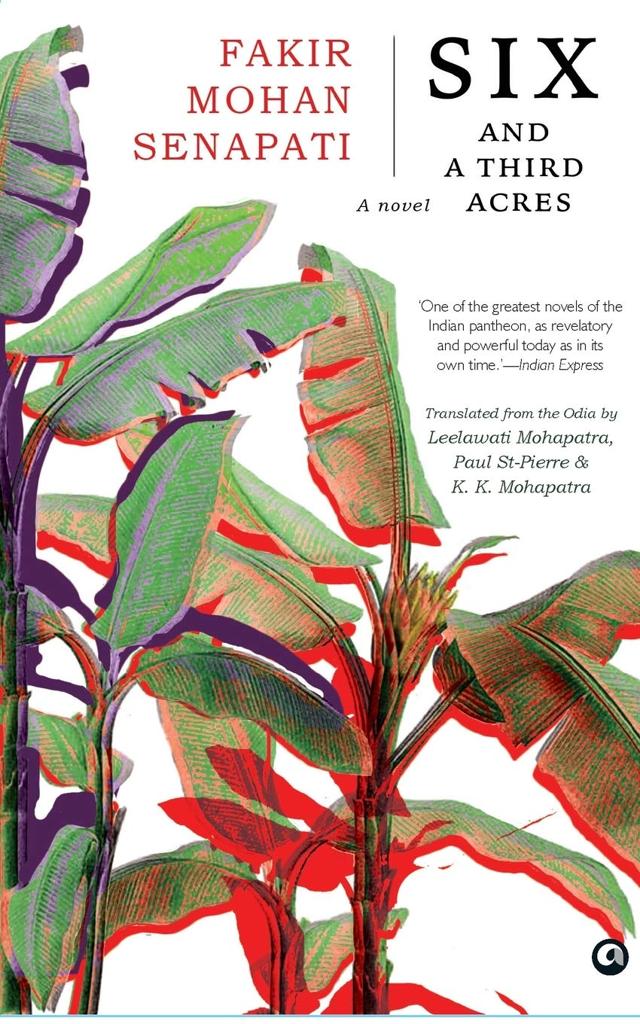
Chha Mana Atha Guntha written by the father of modern Odia literature, Fakir Mohan Senapati, was serialised in the literary monthly Utkal Sahitya between 1897 and 1899. It was published as a book in 1902 and stands in the league of such translated Indian novels as Premchand’s Godan and Rabindranath Tagore’s Gora.
This sixth English translation by Leelawati Mohapatra, Paul St-Pierre, and KK Mohapatra attempts, as the afterword says, to overcome the shortcomings of earlier texts which “lacked the verve of the original”, “failed to fully capture the author’s tone”, or were “based on flawed versions of the original text”. Friends convinced the translators to attempt yet another translation as classics such as Franz Kafka’s The Metamorphosis and Gustave Flaubert’s Madame Bovary have been translated over a dozen times, while Alexander Pushkin’s Eugene Onegin has been translated 46 times!
Senapati (1843–1918) was a novelist, short story writer, poet, philosopher, and social reformer. Much of his work was inspired by his desire to “campaign for the preservation of the Odia language in the face of Bengali linguistic and bureaucratic imperialism”. He set up a printing press in 1868 in Balasore and floated the first Odisha-based joint stock company to finance his publishing venture.
The novel’s protagonist, Ramchandra Mangaraj, is a sly zamindar-moneylender from Govindpur village, who prefers to give out loans in grain rather than cash. His zamindari, known as Fatehpur Sarsandh, extends over 565 acres, the revenue from which is not taxed, and an additional 327 acres. At the centre of the story is a small patch of land - six and a third acres – that Mangaraj has set his heart on. The patched is owned by Bhagia and Saria, a God-fearing lower caste childless weaver couple. All pleas by Mangaraj’s pious and virtuous wife, known to stand up for his victims, to return Bhagia and Saria’s land are lost on him. With their land and precious cow Neto snatched, the weaver and his wife are driven to despair and madness. Saria dies of grief and starvation in Mangaraj’s backyard, while Bhagia ends up in a lunatic asylum.
{{/usCountry}}The novel’s protagonist, Ramchandra Mangaraj, is a sly zamindar-moneylender from Govindpur village, who prefers to give out loans in grain rather than cash. His zamindari, known as Fatehpur Sarsandh, extends over 565 acres, the revenue from which is not taxed, and an additional 327 acres. At the centre of the story is a small patch of land - six and a third acres – that Mangaraj has set his heart on. The patched is owned by Bhagia and Saria, a God-fearing lower caste childless weaver couple. All pleas by Mangaraj’s pious and virtuous wife, known to stand up for his victims, to return Bhagia and Saria’s land are lost on him. With their land and precious cow Neto snatched, the weaver and his wife are driven to despair and madness. Saria dies of grief and starvation in Mangaraj’s backyard, while Bhagia ends up in a lunatic asylum.
{{/usCountry}}Mangaraj, once an impoverished orphan himself, had worked his way up by first winning the trust of his absentee landlord and then snatching the zamindari from him. None can match his cunning in the village, except Champa, the housemaid, and his partner-in-crime. When karma does catch up with Mangaraj – a concurrent theme in the novel – Champa steals his movable property and escapes with a new partner-in-crime. Mangaraj’s immovable property goes to another unscrupulous person who, as the villagers animatedly discuss, was to arrive with his entourage - two palanquins, five horses, two hundred armed guards - to take charge of the vast zamindari.
The way the poor suffer at Mangaraj’s hands is a portrayal of the tumultuous times Senapati had himself lived in - when the evil zamindars usurped land by taking advantage of loopholes in the new legal system such as annulment of all customary rights of tenants and the sweeping powers they enjoyed to jail defaulters without a fair trial.
Senapati does not spare the readers the heart-shattering littlest details of a caste-ridden society, or of the economic hardships that defined human relationships in colonial India. Critics see Senapati’s novel as a lead example of literary realism in 19th century Indian literature.
The timelessness of the novel, set in the 1830s, lies in this theme of rapacious greed. Mangaraj, Champa, Bhagia, and Saria are our collective past, present, and future. It takes a while to get used to the tone of the omniscient narrator as he leisurely presents the main characters. Once the readers get the hang of his pranks, it is difficult to disengage. The following is the description of the wily Mangaraj: When the exceptionally pious man, a devout observer of fasts and vigils, went around serving Brahmins fistful of rice flakes with a pinch of jaggery, he would say with folded hands – “Venerable Brahmins, would you be needing more? There’s plenty, of course, but don’t I know your eyes are bigger than your bellies.”
So why is it that generations of readers are still fascinated by this sombre tale? “The answer lies in his innovative technique of presenting a story full of twists and turns, in the voice of a master storyteller. Everyone who reads this novel comes under the spell of its ubiquitous narrator with his quicksilver wit and golden tongue,” the translators emphasise in the afterword.
Senapati’s good characters are one-dimensional. He spent more time building say a Mangaraj and Champa, than a Bhagia or a Saria. The translators note that he was too great a writer to not realise that human frailties make for great reading.
Senapati wrote four novels and 20 short stories, and an autobiography Atmacharita. UR Ananthamurthy, one of the foremost writers of the twentieth century, hailed this novel as “a foundational text in Indian literary history”. In this valuable addition to the existing body of translations, the translators place Senapati on a higher pedestal and call him a “quintessential Renaissance man”.
Lamat R Hasan is an independent journalist. She lives in New Delhi.