Had Kafka experienced an epiphany about the renewal of memory, Metamorphosis would have encompassed a thousand histories of a thousand years. Thankfully, he left that for illustrator, artist and poet exemplar Siddhesh Gautam to achieve in The Blue Book. Among the few who have centralized Shraman-Bahujan history, Gautam is a true savant of India’s graphic novel scene.
His work is certainly vastly different from the Chacha Chowdhury comics I loved as a child. It was a love that was cut short by my father’s insistence that I read Tolstoy, Raja Dhale, Einstein and Kanshi Ram — heavy stuff. For a while, I rebelled. But the comic book love affair soon came to an end as it was expensive, and Nanded, where I grew up, didn’t have a culture of comic book clubs and libraries, or at least, I was not aware of them.
These days, I sometimes pick up graphic novels, especially those that focus on the stories that most are afraid to tell. Here, the works of Joe Sacco, the defiant cartoonist, whose subjects have included UP’s Muslims, north India’s Dalits, and the Palestinians, especially stand out.
{{/usCountry}}These days, I sometimes pick up graphic novels, especially those that focus on the stories that most are afraid to tell. Here, the works of Joe Sacco, the defiant cartoonist, whose subjects have included UP’s Muslims, north India’s Dalits, and the Palestinians, especially stand out.
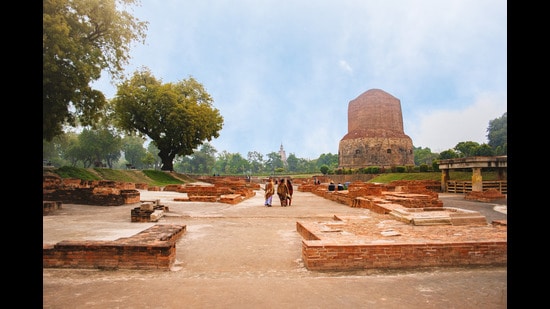
{{/usCountry}}Gautam’s book falls in similar ideological territory but it also stands in a category all its own. The poetry embedded in the social history written in The Blue Book is healing. Take the verse where the author morphs into a deer and ends up in the Deer Park near Sarnath in the fifth century, BCE. When he greets fellow deer, they don’t respond. He greets them again and is met with a bespectacled silence. Then, the herd takes off.
The author is surely presenting something he has experienced many times; the people he has tried to befriend over several lives have just not made time for him. And, in this current blessed-wretched life, he has attempted, once again, to be like others. He has changed his clothing, his behaviour, and his nature so he doesn’t intimidate others. Yet, their curious-yet-fearful tenor deprives him of that acquaintance, the friendship to follow. “They ran not from fear, but from now knowing how not to stay... I was alone again”.
This graphic novel invokes many traditions, and attempts to recall many figures from the past. It’s true that there are many who haven’t got their due in mainstream discourse and the reader is taken through a longer but non-linear history that features glimpses of Ravidas, Meerabai, Savitri and Jotiba Phule, BR Ambedkar, Gail Omvedt, Annabhau Sathe and Kausalya Baisantri. The narrator talks to these eminent personages in his dreams, and in doing so, makes those dreams an art of learning.
He finds solace as he “sleeps on the Buddha”. It is a space and state of mind, of awakening, that demands constant practice. In his panels, the reader is taken right into his room, onto the bed where he lounges as his pencil runs strokes of familiar intimacy on his iPad. It almost feels like one is sharing the room with a good friend and together building a Platonic life.
Occasionally, the work attempts to do too many things at once. For instance, while the author is right to critique the male gaze, he is sometimes overzealous. It is a good reckoning of history to state that Savitribai brought her great ability and capacity for candour to Jyotirao Phule’s life and to his movement, but the reader balks to see her presented as the pathfinder while he becomes a mere second-guesser. What this view inadvertently does is frame the caste struggle as one hobbled merely by a disease of conviction. The truth is that the agents of caste harness the biological division to assign weaker roles to a group. The social oppression that women face is part of the cruelty of a culture that disallows potential challenges to the entrenched hierarchical order. This hierarchy would fall with the disbanding of gender roles. It is true that women have been stigmatized to carry the burden of their birth. Even progressive societies intent on bringing about gender equality need to relearn many things and introduce corrective measures. This is also why advocacy against caste is incomplete without wider group participation, which includes that of women. But breaking the piquant terminology of “allyship” on Ambedkar’s and, by extension, Phule’s scalp is too much.
But this is a minor complaint. Siddhesh Gautam speaks to many in his generation who, despite being armed with higher education, even fancy foreign degrees and pedigrees of intellect, still see themselves as lost and know not where they are headed. Perhaps the answer is to go back to one’s roots, all the way to the “last human remain we found in East Africa, and beyond”.
Suraj Yengde is the author of Caste A Global History, a Ford Foundational Presidential Fellow, and Assistant Professor at the University of Pennsylvania.