Few contemporary Urdu novelists have fashioned a fictional universe as distinctive as Syed Muhammad Ashraf. At a time when much of Urdu fiction has remained anchored either in social realism or in the formal preoccupations of modernism, Ashraf has quietly forged a narrative world in which memory, history, myth and metaphysical reflection exist in constant conversation. His fiction resists easy classification. Deeply rooted in the cultural and linguistic traditions of north India, it nevertheless addresses questions that extend far beyond them, probing the moral and psychological complexities of human existence with unusual intellectual assurance.
What distinguishes Ashraf is the rare synthesis he achieves between philosophical reflection, particularly informed by the Sufi tradition, psychological insight and narrative artistry. In his fictional world, the personal is never detached from history; nor the ordinary from the metaphysical. Everyday objects, domestic spaces and intimate relationships gradually open into meditations on time, loss, faith, inheritance and civilizational decline. Through stylistic elegance, emotional resonance and extraordinary imaginative range, the book repeatedly addresses moral ambiguity, fractured identities and the silent wounds that shape the human condition. While reading Ashraf’s fiction, as a reader of Urdu first and English later, one finds that it is firmly rooted in the literary traditions of Urdu yet never confined by them. He returns to familiar themes and narrative forms only to invest them with fresh life and new possibilities. Through his novels and short stories, which have together earned wide critical recognition, he has come to occupy a distinctive place in contemporary Urdu literature.
Ashraf came to wider literary attention with Daar Se Bichhre. From the outset, the novel drew the notice of serious readers and critics for the assurance of its craft, the freshness of its vision and its emotional resonance. The long journey from Daar Se Bichhre to Aakhiri Sawariyaan, translated into English as The Last Rides, reflects a steadily deepening command over language, atmosphere, structure and psychological complexity. The present novel is not merely another accomplished work but the mature flowering of a literary imagination that has continued to expand in depth and confidence over several decades.
{{/usCountry}}Ashraf came to wider literary attention with Daar Se Bichhre. From the outset, the novel drew the notice of serious readers and critics for the assurance of its craft, the freshness of its vision and its emotional resonance. The long journey from Daar Se Bichhre to Aakhiri Sawariyaan, translated into English as The Last Rides, reflects a steadily deepening command over language, atmosphere, structure and psychological complexity. The present novel is not merely another accomplished work but the mature flowering of a literary imagination that has continued to expand in depth and confidence over several decades.
{{/usCountry}}Translated by A Naseeb Khan, The Last Rides is a haunting, elegiac and intricately layered meditation on inheritance, memory and the invisible burdens that travel across generations. It moves with the cadence of a mournful song, slow, resonant and shadowed by loss, traversing faith and silence, myth and reason, innocence and decay. What begins as the recollection of a childhood world gradually unfolds into an exploration of the ways in which private wounds and historical decline become inseparable within human consciousness. The novel possesses that rare quality by which intimate experience expands into civilizational allegory without sacrificing emotional immediacy.
Running like an unseen current through the novel is a mysterious and disfigured travelogue, less a manuscript than a psychic relic, whose unsettling presence reverberates across generations. Hidden away by a rational father determined to neutralise its disturbing influence, the text becomes an object of fear, fascination, superstition and emotional reckoning. It ultimately comes to embody the paradox of tradition itself: a source of continuity, identity and belonging that also preserves unresolved grief, inherited anxieties and historical fractures. One of Ashraf’s finest achievements lies in his refusal of simplistic oppositions. Rationality never fully dispels dread, just as folklore never merely imprisons consciousness. Instead, reason and ritual emerge as parallel human responses to vulnerability, fear and the enduring need to make meaning of suffering.
Childhood furnishes the novel with its deepest emotional register, though Ashraf renders it not as a sanctuary of innocence but as the theatre of first wounds, first bewilderments and first recognitions of power. Ashraf illuminates the delicate sensibilities of youth through the reflective consciousness of adulthood, achieving an unusual balance between tenderness and retrospection. The relationship between the young narrator and Jammo, an older girl trapped within the intersecting structures of poverty and patriarchy, is drawn with extraordinary restraint and emotional precision. Jammo’s quiet resistance, most notably her refusal to submit to the expectations of a forced marriage, becomes one of the novel’s deepest moral centres. In a world ordered by coercion, her silences acquire the force of defiance.
One of Ashraf’s greatest gifts is his ability to transform the ordinary into the mythic. A mynah dyed red, rejected by its own kind before being torn apart by a kite, becomes an unforgettable image of stigma, exile and communal cruelty. Such episodes reveal his extraordinary capacity to invest familiar creatures and domestic objects with emotional truths that human language often struggles to articulate. In this fictional universe, grief and belief remain inseparable from the objects that carry them. Things do not merely furnish the narrative; they remember, accuse and mourn.
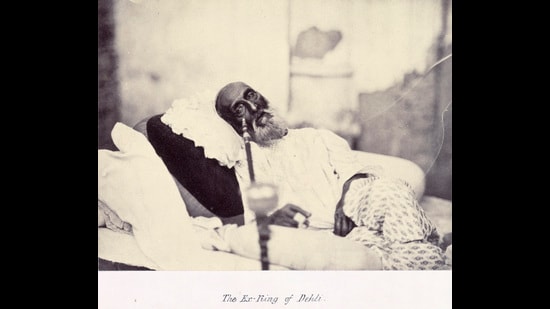
Domestic memory, however central it remains, is only one horizon of the novel’s imaginative world. It opens outward into historical allegory, summoning spectral figures such as Timur and Bahadur Shah Zafar, whose voices emerge from the ruins of empire to meditate on conquest, beauty, futility and decay. Timur, broken and introspective, embodies the exhaustion of power after violence has consumed itself. Zafar, dispossessed yet still sustained by poetry, emerges as the last representative of a civilisation that has already begun to disappear. His verses become a way of bearing witness to a world that can no longer be recovered. Through Zafar, Ashraf brings the past into the present of the novel. History is not treated as something finished or remote, but as an inheritance that continues to shape the lives of his characters. The dead do not simply inhabit memory; they return to remind us of the transience of power and the impermanence of worldly glory.
The novel is equally an elegy for the gradual erosion of a shared culture, one sustained by poetry, etiquette, architecture, cuisine, language and everyday social customs. The titular rides and wagons become the final carriers of books, utensils, gestures, idioms and sensibilities from a disappearing world. Their slow movement assumes the character of a funeral procession for memory itself. Within the creaking of their wheels and their gradual disappearance, the narrator hears the last echoes of a civilisation that once united aesthetic refinement with spiritual depth. Ashraf’s elegy is never nostalgic in any facile sense. Rather, it recognises that cultures rarely perish through spectacular catastrophe. More often, they fade through neglect, fragmentation and the gradual erosion of everyday forms of grace.
One of the novel’s quiet triumphs lies in its recognition of women as the custodians of continuity. Amma, Nani, Mami, Jammo and others preserve not merely households but emotional memory, ethical tenderness and those forms of resilience that seldom find a place in official histories. Public narratives celebrate rulers, wars and institutions; Ashraf restores our attention to the quiet labour through which women carry fractured worlds across generations. They preserve languages of affection, habits of care and modes of endurance that survive the rise and fall of political power. It is they who furnish the novel with much of its moral authority and emotional warmth.
Few contemporary Urdu novelists command tonal shifts with Ashraf’s effortless assurance. His prose moves effortlessly between realism and reverie, humour and sorrow, anecdote and metaphysical reflection. Few contemporary Urdu novelists possess his ability to endow ordinary scenes with symbolic radiance while keeping them firmly anchored in lived experience. The result is a narrative that remains intimate even as it acquires the dimensions of cultural elegy and philosophical meditation. His language does not merely narrate events; it creates atmosphere, summons memory and gives eloquence to silence.
The novel’s closing movement is especially remarkable. Ashraf evokes the slow fading of a civilisation with such imaginative authority and spiritual refinement that the experience lingers long after the final page. Few contemporary novels succeed in mourning historical decline without surrendering psychological truth; fewer still sustain such lyrical control while doing so. The Last Rides accomplishes both with remarkable assurance.
Seen against the breadth of Ashraf’s achievement, The Last Rides represents considerably more than another accomplished novel. It is a major contribution to modern Urdu fiction and a significant landmark in the continuing evolution of the Urdu novel. Beneath its narrative lie questions that remain enduringly human: What survives when memory itself becomes fractured? How are identities fashioned as much by silence as by speech? Can stories, broken and whispered across generations, still hold a life together after history itself has forgotten them? Few recent novels pursue such questions with comparable tenderness, intelligence and imaginative power.
If the novel itself deserves close attention, so too does the challenge of carrying it into another language. The recent resurgence of translations from Urdu into English has enlarged access to one of South Asia’s richest literary traditions. Classical poetry, modernist experimentation, memoir, short fiction and the contemporary novel have all found new readerships beyond their original linguistic communities through the work of committed translators, scholars and publishers. This welcome development does more than widen readership. It enables literary traditions to enter new conversations without severing them from the cultural worlds that produced them. Translation here does more than move a text from one language to another. It also carries forward the culture from which that text emerged.
Aakhiri Sawariyaan presents precisely the kind of work that tests the limits of translation. Its power resides not only in narrative but in atmosphere, cadence, silence and cultural memory. The emotional climate of the novel is captured in a striking scene, noted by the translator himself, in which a father asks his son why he returns obsessively to a particular book that leaves him, year after year, feverish, withdrawn and emotionally exhausted. The episode reveals one of the novel’s central preoccupations: memory not as consolation but as affliction. The mysterious volume at the heart of the narrative functions less as an object than as a repository of inherited sorrow, unresolved grief and ancestral unrest. Each return to it unsettles rather than reassures, suggesting that reading may become an encounter not with knowledge alone but with truths long buried yet unwilling to remain so.
It is precisely this atmosphere of fascination and dread, A Naseeb Khan acknowledges, that shaped the translation from the very beginning. The task was never simply to carry over sentences from one language into another. It required preserving the novel’s emotional climate and the quiet rhythm through which it unfolds. Like the finest works of Urdu fiction, Aakhiri Sawariyaan derives much of its power from what remains implicit: its tonal modulations, cultural textures, symbolic density and carefully measured silences. Such qualities resist mechanical translation. They demand attentiveness not only to what is spoken but equally to what is withheld.
The central challenge in translating The Last Rides, therefore, lies less in vocabulary than in transmitting its emotional architecture and civilizational atmosphere. Many apparently simple Urdu words carry within them entire worlds of intimacy, memory and social relationships. Kinship terms, as the translator himself observes, routinely exceed their dictionary equivalents. Amma, for instance, signifies far more than ‘mother’. It evokes warmth, authority, affection, intimacy and an entire domestic register of feeling. To substitute it mechanically with ‘mother’ would flatten those accumulated emotional associations. Retaining such words in their original form therefore allows readers to enter the cultural world of the novel rather than encounter an impoverished approximation.
The same difficulty appears elsewhere. Dupatta is not simply a scarf. It carries associations of modesty, femininity, ritual belonging, gesture and social presence that no straightforward English equivalent can adequately convey. The phrase paraya dhan presents a different but equally significant challenge. Embedded within it is the patriarchal assumption that an unmarried daughter belongs ultimately to another household. Here the translator confronts not merely a linguistic problem but an ethical one. To soften the phrase is to conceal the ideology it embodies; to translate it literally is to preserve the discomfort that the original itself invites. In such moments, translation becomes responsible not only for transmitting beauty but also for carrying forward the social critique embedded within the language itself.
Perhaps nowhere is the translator’s task more delicate than in the novel’s material world. Objects, fragrances and seemingly ordinary names carry meanings that far exceed their immediate reference. Names such as Itr Majmua were retained because they function not merely as perfumes but as repositories of memory and emblems of a syncretic cultural world. Their presence evokes shared histories, sensory inheritance and composite traditions. To replace them with generic approximations would be to efface the layered symbolic life they carry within the narrative.
The greater challenge, however, lay with words that resisted substitution altogether. Terms such as shaitan and rakshas may may appear to invite English equivalents such as ‘devil’ or ‘demon’, yet such substitutions collapse distinct cultural universes into a single, indistinct category. Each word arises from a different religious imagination and carries its own emotional texture, symbolic history and domestic usage. Within the novel’s world, such expressions often move effortlessly between teasing, affection, myth, intimacy and communal coexistence. Retaining them enables readers to encounter the layered plurality that the novel inhabits rather than a simplified linguistic substitute.
The translator’s choices recall what translation theory describes as a strategy of foreignization, not foreignness for its own sake, but a principled refusal to erase difference. The objective is not to dissolve the source culture into the comforts of the target language but to allow readers to encounter another imaginative world on its own terms. Such an approach recognises that literature carries not only meanings but textures, cadences, silences and habits of feeling that cannot always be domesticated without significant loss.
In the case of The Last Rides, such fidelity is especially important because the novel itself is preoccupied with inheritance, memory, fading civilisations and the persistence of emotional residues across time. To translate it responsibly is, therefore, to participate in the very labour the novel describes: carrying fragile things forward before they disappear. Language itself becomes one of the novel’s wagons of memory, bearing words, customs, fragrances, kinships and silences from one community of readers to another.
Read against the challenges outlined above, the recent resurgence of Urdu translation into English emerges as something far more consequential than a publishing trend. It represents an important act of cultural preservation and literary renewal. The work of translators such as A Naseeb Khan enables important works of Urdu literature to reach readers beyond the language without losing the qualities that give them their distinctive character.
The lasting value of such translations ultimately lies not in making Urdu literature appear familiar, but in allowing it to remain unmistakably itself while reaching newer audiences. Each translation that can accomplish this broadens the readership of not merely an individual piece of writing but also the imaginative geography of literature itself. In this respect, The Last Rides is more than another addition to the growing corpus of translated fiction. It enables an important Urdu novel to find its place among English readers without surrendering the qualities that make it unmistakably a work of Urdu Adab.
Ather Farouqui is an Urdu scholar and critic, and the author of several works on Urdu literature and its critical traditions. He holds a PhD from Jawaharlal Nehru University and serves as General Secretary of Anjuman Taraqqi Urdu [Hind], New Delhi.