
 E-Paper



Review: Why Should I Trust You by Sudeep Nagarkar
Featuring a love triangle, sibling rivalry and a college setting, this romantic thriller set in the hillside town of Kangra deals with betrayal and heartache

 Prefer HTon Google


Sudeep Nagarkar’s latest romantic thriller, Why should I trust you?, begins with 18-year-old Nandini waking up from a coma in the small hillside town of Kangra in Himachal Pradesh. Having lost her memory, she no longer remembers who she is or her life before the accident. A mysterious maasi comes to claim her and take her home. Despite Nandini’s many attempts to ask her maasi about her past, she refuses and for some inexplicable reason, maasi’s daughter Rashi already hates her. Things take a turn for the worse when Nandini starts going to college. She comes face to face with Sahil, a boy connected to her past, whom she no longer recognizes, who is now dating Rashi. He too seems to hate her. While Nandini tries to piece together the puzzles of her past, she must also fight off the attentions of Rudra, another popular boy in college who is suddenly interested in her.

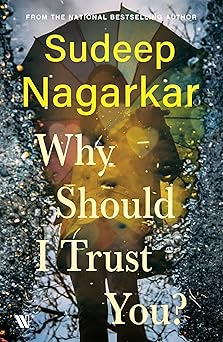
Nagarkar’s story deals with the usual themes of love, betrayal, and heartache. It also features all the usual suspects – a love triangle, a best friend who is also going through a breakup, sibling rivalry, and a college setting that’s like a background prop in a play. There is almost no mention of subjects, professors, college festivals or even a classroom. Much like colleges in commercial Indian films, this college exists solely to unite young lovers.
When Nandini’s memories of her past start coming to the surface she realises that knowledge is a double-edged sword. Her curiosity to know more is countered by the pain it brings. Not only does her past change her present relationship with Sahil and her maasi’s family but her fragmented memories take a physical and mental toll on her health leading to hallucinations and fainting spells that force her to return to the hospital. Her life is further complicated when her absentee father turns up out of nowhere to take her home to Delhi. But as Nandini discovers, her secrets are scarcely her own; they include those of her parents intertwined with maasi’s family. There are good reasons for why her cousin hates her. Things come to a head when Sahil asks Nandini to make an impossible choice. To make things worse, she finds out that she is being stalked and someone is threatening her family.
The issues with Nagarkar’s otherwise heady plot are the prose and the everchanging toles of characters. Much of the book is made up of internal monologues with the multitude of questions arising in Nandini’s mind hampering the flow of the prose. There are also sudden shifts from personal language to terms from physiology and psychology and terms like ‘trauma’ being used very casually. The reader also gets no explanations for why certain characters behave the way they do. There is only so much of Sahil’s flip-flopping that can be put down to teenage immaturity. At some points when he suddenly rejects Nandini and refuses to believe her, his behaviour is downright toxic. It often feels as if these characters behave in inexplicable ways only to introduce a twist in the plot.

Though readers might relate to the teen romance on which the book turns, it is also problematic. Whenever Nandini is in trouble, help conveniently arrives at the hands of her boyfriend’s wealthy and connected father. Her story is often dictated not by her own agency but by the men in her life. The surrounding cast of characters is also treated quite dismissively. We know little about maasi, Kartik or Megha except for what is relevant to Nandini. Maasi’s husband is the stereotypical father figure who says very little and most of the popular boys in college drive fancy cars and have wealthy fathers. The politicians are still corrupt and the cops are still ineffective. The book seems to imply that as long as you date or know someone rich and powerful enough there is very little you can be held accountable for.
In sum, Why Should I Trust You? is a quick and breezy read about young love in a small Indian hill station. Nagarkar uses simple prose and a quick pace to keep the reader engaged throughout a novel that is entertaining and has some nice twists. However, its overreliance on stereotypes and the use of predictable tropes robs the story of a lasting impact.
Percy Bharucha is an independent writer.


