Were one to search for a genre that could be labelled as ‘the literature of attention’, one wouldn’t have to venture much beyond what has loosely come to be known as ‘nature writing.’ While all good literature is an expression of attentiveness – not only to language but also to the world around, real or imagined – nature writing consciously deploys the act of ‘perceiving with care’ as its underlying framework and philosophy. Such writing, however, rests on a curious paradox: instead of drawing upon a hidden or mysterious reserve of concentration and awareness, it enacts its own formation in synchronization with the unfolding natural environment. Despite the human observer-writer occupying the obvious central position, it is the surrounding realm of flora, fauna, soil, seasons and so much more that enables the former to furnish her powers of observation in provocative and humbling ways.
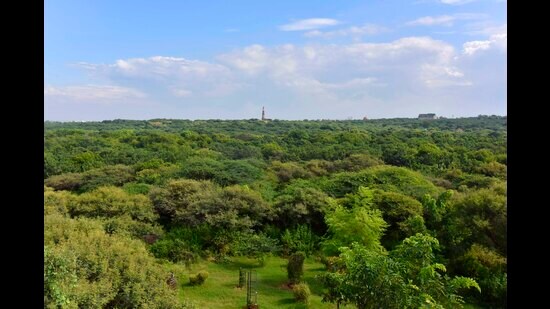
With aplomb and dexterity, Neha Sinha’s glorious new book Wild Capital: Discovering Nature in Delhi plumbs this very crucible of attention-making by charting a variety of natural spaces in and across the larger city of the National Capital Region (NCR). A conservation biologist working with the World Wildlife Fund (WWF) India and author of the acclaimed Wild and Willful: Tales of Fifteen Iconic Species (2021), this, her second offering steadily makes its way through those cracks and openings of the capital city that reveal a penchant for the more-than-human presence. Whether it is her immediate home or the distant hinterlands, the pulse of the wild throbs all around in numerous registers. Set in the contemporary polycrisis-ridden climate, and running across 17 chapters poignantly playing with the theme of ‘forgotten-and-found nature’, Wild Capital presents a highly textured perspective on the region’s multi-species tapestry.
From the wetlands of Chandu-Budhera, the sacred grove of Mangar Bani, the old forts of Delhi and the threatening thickness of Sanjay Van, to the trendy milieu of Hauz Khas village, the lushness of roadside trees and the oft-frequented Aravalli hills (arguably Sinha’s favourite terrain), the author covers an impressive array of spaces. Written as a collection of long essays over the last few years, what holds the book together is a recurring set of markers, ideas and anchors: the Covid Pandemic and its suffocating sense of stasis; the stronghold of childhood as the genesis for Sinha’s interest in wildlife; the embodied act of walking light-footedly where several senses converge as a mode of cognition; the thoughtlessness of governmental horticultural projects in the name of ‘beautification’ versus the rigour and sensitivity of rewilding endeavours helmed by wildlife warriors; the braiding together of nature and culture in real and imaginary ways; the persistent reckoning with gender at every other turn while navigating Delhi’s patriarchal topography; and the endless permutations and combinations through which plants, animals, birds, insects and the very earth itself ‘keep’ time.
{{/usCountry}}From the wetlands of Chandu-Budhera, the sacred grove of Mangar Bani, the old forts of Delhi and the threatening thickness of Sanjay Van, to the trendy milieu of Hauz Khas village, the lushness of roadside trees and the oft-frequented Aravalli hills (arguably Sinha’s favourite terrain), the author covers an impressive array of spaces. Written as a collection of long essays over the last few years, what holds the book together is a recurring set of markers, ideas and anchors: the Covid Pandemic and its suffocating sense of stasis; the stronghold of childhood as the genesis for Sinha’s interest in wildlife; the embodied act of walking light-footedly where several senses converge as a mode of cognition; the thoughtlessness of governmental horticultural projects in the name of ‘beautification’ versus the rigour and sensitivity of rewilding endeavours helmed by wildlife warriors; the braiding together of nature and culture in real and imaginary ways; the persistent reckoning with gender at every other turn while navigating Delhi’s patriarchal topography; and the endless permutations and combinations through which plants, animals, birds, insects and the very earth itself ‘keep’ time.
{{/usCountry}}READ MORE – Neha Sinha: “Your life is less rich if you’ve never known what a firefly is”
Across her ambles, Sinha’s sensorial regard for the non-human ‘other’ progressively sharpens and shines. Hers is a prose that sings and soars page after page. For her, semal trees “are the bays that the crashing waves of a kite’s flight dock in,” and a gecko is a “black and slippery-looking [creature], furtive like an eel in the sea, covered finely in dots.” Even as she goes out in search of her favourite tree or bird, she ends up encountering much more, as is often the case with outdoor experiences. Seasonal plenitude and stylistic particularity become amiable bedfellows right from the beginning, with the book unfurling as a long love letter to Delhi without overlooking its oppressive and discriminatory tendencies. But her explorations gain an added resonance in the company of people. “Nature has a way of gluing people together,” she writes, and despite the fact that it is only the book’s second segment that is explicitly titled A City of its People, all three parts teem with dramatis personae of a highly eclectic kind. This inclusivity only contextualizes the author’s insights and learnings within a shared field of environmental admiration, it also drives home the point that nature and people are not separate entities. Tellingly, many writers of the genre maintain a conscious aversion to the term ‘nature writing’ because the phrase – intentionally or unintentionally – establishes a divide between ‘nature’ and ‘humans’, casting them as enclosed categories.
As the navigation of various entanglements between humans and non-humans takes Sinha to new areas across Delhi, her experiences of the pandemic collide with the landscape of her childhood. Memory, gender, marginalization and suffering routinely fuse together to offer a richly intimate understanding of the self that also finds surprising parallels in the animal kingdom. Speaking of the craze during the pandemic era that led to the burning of many bat-roosting trees, Sinha cleverly interprets those horrifying acts not as the killing of bats but as the burning “of the proverbial witch, the ‘idea’ of a bad thing, the totem of shifted blame.” But not all is doom and gloom, and there is much to appreciate and celebrate – from successful rewilding projects to the commonplace abundance of beauty. This lushness also infuses the book’s linguistic temperament, which frequently delights in parallels and metaphors. For instance, Sinha brilliantly describes the fraying of Delhi’s Old Fort in terms of a “rose that’s blown out, its petals opened to the maximum extent, just before it falls apart.” And a parakeet in flight tempts her to think of the creature as a verb: “to ‘parakeet’ through life would mean to face life with a defiant squawk and eliminate threats through the sheer force of frolic.”
At once a piece of urban history, natural history, feminist text, pandemic literature and even cultural history, Wild Capital’s lyrical examination of the environment is as poetic as political. It is to the credit of the design team that even as a physical object, the gold-spined cover-jacket splayed with tenderly envisioned water colour art (found aplenty inside too, along with Sinha’s photographs) perfectly captures the text’s spirit. And as we approach the end, the book’s ethos of attention seamlessly washes over the readers: a gift, like nature itself.
One couldn’t agree more with Sinha’s recurrent refrain: this is Delhi too.
Siddharth Pandey is a cultural historian, writer and artist from Shimla.