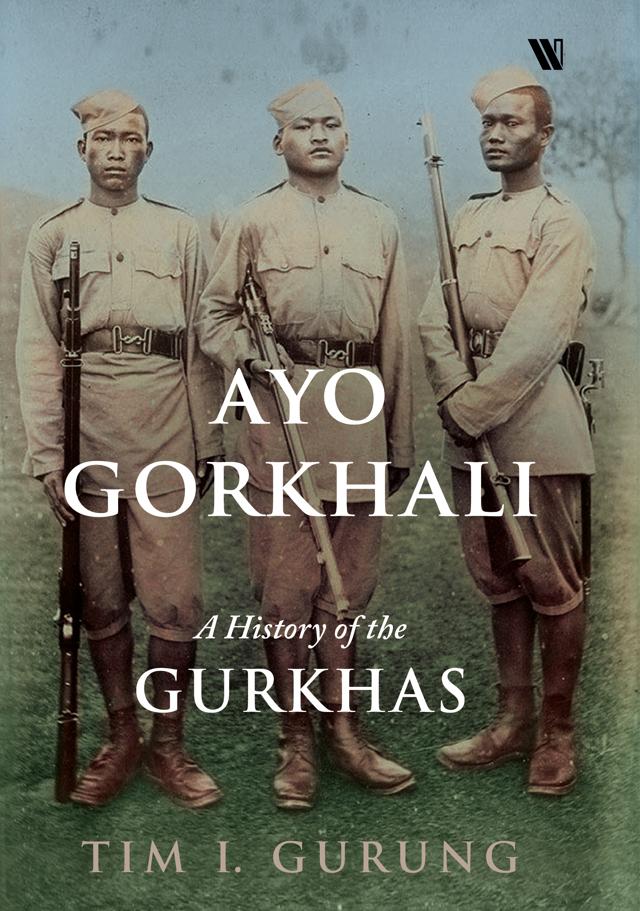
Over the past two centuries the Gorkhas of Nepal have built up an enviable — and richly deserved — reputation as fearsome warriors. The stature of the Gorkha as a soldier par excellence is in sharp contrast to his diminutive physical appearance, and he stands tall amongst the most famous fighting races of the world. The reputation of the Gorkhas, and their penchant for decapitating their enemies in battle with the deadly khukri, often precedes them; and in the Falklands War in 1982, a large number of Argentine troops surrendered in panic to a nearby British unit when they realised that a Gorkha battalion was advancing to attack their position.
However, as the author interestingly points out, the term ‘Gorkha’ or ‘Gurkha” as the British prefer to call them, is not one that is widely used within Nepal itself. There they are better known as Lahure, since the time when they used to take service in the army of the Lahore Durbar under Maharaja Ranjit Singh. They later came to be known as Gorkhas since they originally came from a small kingdom of the same name. The ruler of Gorkha, Prithvi Narayan Shah, gained fame as the founder of modern Nepal. After the Treaty of Sugauli in 1815, following the Anglo-Nepalese War, Gorkhas began to be enlisted in the army of the Honourable East India Company. This was the beginning of a lasting relationship between the Gorkhas, the Indian Army, and in time, the British Army as well.
Over time, Gorkha regiments began to appear in the order of battle of the Indian Army, with their own distinct lineage. The British, in keeping with their policy of ‘divide and rule’, fostered a distinct identity for the Gorkhas as part of the vaunted ‘martial races’ construct applied by them to communities that they perceived made good soldiers. Within Nepal, only certain castes or tribes, such as the Gurungs and Magars from the West, and Rais and Limbus from the East, were recruited into the army. The contemporary term ‘Gurkha Brigade’, which the author applies to these regiments from their early days, did not however come into common use till Independence, when the existing 10 ‘Gurkha’ Regiments were split between the armies of India and Great Britain. Whereas all the six regiments that remained in the Indian Army continue to maintain their distinct identity, the four which went to the British Army have long since been amalgamated into a single ‘Royal Gurkha Rifles’.
{{/usCountry}}Over time, Gorkha regiments began to appear in the order of battle of the Indian Army, with their own distinct lineage. The British, in keeping with their policy of ‘divide and rule’, fostered a distinct identity for the Gorkhas as part of the vaunted ‘martial races’ construct applied by them to communities that they perceived made good soldiers. Within Nepal, only certain castes or tribes, such as the Gurungs and Magars from the West, and Rais and Limbus from the East, were recruited into the army. The contemporary term ‘Gurkha Brigade’, which the author applies to these regiments from their early days, did not however come into common use till Independence, when the existing 10 ‘Gurkha’ Regiments were split between the armies of India and Great Britain. Whereas all the six regiments that remained in the Indian Army continue to maintain their distinct identity, the four which went to the British Army have long since been amalgamated into a single ‘Royal Gurkha Rifles’.
{{/usCountry}}While there have been many books that deal with the ‘Gurkhas’ and their military history, extolling their virtues and romanticising their valour, almost all of these have been written by British — and in recent years, Indian — officers. As Byron Farwell wrote in the foreword to his eminently readable account The Gurkhas (Allen Lane, 1984): ‘…no Gurkha ever wrote a book about his experiences in any language; no collections of Gurkha letters are extant; no Nepalese records are available; until the middle of this century there were not even short articles written by Gurkha soldiers.’
While since then there has been a published transcript of Gorkha voices (JP Cross and Budhiman Gurung, Gurkhas at War, Greenhill Books, London, 2002), this book rectifies that shortcoming in Gurkha historiography — a book about the Gorkha soldier, written by one of them. The author is himself a Gorkha and served for 13 years in the British Gurkhas. He offers a glimpse into the Gorkha story that is somewhat different from the standard narrative of the ‘noble warrior’. He attempts to present a more nuanced understanding of the various factors that have influenced Gorkha identity across time and space. This is a challenging task, as these intrepid soldiers continue to serve in the armies of three nations, India, UK and Nepal, to this day.
In order to do so, the author has notionally divided the book into two halves. The first half covers the salient features of the military history of the Gorkhas, while the second half is devoted, in the author’s own words, to exploring ‘the consequences of that history’.
In the first segment, the book traces the exploits of the Gorkhas in a linear chronological sequence, from the early years through the two world wars until Independence and beyond, in both the British and the Indian Armies. The second segment discusses areas not commonly addressed in literature on the Gorkhas. These include topics such as the social and economic impact of decades of discriminatory policies practised by the British against the Gorkhas in matters of pay, pensions, and other service benefits and the adverse impact this had on the soldiers and their families; both in the UK and in Nepal. It examines the stereotypical portrayal of the Gorkha by the British as a simple, brave, loyal and honest soldier and places it in a wider socio-political context. Other facets that are touched upon include the role of Gorkha women and the immense sacrifices made by these unsung heroines in a patriarchal system. The chapter on Gorkhas in literature is particularly interesting as it goes on to document the oral folk traditions that recorded ballads extolling the valour of Gorkha soldiers in battle through the ages.
The book is by no means a scholarly exposition of the various issues discussed within its pages. There are a number of minor errors of detail that might irk the purist but on the whole it is a well-presented account, meant for a general readership. What adds weight to the arguments is the fact that it is written by a Gorkha (emphasis added), highlighting issues that affect this extraordinary community of soldiers. The book attempts to go beyond the usual hagiographic mythologies connected with the Gorkha soldier and to present the reader with a broader, and deeper, understanding of some of the issues that have gone into both creating that mythology as well as shaping the resulting Gorkha identity.
Rana TS Chhina, MBE, is Secretary and Editor, Centre for Military History and Conflict Research, New Delhi