Once upon a time, there was no television in India. This is a true story. When TV did arrive in the mid-1960s, the black and white transmission of regional programmes that focused on agriculture and education was limited to a few hours and to few cities. Colour TV was launched in India in 1982 and inform, educate and entertain the masses it did but still within neat boundaries of transmission time and in a very prim fashion.
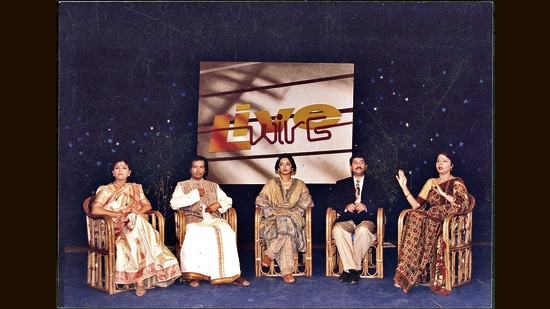
Doordarshan Diaries – the Golden Era of Television by Sheila Chaman, a former anchor on Doordarshan and a former Miss India to boot, tells the story of TV’s arrival in India – complete with pictures, timelines and first-person accounts. The author describes how basic technology was often stretched and innovations made to make TV transmission available in the best possible formats to a larger number of citizens. She writes of times when tele-prompters were unavailable and large chunks of text had to be memorised by those facing the camera. The book also provides insights on better TV presentation skills and shows how the sedate style of Doordarshan (DD) gave way to cable TV’s bold content. There was no looking back after that.
This book probably reads like period fantasy for those who have never known a life without TV. Multiply that effect manifold for those who’ve always known smart phones. What would they think now of the quaint school and college debates of an earlier era on the possible impact of cable TV on “Indian culture”? Reading Doordarshan Diaries provokes Gen Xers, those who came of age in the 1980s, especially, to reflect on the rapid and substantial technological changes that have taken place within the span of a lifetime.
{{/usCountry}}This book probably reads like period fantasy for those who have never known a life without TV. Multiply that effect manifold for those who’ve always known smart phones. What would they think now of the quaint school and college debates of an earlier era on the possible impact of cable TV on “Indian culture”? Reading Doordarshan Diaries provokes Gen Xers, those who came of age in the 1980s, especially, to reflect on the rapid and substantial technological changes that have taken place within the span of a lifetime.
{{/usCountry}}This reviewer was seven when a Sony colour TV from Abu Dhabi was installed in the hall – the term “living room” was still in the future -- of their south Bangalore home with its distemper green and red oxide walls covered with “god photos”. The book brought back memories of TV serials and commercials, of public functions being interrupted so the audience could watch the next episode of Mahabharata or Ramayana before returning to the programme and taking up where they had left off. The Milky Ways of choice would open up much later. In the beginning, everyone was united in sincerely savouring the limited fare offered by the single available DD channel. The regional film on Saturday evenings and the Hindi film on Sunday evenings was viewed with more devotion to routine than to cinema. Music programmes like Chitrahaar, and TV serials like Hum Log, Buniyad, Yeh jo Hai Zindagi, Khandaan, Udaan, Rajani, Nukkad, and Mr ya Mrs, among others, had a devoted viewership across age groups. No one knew then that, in a few decades, our collective minds would be blown by unlimited content from over the world, that screens of every size would dominate lives.
Cut back to when DD was new: Mythological characters breezed into homes, those who had colour TV became immensely popular, and entire families bonded over the single prime time TV serial that played every night. Equally gripping TV commercials moulded lifestyles and fashion aspirations, and school fancy dress competitions always had at least one Lalitaji (“Surf ki khareedaari mein hi samajhdaari hai!”). This was the era in which every household had to include an expert climber of walls and trees to adjust the rooftop TV antenna when video quality faltered. Hindi and English news readers were admired and respected for the grace and dignity they brought to the newscast. In that long gone age, students were advised to watch the news to strengthen language learning.
Sheila Chaman’s Doordarshan Diaries captures all this. The book includes detailed back stories to many historical events like the Emergency, the assassination of Prime Minister Indira Gandhi, and the subsequent anti-Sikh riots of 1984. It also describes the author’s personal journey in Indian television beginning with the presentation of Mirror of the World in June 1976. For it, Chaman received a cheque of Rs75.
Doordarshan Diaries weaves together history, culture, politics and electronics and also presents the views of those who were at the helm during the DD era. A must-read for students of journalism and electronics, and for those viewers who first encountered television through DD, this book is a great nostalgia trip. Readers must keep in mind, though, that the government broadcaster constantly censored the news – an aspect that the author does touch upon. While the focus is on Doordarshan, the heroes of this tale of the country’s earliest channel really are those who worked with it to lay the foundations of Indian television.
Charumathi Supraja is a writer, poet and journalist based in Bengaluru.