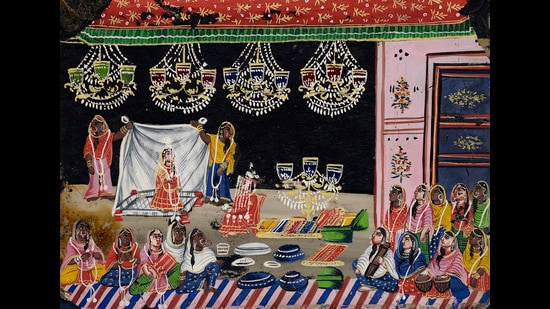
In 1838, a scandal broke out in the then princely state of Burdwan (now, Bardhaman in West Bengal), when Basantakumari, one of the widows of the deceased king, Tejchandra, eloped with Dakshinaranjan Mukhopadhyay, a Calcutta-based lawyer. Basantakumari had hired Dakshinaranjan, along with two other lawyers, to represent her in a property dispute. When the two of them got married later, they challenged multiple social and religious taboos — inter-caste marriage, civil union and widow remarriage. Hindu widows getting married was almost unheard of in the 1830s; it would find legal sanction only in 1856, under the Hindu Widows’ Remarriage Act of the British East India Company (EIC).
The sole credit for this reform is often assigned, in both academic and popular history, to Ishwar Chandra ‘Vidyasagar’, while Dakshinaranjan, and his comrades in the radical Young Bengal party, are completely ignored at best or vilified at worst. “The tendency to deify Vidyasagar and vilify Young Bengal has little basis in history,” writes Rosinka Chaudhuri in her latest book, India’s First Radicals: Young Bengal and the British Empire. Through painstaking archival work, Chaudhuri shows that Vidyasagar’s campaign for getting widows remarried was not the result of an “eureka” moment of a “great man”, but emerged out of numerous socio-political debates that took place in Calcutta over the previous decades, in which members of Young Bengal took an active part. Chaudhuri, in fact, demonstrates that many of the socio-political ideas adopted by Indian nationalists later on — secularism, freedom of speech, equality, inclusivity — had their origins in this radical group that has been mostly ignored till now.
Chaudhuri writes how, as a student at the University of Oxford in the early 1990s, she was prompted by her supervisor Robert Young to locate a book on the Young Bengal group. However, after an entire day’s search at the erstwhile New Bodleian building she had been unable to find any. Over the years, Chaudhuri also asked multiple historians on why there were no books on Young Bengal, receiving only unsatisfactory answers. In the Introduction to the book under review, Chaudhuri writes: “Every historian of nineteenth-century India has heard the name ‘Young Bengal’… is aware of the huge disruption to social and political order created by this group… Yet no serious analysis has been undertaken to document [them].”
{{/usCountry}}Chaudhuri writes how, as a student at the University of Oxford in the early 1990s, she was prompted by her supervisor Robert Young to locate a book on the Young Bengal group. However, after an entire day’s search at the erstwhile New Bodleian building she had been unable to find any. Over the years, Chaudhuri also asked multiple historians on why there were no books on Young Bengal, receiving only unsatisfactory answers. In the Introduction to the book under review, Chaudhuri writes: “Every historian of nineteenth-century India has heard the name ‘Young Bengal’… is aware of the huge disruption to social and political order created by this group… Yet no serious analysis has been undertaken to document [them].”
{{/usCountry}}Chaudhuri argues that the scholarly apathy from which the group has suffered has been the result of certain trends and attitudes of Indian historiography, which has focussed on the lives of “great men” such as Gandhi, Nehru and more recently Ambedkar, and since the 1970s, on subaltern figures such as Dalits, Adivasis, women, etc. The university-educated, professional middle classes, to which almost all members of Young Bengal belonged, “do not quite fit into these paradigms”. Chaudhuri, however, makes the bold claim that members of Young Bengal were not only the precursors of the Indian nationalists, who emerged in the late-19th century, but they were, in fact, the catalysts of modernity in Indian society. Chaudhuri proceeds to prove her claim through a detailed analysis of the work and lives of some key figures among the Young Bengal, while finding resonances with our contemporary times.
Though the name Young Bengal was ascribed to the group only in the 1840s — around the same time as Mazzini’s Young Italy and Young Ireland in Dublin found frequent mention in Calcutta papers — their origin can be traced to the appointment of Henry Louis Vivian Derozio, a 17-year-old Anglo-Portuguese poet and journalist, as a lecturer in the newly established Hindu College in 1826. (Most Indians would be familiar with his sonnet that was posthumously titled To India, My Native Land.) Inspired by the American and French Revolutions as well as the philosophers of the Scottish Enlightenment, Derozio and his students brought out publications and formed societies, where they challenged both the misrule of India by the EIC and dogmatic traditionalism in Hindu society.
As befitting their youth, many of their activities were deliberately provocative. For instance, Sibnath Sastri notes in his 1903 book, Ramtanu Lahiri O Tatkalin Bangasamaj, how students from Hindu College would openly drink Madeira, eat beef in violation of caste taboos and jeer at Brahmins with tonsured heads in the streets of the city. In 1831, a scandal broke out in Calcutta when a few students gathered at the home of their friend Krishna Mohan Banerjee, consumed beef and wine, and threw the bones into the neighbouring house of a Brahmin. This led to Krishna Mohan’s expulsion from his home and his conversion to Christianity. Chaudhuri’s 2012 book Freedom and Beef Steaks: Colonial Calcutta Culture (Orient Blackswan) begins with a reference to this incident.
Unfortunately, these are the incidents that have found wider circulation and acceptance in the popular imagination. Satirical accounts and descriptions of the members of Young Bengal, both in English and Bengali — such as Henry Meredith Parker’s poem Young India: A Bengal Eclogue (1831), Ishwar Gupta’s diatribes against Derozio and his students in the conservative publication Sambad Prabhakar, Michael Madhusudan Dutta’s satirical Ekei Ki Bole Sabhyata? (1860) and Dinabandhu Mitra’s Sadhabar Ekadashi (1866) — have focussed on their western attire and intemperate actions, such as consumption of beef and wine. Even a more sympathetic depiction, such as the 1979 Bengali film Jharh, written and directed by thespian Utpal Dutt, included unsubstantiated material such as a romantic relationship between Dakshinaranjan and Derozio’s sister, Amelia.
Chaudhuri rescues the group from the smog of misinformation and apathy that have hidden it for more than a century. In 1831, Derozio was dismissed from his position at Hindu College for allegedly teaching atheism to his students, and later that year, he succumbed to cholera. However, even after his death, his students — including Dakshinaranjan, Krishna Mohan, Tarachand Chakraborty, Ramgopal Ghosh, Ramtanu Lahiri, Rasik Krishna Mallick, Peary Chand Mitra, Radhanath Sikdar — took up important position in government or private service, edited newspapers and journals, formed associations such as the Society for the Acquisition of General Knowledge (SAGK) in 1838 and the first political party, Bengal British India Society (BBIS) in 1843. “(T)hey also wrote original poetry, plays and prose (including the first play by an Indian in English and the first novels in English as well as Bengali).”
The vast material collected by Chaudhuri over decades is organised thematically into six chapters. In the first chapter, Chaudhuri shows how members of Young Bengal responded to the distress in the farm sector in India, following the Permanent Settlement Act of 1793. Their focus was primarily the ryots or middle farmers, who suffered from increasing demands of taxes. Chaudhuri analyses two texts by Peary Chand Mitra — one fiction and one non-fiction — that critiques the only rationale of the EIC’s policies: revenue. Chaudhuri shows how Young Bengal’s concern was not merely idle sympathy of urban intellectuals for their fellow rural citizens, but truly socialist concerns that would find more militant expression in the 20th century.
In the second chapter, Chaudhuri analyses, among other documents, two pioneering books of geography — Akshaykumar Datta’s Bhugol (1841) and Krishna Mohan Banerjee’s Bhugol Brittanta (1848) — which not only educate the readers about Indian and global geography, but are radical imaginations of the nation itself. Despite differences of language, custom, religion or tradition, both authors imagine India — they use the term ‘Hindustan’ — to be an inclusive space, laying the groundwork for how nationalists would imagine it a few decades later. In our times, as a more exclusivist imagination of the nation (sometimes called Akhand Bharat or Hindu Rashtra) has gained currency, such a liberal conception has strong resonances.
While the third chapter of the book focusses on the formation and work of the SAKG and the BBIS, the three final chapters bear the words liberty, equality and fraternity, as a nod to the ideals of the French Revolution that inspired both Derozio and Young Bengal. Though self-conscious subjects of a despotic regime, members of Young Bengal strived constantly, as Chaudhuri shows, to demand democratic rights, such as freedom of speech and action; benevolent governance; racial, class, gender and caste equality. Their social activism led to them being described as “treasonous” (by DL Richardson, then principal of the Hindu College). Later on, they would also be described as “denationalised” — a possible precursor to “anti-national”, which is frequently used these days.
In the final chapter, Chaudhuri argues that the rejection of religion by Young Bengal, for which they have been frequently vilified, was not merely a youthful, performative stance, but rather a political strategy. Drawing from Akeel Bilgrami’s definition of secularism, Chaudhuri claims that “secularism as a political doctrine in India was birthed quite clearly in two resolutions authored by them (Young Bengal)”. Though the word “secular” as a descriptor of the nation would be added to the Preamble of our Constitution only in 1976, it is in the writings of Young Bengal that we first find a conception of this radical inclusivity that is increasingly challenged by undemocratic forces in our times. Rescuing their legacy, as Chaudhuri has done, is, then, in itself a radical act.
Uttaran Das Gupta is an independent writer and journalist. Translations from Bengali are his own.