In the twenty-first century, two events in the life of Aligarh Muslim University stand out: the Supreme Court judgment reaffirming its status as a minority institution, and the publication of Sir Syed: A Private Life, the English translation of Sir Syed Daroon-i Khana by Iftikhar Alam Khan. A book that contains almost everything essential to understanding the life of the founder of AMU, this translation makes available valuable material that might have remained inaccessible to scholars at a time when Urdu has become alien to the elite and when most historians rely solely on translations, many of which are not accurate.
Sir Syed Ahmad Khan (1817–1898) remains one of the most consequential figures of nineteenth-century India, a man whose intellectual and institutional interventions altered the trajectory of Muslim life in the Indian subcontinent. His presence was not merely local; his ideas reverberated globally, shaping Muslim thought far beyond the borders of undivided India. At a time when the very word ‘Muslim’ has been made to appear suspect, it is worth recalling that he envisioned nothing less than a Muslim renaissance, a redirection of a dispirited community towards learning, rational enquiry, and modern science. Although his educational work was concentrated in north India, particularly western Uttar Pradesh, his concerns were never parochial. He diagnosed with precision the decline of Muslims across the subcontinent after 1857 and chose modern education as the instrument of renewal. English, the language of power in the changing political scenario and modern sciences, became the medium through which he sought to reinvigorate Muslim society. This was not simply a programme of instruction but a cultural project, one that has left its imprint on Islamic thought across South Asia and, by extension, wherever Muslims carried its intellectual legacy. Today, though the region once shaped by Sir Syed’s movement is divided between India, Pakistan, and Bangladesh, the influence of his vision persists.
It is therefore not surprising that every section of Indian society including nationalists, religious reformers, and historians alike have sought to appropriate his legacy. The reality, however, is more complex. Indian Muslims were never culturally homogeneous; their social practices were intensely localised, bound to the region in which they lived. Religious interpretation only intensified these fissures. Sir Syed recognised this fracturing but insisted on education as a unifying thread that could prepare Muslims to face a modern, colonial world.
{{/usCountry}}It is therefore not surprising that every section of Indian society including nationalists, religious reformers, and historians alike have sought to appropriate his legacy. The reality, however, is more complex. Indian Muslims were never culturally homogeneous; their social practices were intensely localised, bound to the region in which they lived. Religious interpretation only intensified these fissures. Sir Syed recognised this fracturing but insisted on education as a unifying thread that could prepare Muslims to face a modern, colonial world.
{{/usCountry}}His own life evolved through distinct phases: as a historian, a reformer, and a translator of both the Quran and the Bible. He was not a man frozen in dogma but one willing to revise his convictions. At one time, his decision to publish the Ain-i Akbari met with resistance in Ghalib’s famously sardonic foreword; and his authorship of the pioneering Aasaarussanadeed on Delhi’s monuments reveals both his curiosity and intellectual resilience. He altered the text of Aasaar considerably in response to the changing political winds, especially the language policy of the British rulers, in its second edition in 1854, minimising the impact of Persian.
The Urdu-Hindi controversy was a significant development of nineteenth-century politics, as the British aimed to create a new language for Hindu identity. Their strategy involved changing the script of Hindi to Nagari, infused with Sanskrit words to give it a Hindu character, while vilifying the existing script as Arabic-Persian and promoting the same Hindi as Urdu, a distinct language of Muslims. Both were flat-out wrong. When the issue intensified in 1882, the Viceroy, Lord Ripon, appointed the Education Commission under the leadership of Sir William W Hunter. Sir Syed addressed the matter with remarkable insight but did not accept its membership; instead, he established an organisation for the promotion of the Urdu language, which in 1903 was rechristened as the Anjuman Taraqqi Urdu, with the word ‘Hind’ added later, in 1936. However, his successors supported the British move to term Urdu as the language of Muslims and as an Islamic language. After his death, one of his former colleagues, Shibli Nomani — expelled from the College during his lifetime — restructured the organisation with a nationalist perspective and character and with active support from his disciple, Maulana Abul Kalam Azad. Nomani became the Secretary and Azad the Assistant Secretary of the Anjuman in 1903. Their vision is evident from the fact that only three years later, in 1906, the Muslim League emerged from Sir Syed’s Muslim Educational Conference as the newly formed political party, while the Anjuman continued along a nationalist path and severed its ties with the Muslim League.
Had the Anjuman not asserted its autonomy in 1903, it might easily have been absorbed into the Muslim League. Its independence preserved Urdu’s cultural rootedness within India’s composite civilisation. Yet, Sir Syed’s writings have also been shrewdly exploited. Commentators supporting the idea of Pakistan seized upon unverified remarks in his work, treating them as the ideological foundations for the new Muslim nation. This interpretive leap is more fiction than history. It is not a properly researched statement, which turned isolated lines into prophetic declarations, constructing a narrative for the supporters of Pakistan that was and remains convenient but profoundly misleading. According to this narrative, in a purported conversation, Sir Syed had with a British officer, he mentioned that it seemed difficult for Muslims and Hindus to live peacefully together. Even if this is true, another quite contrary interpretation is also possible: blaming fast-growing Hindu separatist tendencies, which certainly existed alongside Muslim separatism in the nineteenth century, which was fast growing in several ways, for the prediction. Both separatist tendencies became politically decisive in the 19th century due to the calculated intent of British rule, which provided them with space to grow.
The eventual creation of Pakistan owed little to Sir Syed’s views and far more to the contingencies of twentieth-century geopolitics. British strategic planning, sharpened by the pressures of World War II, proved decisive. Indian Muslim separatism, which had lingered as a minor undercurrent, was propelled into prominence through imperial manipulation and political miscalculation of Mahatma Gandhi, whose ill-judged support for the Khilafat movement further inflamed these divisions, lending an unexpected mass character to what had been an elite discourse. In this sense, Pakistan was not the inevitable fulfilment of Sir Syed’s vision, but a by-product of later political crises, imperial strategy, and nationalist folly.
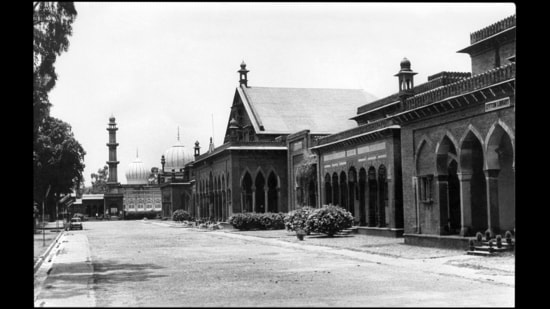
The watershed of 1857 marked a profound turning point in Sir Syed’s life. For the British, reconciliation with the Muslim elite was essential if their rule was to endure. The zamindars, fearful of losing status and estate, were eager to have an interlocutor. Sir Syed, already trusted by the colonial establishment, became a figure through whom this accommodation could be achieved. Out of this fraught context emerged his most enduring project: the Muhammadan Anglo-Oriental College, the seed that would later become Aligarh Muslim University. The College embodied his attempt to negotiate between the Muslim past and the British present, marrying tradition to the promise of modern knowledge.
The reason for the absence of a definitive biography of Sir Syed so far is most likely strategic, in line with the logic of the AMU, partly because every group has sought to appropriate his image. Perhaps because of this, Aligarh Muslim University, the house he built, did not publish his complete works for a long time. His commentary on the Bible was published recently by the university’s Sir Syed Academy. Only fragments exist as a record of his life: Maulana Altaf Husain Haali’s affectionate Hayat-i Javid, Lelyveld’s superficial Aligarh’s First Generation 1978, and Laurence Gautier’s recently published quite ordinary treatise, Between Nation and Community: Muslim Universities and Indian Politics After Partition, and a scattering of inadequate or tendentious studies. One should also mention The Aligarh Movement by Mumtaz Moin (1976), which appears to be a project by the Government of Pakistan aimed at presenting a comprehensive account of Sir Syed’s work in support of Pakistan. Another notable book is Hafeez Malik’s Sir Syed Ahmad Khan and Muslim Modernisation in India and Pakistan (1980). Unfortunately, this too suffers from the inherent myopia of Pakistani scholars. The most authentic and objective work on Sir Syed Ahmad Khan, titled Sir Syed Ahmad Khan: Reason, Religion and Nation, by Shafey Kidwai was not published until 2021. Before that is Anil Maheshwari’s Aligarh University, Perfect Past and Precarious Present (2001), an objective history of the institution. The book was updated and republished in 2025 but it is hardly known to people in the relevant circles. Only Malik and Kidwai have utilised the rich sources on the subject, primarily in Urdu and thus not readily available to Western scholars. A book on MAO College, titled History of MAO College by SK Bhatnagar, was also excellent, despite the author not having access to all the resources available to later writers, especially Lelyveld and Kidwai.
Until Sir Syed’s whole corpus is made accessible through careful editing and translations at least in English and Hindi, our understanding of the Muslim imagination in north India before and after 1857 will remain partial.
Sir Syed’s intellectual daring was often balanced by political compromise. His uneasy negotiations with the Deobandi ulema, culminating in the expulsion of Shibli Nomani from the College, revealed the cost he was prepared to pay for the institution’s survival. Such concessions do not diminish his stature, but they remind us that reform never has a smooth course. To revisit Sir Syed today is to confront his achievements and silences. He was at once a pragmatist and a visionary, a man shaped by colonial exigencies yet determined to wrench his community into modernity. His legacy is neither the property of so-called nationalists nor separatists, but a living intellectual challenge: how to reconcile faith with reason, tradition with change, and memory with the present demands.
Sir Syed scholarship in English is almost negligible. The primary reason is the lack of awareness of sources, mainly in Persianized Urdu. Iftikhar Alam Khan accessed the sources in their original language and dedicated his life to Sir Syed studies, authoring 17 books. Sir Syed Daroon-i Khana effectively utilised sources and addressed aspects not covered by other treatises. Ather Farouqui’s translation gives it a new life. A scholar in the field of Urdu language and education in post-Partition India, who has studied the Aligarh movement from the perspective of language politics, Farouqui is also the General Secretary of Anjuman Taraqqi Urdu (Hind). This gives the endeavour an added significance as it revives the historical and ideological ties between the Anjuman and Aligarh Muslim University.
Sadaf Fatima has a PhD from Jawaharlal Nehru University. Her specialisation is Delhi’s history in 18th and 19th centuries.