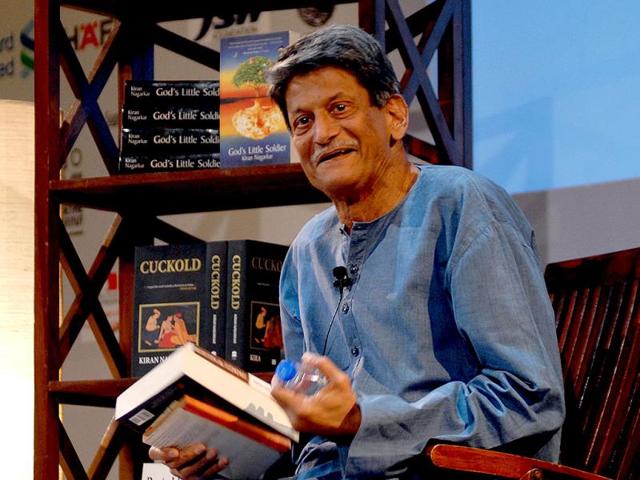
This is a sad story. And if you have not read Kiran Nagarkar's works - odds are, you haven't - it is a tragedy. It is a rare novel that can cast a spell so strong, that you need days to recover. Cuckold is on the very top of that list.
The Ravan & Eddie trilogy will cast no such spell. But it will inspire singularly tender feelings towards the two boys. Ravan and Eddie are my favourite boys in Mumbai - that is, counting all my friends and family in the city. Nagarkar has written seven books. Each of them is brilliant. This, in fact, is the year of Kiran Nagarkar. His nearly-four-decade-old play Bedtime Story, an electrifying version of the Mahabharat, was published for the first time a few months ago. And in a few days, Rest in Peace Ravan & Eddie, the third part of the trilogy, will be available in bookstores. The boys, who grew up in a Bombay chawl in the 1950s to become film extras, have finally come into their own, they're successful music directors - but more importantly, they're grown men. Towards the end, the book itself turns into a fast-paced film - with the mafia and tall buildings thrown in. In this final book, Ravan and Eddie become famous. The same cannot be said of their creator. "Some people have luck, some people don't. I think I'm one of the latter," says Nagarkar quietly.
*In the late 19th century, BB Nagarkar, a Chitpavan Brahmin, abandoned the orthodox Hinduism of his village, became a Brahmo, and moved to the city. Kiran's grandfather, one of the first Indian professors of English in Bombay, was also a representative of the Brahmo Samaj at the 1893 World's Parliament of Religion in Chicago. When Kiran was born in 1942, Bombay was beautiful, "still full of trees" and a better city than Mumbai. The Hindu Colony in Dadar, where the Nagarkars lived, was a middle-class, upper-caste neighbourhood. "It was not the kind of rabid Hinduism that people seem to want to publicise today." It was "strange" being Brahmo. What made the family different from their neighbours was not just that they did not believe in idol worship, but that they were Westernised. "We were anglicised, but very poor," he says. *Ravan & Eddie opens in 1947, when one-year-old Ram falls from the verandah onto Eddie's father, accidentally killing him. In the days that follow, two things happen: Eddie is born, and Ram's mother renames her son Ravan to ward off the evil eye. Ravan is Maharashtrian, Eddie is Catholic and although the boys are neighbours and their lives will be forever interlinked, they don't know it yet. This book is about several things: life in a chawl, films (because the boys love them), the Goan Catholic community of Bombay and the rise of the Right.
When he was 10 years old, Nagarkar wanted to be an actor, "but I was so thin and so self-conscious, I didn't know what I was going to do." He was more Eddie than Ravan, though. "We couldn't afford to watch too many films, but when we did, it was only English films, never Hindi." Ravan & Eddie was originally written as a screenplay. Its sequel, The Extras (2012) - set in the 1970s Hindi film industry, packed with song-and-dance - is a must read for anybody who loves Bollywood.*Education was always very important to Kiran's father, even if it meant he had to borrow money to pay for it. "And yet, he invariably gave money to Dalits." Many underpriviliged children would reach the 10th standard and then fail the board examination. This was a time when you finished your high school education in class 11, and so that one year was very important. "My father would give them money to reappear and reappear every year till they passed the exam - because once they crossed that barrier, they could get better jobs, make something better of their lives." Like his father, Nagarkar too is "obsessive about my duty to help" and to educate."The wonderful capital that this country has is the intense faith in education; that the quality of education is horrendous is a different matter. But we believe that irrespective of how poor we are, education will make us rich, it will make our life better," he says. In his old interviews, from the 90s and early 2000s, reporters noted that Nagarkar liked talking about his life and about his childhood. Now, ask a personal question and he steers the conversation, almost absentmindedly back to his work. Or, to the terrible times we live in and the state of the world in general. It is something that visibly distresses him.*Nagarkar studied English literature. But because he had been to Xaviers and because he was so anglicised, no one would talk to him, and so it forced him to spend time in the library and become a serious reader. His first stories though, appeared in Marathi. His friend (the writer) Dilip Chitre's father ran Abhiruchi, a Marathi magazine. "I wrote a very very short story, of which I'm not ashamed even today. And the next thing I knew was I was writing a novel," he says. In 1973 he wrote Saat Sakkam Trechalis (translated as Seven Sixes Are Forty-Three), that is considered a landmark Marathi classic.*In 1965, Kersey Katrak, the advertising maverick, started MCM (Mass Communications and Marketing), an ad agency which would become the top agency of the time, one that revolutionised Indian advertising, "a company where every time you went to the pot, you were supposed to come up with a brilliant idea." And if accounts are to be believed, they did. When 22-year-old Maneka Gandhi was a model, her claim to fame was a towel ad campaign. The campaign was withdrawn when she was engaged to Sanjay Gandhi. The agency that made this ad was MCM. Nagarkar worked here as a copywriter, his friend (and poet) Arun Kolatkar as a visualiser. They were its rising stars, the "crisis team". And yet, when the agency unexpectedly shut down in 1975, they could not find work after. "And boy did we struggle! It was really odd that we were the only two people who did not get jobs." Nagarkar has watched a few episodes of Mad Men, the hit American TV series about New York admen in the 60s. He didn't like it much. I insist he give it another shot. "I thought it was more style than substance," he says. This seemingly innocuous comment, as it turned out a few minutes later, was more significant than I had imagined. We begin talking about why he didn't get a job in advertising after MCM. "I guess one of the problems was," he says, after much coaxing, "I wear kurta-pyjamas. Kearsey always said, 'It's okay, this idiot can wear kurta-pyjamas.'" But perhaps, it wasn't quite okay. Advertising books will tell you that Nagarkar and Kolatkar then began freelancing. That Nagarkar ultimately quit advertising. But it was a time when the two were in fact "fighting desperately to make a living. Many of the people for whom we freelanced had the gall to refuse our rejection fees [fees for work that is ultimately rejected]".While making ends meet as a freelance copywriter, in 1978, Nagarkar began writing Ravan & Eddie as a screenplay. A Bollywood filmmaker was very keen to turn it into a film - but by the time he completed it, the filmmaker, "did not even have the courtesy to tell me we were on different wavelengths," says Nagarkar. He tried to turn the screenplay into a Marathi novel. "I wrote 71 pages, but then I stopped. I gave up also, I think," he says.Money was tight. "Even when I had a job and I was supposedly doing rather well, I couldn't afford to buy the smallest of places in Bombay," he says.To this day, Nagarkar doesn't have a house of his own. "I live at Tulsi's place," he says. Tulsi Vatsal is his partner of more than three decades. They met at a film festival - where he had been hired to "visualise the whole thing" and she as a synopsis writer. Vatsal who retired from her Communications job as a vice president is "basically, a historian. And unlike Nagarkar who is completely illiterate," he says referring to himself in third-person, "she has studied abroad."*In the Seventies, while he still had a job, Nagarkar wrote Bedtime Story. The play, finished in 1977, would change his life.The context was the Emergency, when everything was being censored. And so was Nagarkar's modern retelling of the Mahabharat. Here is a Draupadi who reprimands the Pandavas for wanting to turn her into a "five-day roster... just because mummy said so". And an Eklavya who, instead of respectfully chopping off his right thumb as dakshina, gives Dronacharya a thumb made out of mud and says, "Like Guru, like gift." Nobody banned the play, per se. But it was not allowed to be performed (for 17 years): The censor board insisted on several cuts and could not fathom why the epic was so altered. Nagarkar stopped writing. He did write some screenplays - many of which are just "lying around the house somewhere - but forgot about them.A few months ago though, to everybody's amazement, HarperCollins India published Bedtime Story in English along with Black Tulip, one of Nagarkar's "forgotten" screenplays. He was in Delhi to promote the book, which was seen as a victory in the face of recent publishing censorship. But, says a friend who had accompanied me to the book launch, "it is heart-wrenching to hear him talk." But perhaps the publication of the book doesn't detract from the lost years - a decade and a half - spent not writing. "I don't know how to make myself pay for the folly of it," says Nagarkar.*Not writing, he says, "played havoc on my conscience." On a fellowship abroad, he turned his original Ravan & Eddie screenplay into a novel. This time, not in Marathi. "After 15 years of rejection, I switched to writing in English for the first time." When it was published in 1994, the English critics loved it, but the Marathi ones ignored it. Not a single review of the book appeared - "there was not even a notice" - it was not translated for years. But the novel established Nagarkar as one of the finest Indian writers in the country. And just three years later, he produced his masterpiece - "it wrote itself"- Cuckold. Last year, in an article in the online literary magazine The Millions, Sue Dickman called Cuckold "one of the most satisfying reading experiences of my life". She seemed surprised that "hardly anyone has heard of it".Let nobody fool you, Nagarkar writes in the book, most couples are conjoined on earth. The mismatches, now they are a different story. They are made in heaven. The novel is about one such mismatch: the sham that was the marriage of Mira bai (who believed she was married to Lord Krishna) and her mortal husband, the Rajput prince Maharaja Kumar. In the backdrop is Babur, set to invading India.
{{/usCountry}}When he was 10 years old, Nagarkar wanted to be an actor, "but I was so thin and so self-conscious, I didn't know what I was going to do." He was more Eddie than Ravan, though. "We couldn't afford to watch too many films, but when we did, it was only English films, never Hindi." Ravan & Eddie was originally written as a screenplay. Its sequel, The Extras (2012) - set in the 1970s Hindi film industry, packed with song-and-dance - is a must read for anybody who loves Bollywood.*Education was always very important to Kiran's father, even if it meant he had to borrow money to pay for it. "And yet, he invariably gave money to Dalits." Many underpriviliged children would reach the 10th standard and then fail the board examination. This was a time when you finished your high school education in class 11, and so that one year was very important. "My father would give them money to reappear and reappear every year till they passed the exam - because once they crossed that barrier, they could get better jobs, make something better of their lives." Like his father, Nagarkar too is "obsessive about my duty to help" and to educate."The wonderful capital that this country has is the intense faith in education; that the quality of education is horrendous is a different matter. But we believe that irrespective of how poor we are, education will make us rich, it will make our life better," he says. In his old interviews, from the 90s and early 2000s, reporters noted that Nagarkar liked talking about his life and about his childhood. Now, ask a personal question and he steers the conversation, almost absentmindedly back to his work. Or, to the terrible times we live in and the state of the world in general. It is something that visibly distresses him.*Nagarkar studied English literature. But because he had been to Xaviers and because he was so anglicised, no one would talk to him, and so it forced him to spend time in the library and become a serious reader. His first stories though, appeared in Marathi. His friend (the writer) Dilip Chitre's father ran Abhiruchi, a Marathi magazine. "I wrote a very very short story, of which I'm not ashamed even today. And the next thing I knew was I was writing a novel," he says. In 1973 he wrote Saat Sakkam Trechalis (translated as Seven Sixes Are Forty-Three), that is considered a landmark Marathi classic.*In 1965, Kersey Katrak, the advertising maverick, started MCM (Mass Communications and Marketing), an ad agency which would become the top agency of the time, one that revolutionised Indian advertising, "a company where every time you went to the pot, you were supposed to come up with a brilliant idea." And if accounts are to be believed, they did. When 22-year-old Maneka Gandhi was a model, her claim to fame was a towel ad campaign. The campaign was withdrawn when she was engaged to Sanjay Gandhi. The agency that made this ad was MCM. Nagarkar worked here as a copywriter, his friend (and poet) Arun Kolatkar as a visualiser. They were its rising stars, the "crisis team". And yet, when the agency unexpectedly shut down in 1975, they could not find work after. "And boy did we struggle! It was really odd that we were the only two people who did not get jobs." Nagarkar has watched a few episodes of Mad Men, the hit American TV series about New York admen in the 60s. He didn't like it much. I insist he give it another shot. "I thought it was more style than substance," he says. This seemingly innocuous comment, as it turned out a few minutes later, was more significant than I had imagined. We begin talking about why he didn't get a job in advertising after MCM. "I guess one of the problems was," he says, after much coaxing, "I wear kurta-pyjamas. Kearsey always said, 'It's okay, this idiot can wear kurta-pyjamas.'" But perhaps, it wasn't quite okay. Advertising books will tell you that Nagarkar and Kolatkar then began freelancing. That Nagarkar ultimately quit advertising. But it was a time when the two were in fact "fighting desperately to make a living. Many of the people for whom we freelanced had the gall to refuse our rejection fees [fees for work that is ultimately rejected]".While making ends meet as a freelance copywriter, in 1978, Nagarkar began writing Ravan & Eddie as a screenplay. A Bollywood filmmaker was very keen to turn it into a film - but by the time he completed it, the filmmaker, "did not even have the courtesy to tell me we were on different wavelengths," says Nagarkar. He tried to turn the screenplay into a Marathi novel. "I wrote 71 pages, but then I stopped. I gave up also, I think," he says.Money was tight. "Even when I had a job and I was supposedly doing rather well, I couldn't afford to buy the smallest of places in Bombay," he says.To this day, Nagarkar doesn't have a house of his own. "I live at Tulsi's place," he says. Tulsi Vatsal is his partner of more than three decades. They met at a film festival - where he had been hired to "visualise the whole thing" and she as a synopsis writer. Vatsal who retired from her Communications job as a vice president is "basically, a historian. And unlike Nagarkar who is completely illiterate," he says referring to himself in third-person, "she has studied abroad."*In the Seventies, while he still had a job, Nagarkar wrote Bedtime Story. The play, finished in 1977, would change his life.The context was the Emergency, when everything was being censored. And so was Nagarkar's modern retelling of the Mahabharat. Here is a Draupadi who reprimands the Pandavas for wanting to turn her into a "five-day roster... just because mummy said so". And an Eklavya who, instead of respectfully chopping off his right thumb as dakshina, gives Dronacharya a thumb made out of mud and says, "Like Guru, like gift." Nobody banned the play, per se. But it was not allowed to be performed (for 17 years): The censor board insisted on several cuts and could not fathom why the epic was so altered. Nagarkar stopped writing. He did write some screenplays - many of which are just "lying around the house somewhere - but forgot about them.A few months ago though, to everybody's amazement, HarperCollins India published Bedtime Story in English along with Black Tulip, one of Nagarkar's "forgotten" screenplays. He was in Delhi to promote the book, which was seen as a victory in the face of recent publishing censorship. But, says a friend who had accompanied me to the book launch, "it is heart-wrenching to hear him talk." But perhaps the publication of the book doesn't detract from the lost years - a decade and a half - spent not writing. "I don't know how to make myself pay for the folly of it," says Nagarkar.*Not writing, he says, "played havoc on my conscience." On a fellowship abroad, he turned his original Ravan & Eddie screenplay into a novel. This time, not in Marathi. "After 15 years of rejection, I switched to writing in English for the first time." When it was published in 1994, the English critics loved it, but the Marathi ones ignored it. Not a single review of the book appeared - "there was not even a notice" - it was not translated for years. But the novel established Nagarkar as one of the finest Indian writers in the country. And just three years later, he produced his masterpiece - "it wrote itself"- Cuckold. Last year, in an article in the online literary magazine The Millions, Sue Dickman called Cuckold "one of the most satisfying reading experiences of my life". She seemed surprised that "hardly anyone has heard of it".Let nobody fool you, Nagarkar writes in the book, most couples are conjoined on earth. The mismatches, now they are a different story. They are made in heaven. The novel is about one such mismatch: the sham that was the marriage of Mira bai (who believed she was married to Lord Krishna) and her mortal husband, the Rajput prince Maharaja Kumar. In the backdrop is Babur, set to invading India.
{{/usCountry}}You wonder when you read the book, why nobody ever dared to imagine what it must be like to be married to a woman who thought she was married to God. This epic of a novel is a love story like no other. It won the Sahitya Akademi Award. "Mira was one of the earliest feminists. And we have all the mythologising sycophancy - the calendar art, the postcards of her looking so dreadfully dull - we lose the person. Think about it, what must it have been like to be married to Mahatma Gandhi? These are great stories."At this point, Nagarkar begins to look angry, angry at people who dare to criticise Gandhi and Nehru. "What makes them great leaders is that they have blundered, it makes them human," he says. What have been some of your blunders, I ask. He looks pensive. "That I have written so little, that I have loved people and then you feel, that…" he trails off."I think my gratitude and greed for life has been one of the problems," he finally says. *In 2012, Sachin Tendulkar was awarded the Order of Australia, the highest civilian honour from a foreign government. A few days after, Nagarkar was given Germany's Order of Merit for his 2006 vast and devastating novel, God's Little Soldier. This is a story of a boy who grows up to become a terrorist, a tale of the complexities of faith - You were about to kill each other for the sake of a god who you claim is either a Muslim or a Hindu. But Inayat, there is only one God and Her name is Life. She is the only one worthy of worship. It won critical acclaim abroad. But none at home. It got some glowing reviews, but little else. Even among several people I know who loved Nagarkar's previous books had not even heard of this one. "It is problematic. You want it to be liked, you want it to be successful. Par aapke haath mein kuch nahi rehta hai na?" he says.* Lots of filmmakers have shown interest in turning the books into movies. Years ago, there were even reports of Dev Benegal turning Ravan & Eddie into a film. (Benegal had earlier adapted Upamanyu Chatterjee's magnificent 1988 novel English, August into the National Award-winning film starring Rahul Bose). The film was never made. How many such offers? "Cuckold, without exaggeration, at least 50. Ravan & Eddie and The Extras, at least 25. But I don't know how to deal with film people. They talk, but nothing comes out of it." *This interview was conducted in several parts, spread over a year. The first time we met was because Ravan & Eddie and Cuckold had both appeared on the HT Brunch list of 54 Greatest Indian Novels Ever Written. Every time we talk, he emphatically stresses on the importance of writing: that, if you're a writer, it is "almost criminal not to work on your own work" - just because you're working for somebody else. And that, a book isn't a book unless it has been published.This year two of his books have been published. The last time we spoke, two weeks ago, it seemed like he had finally had his closure.*Now in his 70s, Nagarkar switched to a laptop a decade ago. But only because he had to - because it was convenient. It is, he says, a terrible way of writing. "The laptop gives you so much leeway to change, that you don't write a single sentence without wanting to change it." The only way to write, however, is to sit down and not "wait for that great sentence". Follow @SaudaminiJain on Twitter
From HT Brunch, July 19Follow us on twitter.com/HTBrunchConnect with us on facebook.com/hindustantimesbrunch