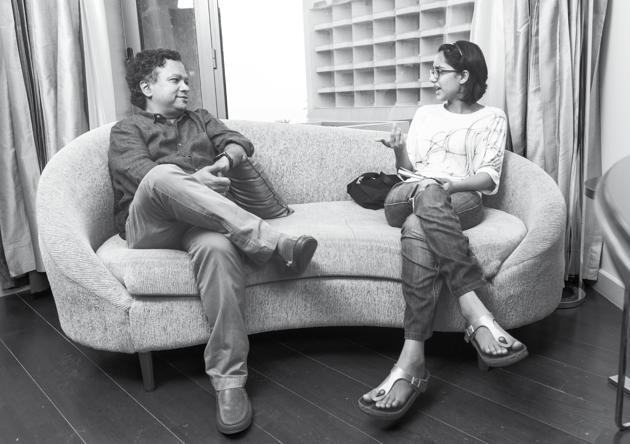
Here’s the thing about being the niece of Vikram Chandra, the author of Sacred Games: Since you want to be a writer too, you get to interview your own uncle! His 900-page novel is now a digital show – the first Indian original series on Netflix, and HT Brunch suggested I put some interview questions to him. Here are excerpts, niece to uncle, writer to writer, Chopra to Chandra.
Zuni: In Ratatouille (2007), Gusteau states that ‘Anyone can cook’. It is later explained that he does not mean that anyone can be a great artist, but that a great artist can come from anywhere. Do you think the same is true for writing?
Vikram: Definitely. One never knows where talent can come from. But I think as is clear in that film and in life as well, privilege or the lack of resources makes a lot of difference. If your parents and immediate surroundings don’t have the resources to support you in that craft, you might not even know you had it. I’ve been teaching writing at the university level now for decades, and I’ve taught people of all races, classes and economic statuses. So I do think talent can come from anywhere but it needs a proper receptive environment and people who encourage you to flourish. At the same time, you can teach craft, but not talent. You have to be born with the talent and then find the right fit to hone it.
Z: What marks out a writer from the rest of the world?
{{/usCountry}}Z: What marks out a writer from the rest of the world?
{{/usCountry}}V: One thing I’ve noticed is that all writers are observers. They love being in other people’s business! Also, I think this might be something that starts from childhood; you know, the kid who feels a little excluded and weird. And of course, someone who has a feel for and a love for language.
Z: You talked about teaching writing at university. Has a student taught you something valuable?
V: Oh, all the time! Often, I ask them to bring in books to class that they love or that mean something to them. In this way, I’m exposed to a ton of incredible work that I probably never would have found on my own. Sometimes they also use a technique that I haven’t seen before. They often challenge the assertions I’ve made, forcing me to know what I’m talking about!
Z: In Midnight in Paris (2011), Hemmingway says ‘If it’s bad, I’ll hate it because I hate bad writing. If it’s good, I’ll be envious and hate it all the more. You don’t want the opinion of another writer.’ How far do you agree with this quote?
V: I think it was actually Salman Rushdie who quite correctly said that the best test of good writing is envy. That’s absolutely true. Sometimes you read a sentence and it just blows your head as to how good it is. And if you feel jealous, you know it’s true.
Z: Who have you been most jealous of?
V: I was just re-reading The English Patient by Michael Ondaatje and my God it’s so good! Not only in its sentence construction but also in its suggestiveness and its economy. It also depends on what I’m reading at the time.
Z: I’ll put that on my list! So, would you say the transformation of Sacred Games into a show is the ultimate ‘bringing to life’ of a book?
V: No, it’s more of a translation. I think books have their own life within a reader’s mind that nothing else can match; there’s a certain intimacy there. And so when you put it into any other medium, it’s a new creation, or transcreation maybe is a better word. It exists at an angle to the book, but it also exists in its own right.
Z: On that note, the book is something like 900 pages! Do you worry that your vision might be cut down in the form of a TV show?
V: No, no. Again, I think it exists in its own universe, it’s its own thing. I’ve worked in the industry, and because I’ve been on the other side I know how frustrating it is when fiction writers whine about how you changed something! (laughs) So you need to let them do their thing, and then what happens at the end is in its own shape and style.
Z: Did you know when you started the book that it would be this long?
V: No. I wouldn’t have had the courage to start! The thing about organised crime is that it cannot exist, as I soon discovered, without politics. Suddenly I’m writing not just about crime, but about politics, and so about religion, and so about the media. I included smugglers, so suddenly it was a spy book. So I would call it a systems analysis of how crime and politics and religion intersect in today’s world.
From HT Brunch, July 22, 2018
Follow us on twitter.com/HTBrunch
Connect with us on facebook.com/hindustantimesbrunch