There is a very subtle separation in progress, and that is good news for either party. By unlinking the tradition of a consumer-focused iPhone and the “Pro” iPhone being launched at the same time, it helps both. The former doesn’t inevitably get overshadowed, and the latter isn’t weighted in terms of comparative price. That also means the iPhone 18 Pro and iPhone 18 Pro Max will be measured in terms of actual camera upgrades including the variable aperture, the A20 Pro chip leap and a collective of changes that lead to a longer-lasting battery. The proverbial cherry on the cake is an undeniable wow factor of the Burgundy. Apple has a lot to show off, and they have done so.
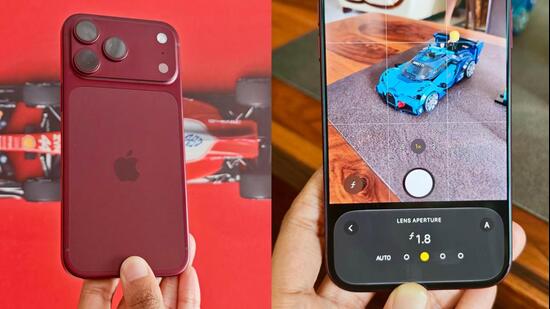
It was last year when Apple redesigned the Pro-grade iPhones with a distinct design language, and the refinements with the iPhone 18 Pro Max and iPhone 18 Pro are noticeable and appreciated. An immediate contrast, from the bright Cosmic Orange as the flagship colour, to an understated and decidedly sophisticated Burgundy. Or even Glacier for that matter, both of which I believe have the right to be joint-flagship shades for this generation. While the dual-tone nature remains to an extent, the glass cutout on the back is now matched more closely with the overall colour. That’s apparent across Burgundy, Glacier, Silver and Black.
If you do allow light to fall at different angles on the Burgundy, there are subtle hues of cherry red that show up from time to time. For some reason though, fingerprints are very prominent on this colour, and as someone who is somewhat obsessed with cleanliness and symmetry, I have another task to keep me momentarily occupied through the day armed with a very soft cleaning cloth. A positive note, this may well be a rare instance of generational compatibility for cases, because the iPhone 18 Pro Max and the iPhone 17 Pro Max have similar dimensions—except a smidgen of added weight because of newer foundational hardware pieces.
Variable apertures, laser-cut precision
{{/usCountry}}Variable apertures, laser-cut precision
{{/usCountry}}There are many pieces that indeed come together to make a fine puzzle. Thermal management architecture has evolved to help the incredibly powerful A20 Pro chip sustain performance that helps it set the benchmark in the world of smartphones. The mechanical aperture that controls how much light reaches the main sensor, is a true camera trick—and one that shouldn’t be taken lightly, since this is the only current generation flagship that has a moving aperture (phones mostly have fixed apertures, Apple has deployed six laser-cut blades) in the 48-megapixel Fusion main camera.
Samsung enthusiasts will come and point to the dual-aperture mechanical system in the Galaxy S9 series from 2018, but the counter to that irrationality is simply a question: do you use a Galaxy S9 today, for photography?
The advantage of variable aperture, as Apple sees it, spans across regular photography scenarios as well as those occasional moments. Narrowing the aperture to reduce the play of light in certain well-lite scenarios can work wonders with the photograph you finally see, whereas opening up the aperture in low light does exactly what you expect that would do. Two things have happened here. First, the maximum aperture is the widest it’s ever been, at f/1.48 with smaller stops at f/1.8, f/2,8 and f/4. Secondly, picture quality across the aperture range doesn’t waver from the standard quality.
While the previous iPhone 17 Pro’s f/1.8 aperture mostly kept the frame in focus, going a bit wider this time may have advantages in tricky lighting conditions. To be fair, this is equally useful for those who prefer leaving the camera in auto mode, and for those who’ll like to manually run the setting sliders. There’s continuity with a typically Apple, warm and likeable colour tone in photographs.
There’s a lot more on the camera front, including a new computational image pipeline and expanded Photographic Styles with texture and grain control. Since I habitually shoot on the 48-megapixel mode (HEIF, to be specific), the immediate difference that’s visible is that the iPhone 18 Pro Max is regularly delivering photos that are a notch more illuminated across the frame, than the iPhone 17 Pro Max. On the video recording front, the Cinematic effect can also be added later in edits, which adds convenience and flexibility.
Hot and cold
Apple’s in-house chip efforts seem to make incredible leaps with every generation, something that’s perhaps been more profound with the M-series chips for Macs in all these years. The A20 Pro silicon for the iPhone 18 Pro series is such a leap ahead in terms of overall performance, Android’s foundational pieces put together by Qualcomm and Mediatek will take a while to catch up, if at all. As Kaiann Drance, VP of Worldwide iPhone & Apple Watch Product Marketing explained to HT in an interaction on the sidelines of the keynote, it is about the power of integration between the silicon hardware and the software, as well as Apple’s unwavering focus on performance per watt.
The fact that the A20 Pro silicon now plays in the same field as the M6 and M5 chips for Macs, as far as single-core scores for the iPhone 18 Pro Max on Geekbench 7 go, and a fair bit ahead of the iPhone 17 Pro Max across the board, underlines that new benchmark. There are foundational changes that have unlocked this level of performance. First, Apple has made a key packaging change, moving the DRAM to the side of the chip instead of being at the top, as Sri Santhanam, VP of Silicon Engineering Group at Apple also explained to us in detail. That opened up space for not just a larger vapour chamber but also means that the chip can sit in closer proximity. And this chamber also has a new composition, also to move heat away from the display.
I will not get bogged down by synthetic benchmarks for much longer, but the generational performance difference is in the range of around 25% for the CPU and around 40% for graphics. The fact that Apple paid equal attention to performance and thermals, and this has been a positive multi-year trend, has a bearing on real-world experiences too—look closely, even the SIM card tray has been aligned differently, to open up some more space for the internals. Barring the iPhone 18 Pro Max betraying some tepidness in the early days after setting up, as Spotlight indexing and app data sync were in full flow. This is overall great news as the A20 Pro will hold performance for much longer, which should be good news for video editing or gaming on the iPhone.
It isn’t just sustained performance which gets a fillip from the redone thermal foundation. Generationally, this has to be the biggest leap in battery life on an iPhone. As a primary phone, moderately heavily used with a mix of calls, lots of messaging, social media, emails syncing and some bit of photo editing as well as Reel edits, 100% to 20% now gets through almost two full days of usage.
A small matter of price
The iPhone 18 Pro and iPhone 18 Pro Max demand a significantly higher monetary outlay than the predecessors, and we can blame the supply chain inflation as well as shortage of components for that translating into a higher price tags. Apple held off for much longer than most other phone brands, to its credit. The iPhone 18 Pro prices start at ₹1,64,900 while the iPhone 18 Pro Max will cost ₹1,79,900 onwards. My feeling is that the 256GB and 512GB storage options will be in vogue this year, in a slight realignment from a past trend that saw users prefer the higher storage tiers.
The subtlety and utility
The Dynamic Island on the iPhone 18 Pro series is smaller than before, which means one more Live Activity can be adjusted in that space. Apple gave us an inside look at some clever engineering that was visible under a microscope, as they worked with brighter pixels in a small part of the display to allow the infrared light to just about pass through for the Face ID to work. And hence, the reduction in the black space defining the cutout. This might be quite handy, if you have music playing, a food order on the way, and sports scores to keep an eye on.
There’s also the matter of the new Siri AI, which underpins the Apple Intelligence suite across iOS 27. The A20 Pro’s Dual 16-core Neural Engines make this so adept at on-device AI tasks as well as the server side responses, I wouldn’t be surprised if the Siri AI app at some point down the line proves its mettle enough for you to consider cancelling any other AI subscriptions you may be paying for. And across Apple’s device ecosystem, the sync and capabilities are at par.
Time for an iPhone Ultra?
Last year’s iPhone 17 Pro Max was the best iPhone Pro that Apple had ever made. This year, the iPhone 18 Pro Max resets that benchmark by quite some margin. This does very well make a case for the larger of the two ‘Pro’ models to have an ‘Ultra’ moniker instead. This is a long away ahead in terms of overall performance, including on-device AI compute, which should worry the current Android flagship crop as well as the next one in terms of just how they’re supposed to respond—this is now the benchmark, for a some time to come.
Secondly, camera upgrades are a serious collective that makes the overall most likeable smartphone camera, even better in many respects. This may not have a camera company as a partner, or a new sensor with more megapixels, but movies and videos have been regularly shot more on an iPhone, than any other phone. With the iPhone 18 Pro Max, the aperture hardware as well as the image processing pipeline updates, have simply done wonders to elevate the overall arsenal of experience. Just call it the iPhone 19 Ultra, if this trajectory continues.