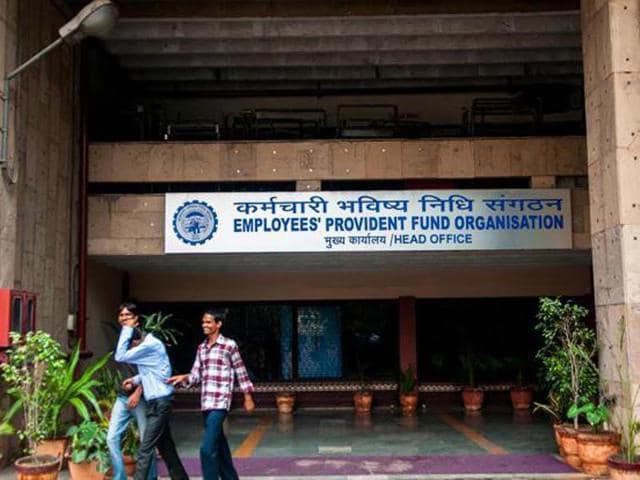
The Employees Provident Fund Organisation (EPFO) hit the stock market on Thursday, with an estimated amount of Rs 5,000 crore.
The fund is the largest player in the Indian retirement fund industry which enables you to save for your old age offering you options like provident funds, life insurance plans, and mutual funds. They invest your money elsewhere, get returns, and give it you later as pension.
The funds have traditionally preferred fixed income instruments – like government securities and debt securities – and kept themselves away from the equity market, due to it's volatile nature and risk factors. But with this move, the scenario has started to change, but with much caution.
Though the finance ministry had instructed EPFO to invest 5 to 15% in equities, it is starting with only 1 to 5%. They are still not confident of the equity markets.
"We are going step by step. And want to see the progress of this first step," said Ravi Wig, member CBT, the body that takes EPFO’s investment decisions.
Fixed income instruments get you a specific interest rate, regardless of market fluctuations. But, the return from fixed income assets depends on inflation and it goes below zero at times of high inflation. Say, if a government security carries an interest rate of 9%, and there is 12% inflation, you earn a negative 3% interest.
Equity investments are inflation proof. When there is a rise in inflation, their returns rise accordingly. Also a recent report by credit rating agency CRISIL has shown that though the Indian equity marketshare is often volatile in short term, they are less so in long term, say, more than 10 years.
Market depth and investor awareness
Globally, equities are preferred for investing pension money. An OECD survey in 2014 shows that large pension funds globally have about 30% exposure to equity. This depends on the depth of the market, in other words, how much money it has.
KK Jalan, Central Provident Fund commissioner (also CEO, EPFO) said, “Now [moving out of] a 22,000 crore by FII could shake the market,” adding that deepening the market would make it more attractive for pension funds.
Manish Jaiswal, senior director of CRISIL said that the very arrival of pension funds to the equity market would help the deepening. “[They] have the potential to deepen capital markets and add stability in the face of short term money flows,” he said.
The EPFO, according to Jalan has plans to offer investment options to the account holders: that is, to ask them how much they want to invest in equities, bonds and other instruments. But he said that it would depend much on the financial literacy of the investors, as only a good understanding of various financial instruments would enable them to effectively exercise this option.
Pension models
Globally, equities are preferred for investing pension money. An OECD survey in 2014 shows that large pension funds globally have about 30% exposure to equity. This depends on the depth of the market, in other words, how much money it has.
KK Jalan, Central Provident Fund commissioner (also CEO, EPFO) said, “Now [moving out of] a 22,000 crore by FII could shake the market,” adding that deepening the market would make it more attractive for pension funds.
Manish Jaiswal, senior director of CRISIL said that the very arrival of pension funds to the equity market would help the deepening. “[They] have the potential to deepen capital markets and add stability in the face of short term money flows,” he said.
The EPFO, according to Jalan has plans to offer investment options to the account holders: that is, to ask them how much they want to invest in equities, bonds and other instruments. But he said that it would depend much on the financial literacy of the investors, as only a good understanding of various financial instruments would enable them to effectively exercise this option.
Pension models
Pension schemes in India, where only 8% of the working population is currently covered under social security, has been designed in Defined Benefit(DB) – where the employer, usually the government, offers you a predetermined amount in monthly instalments after your retirement– and Defined Contribution(DC) model – where employee and employer contributes to the future pension.
As DB model was not fiscally sustainable for the government, it started shifting to the DC model. One initiative was the New Pension Scheme, introduced in 2004, and opened to public in 2009.But the recent Atal Pension Yojna, aimed at the poorer unorganised sections of the population, is a combination of both the models.
Issue of regulation
Although Pension Fund Regulatory Agency (PFRDA) regulates the sector, there is dearth of data on the pension funds in the country, their corpus, and their investments.
“We need to study how many Pension Funds are there, and their total corpus,”said Jalan. Although one and half years ago EPFO reported to parliament that there were 3621 such funds in India, it later found that there were only about 1500, and could monitor online only about 23, he added.
“There are [funds] that are not investing not in accordance with the rules of the provident funds, finance ministry or EPFO,” he said. “..wrong things can happen..and has happened before,” he added.