There is a question to be asked about whether you need a separate artificially intelligent note taking device for your meetings and interviews, at a time when most phones have voice recording apps that also rely on artificial intelligence (AI) to transcribe? And as an extension to that question, when there are multiple web and app-based services that will transcribe and summarise audio recordings, for a monthly subscription? The Silicon Valley-based AI technology company Plaud is building what it calls the human-AI alignment on the basis of a note-taking hardware, linked to a software in your phone, but also de-links the core task from the phone.
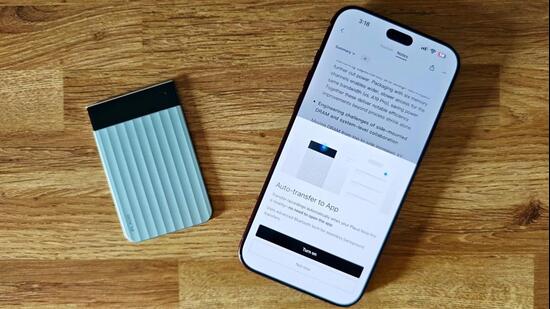
In India, the company has a four strong audio device portfolio, including the Plaud NotePin (this is priced at ₹16,990), a more advanced Plaud NotePin S (for ₹19,990), the Plaud Note ( ₹16,990) and the top-tier Plaud Note Pro (this is priced at ₹20,990) that we are assessing from the perspective of a companion for during and after meetings. Each of these devices, and it’s inarguable, demands a substantial monetary outlay for something you may already be doing fairly well on your iPhone or Android phones.
For apps such as Otter, Fireflies and Fathom, they need a phone app, or a desktop to record audio in meetings. Secondly, there’s an argument that they’ve become more and more expensive over time. For instance, Otter will charge you ₹9,980 or so for a year’s worth of Pro subscription, that is still limited to a maximum of 90 minutes per meeting recording. Neither is exactly inexpensive, but value will depend on how you perceive usage with costs and limits.
And paired with an AI subscription, summarisations might be fairly well ticked off too—but that’s debatable as to whether those are actionable generations, or not. The scenario where you cannot compromise on post meeting clarity, is exactly where Plaud makes a strong case for itself. The hardware piece, such as the Plaud Note Pro records the audio and syncs it with the phone app.
{{/usCountry}}And paired with an AI subscription, summarisations might be fairly well ticked off too—but that’s debatable as to whether those are actionable generations, or not. The scenario where you cannot compromise on post meeting clarity, is exactly where Plaud makes a strong case for itself. The hardware piece, such as the Plaud Note Pro records the audio and syncs it with the phone app.
{{/usCountry}}Instantaneously, the Plaud Intelligence layer, kicks in to transcribe in as many as 112 global languages, including speaker labels particularly if you’ve connected a calendar such as Google Calendar to it, and smart summaries as well as key moments to access later. The summaries also include a chatbot-like feature, and you can ask specific questions about a certain discussion point, a phrase or a point that transpired in the meeting.
Indian language support for transcriptions and summaries includes Hindi, Tamil, Punjabi, Telugu, Bengali, Kannada, Assamese, Gujarati and Malayalam.
The tiers are slightly complex to understand, so bear with me as I illustrate this to the best of my understanding and experience. When you buy a Plaud device, a Starter subscription is enabled for the account with which you are binding that notetaker hardware. For instance, with the Plaud Note Pro, the Starter subscription was immediately enabled, unlocking 300 minutes of AI transcription for recorded meetings every month. This is a rolling benefit, and may be exactly within the limit of how many minutes you’ll consume every month for interviews and so on.
At this point, if you run out of 300 minutes, you must wait for the next month’s cycle to begin before transcriptions or summaries can be generated for your meetings. However, you’ll be able to record as much audio as you need to in this time. Now, you have two choices—buy a Pro plan (that’s 1200 monthly transcription minutes) which costs between $10 per month with annual billing or $21.99 per month with monthly billing. There is also an Unlimited plan that costs $35.99 per month for monthly billing and $24 per month with annual payment. There are sachet options as well, for $3.99 (that’s for a 120-minute bundle), or $14.99 (600-minute bundle). Any more, and you’re better off paying for the Pro plan.
I have noticed that the Plaud app on iPhone has the option of importing audio recorded elsewhere, and that can be transcribed as well as summarised, with usage getting allocated within the 300-minute monthly limit.
For transcription and summaries, Plaud Intelligence works with a number of AI models, with the selection often depending on what sort of profile you’ve set for your account. there’s GPT-5.2, Gemini 3 Pro, and Claude Sonnet 4.5 to name a few.
I must note that the Plaud Note Pro is an incredibly smart device, in terms of how it looks, the refinement of design and the little details that have been taken care of. For instance, the bundle includes a magnetic case, which is very similar to Apple’s MagSafe wallet accessories, allowing for the Plaud Note Pro to be magnetically attached to the back of an iPhone. You may be carrying two different devices, but you’re actually not carrying two different devices into a meeting.
Incredibly slim at 2.99mm and the weight is barely noticeable at 30 grams, but no compromises with the foundations—64GB internal storage, 5 meter effective recording range, a 500mAh battery (Plaud claims up to 30 hours of recording time in enhanced audio mode; I’ve still not breached that threshold) and a collective of 4 MEMS microphones and one VPU or voice pickup unit sensor that isolates human speech from unwanted background noise. In my experience, the Plaud Note Pro does voice separation from the noise rather well, but there are instances in larger meeting rooms, when the finally recorded audio is lower than usual in terms of volume. That could purely be an optimisation aspect, easily resolvable with a software update.
A rather interesting addition to the AI summaries for meetings is the ability to do a short press on the singular key on the Plaud Note Pro to highlight that moment in the conversation—the transcription will highlight it and the summaries will also note that. Also for this key, a long press to start recording and a regular press to stop recording, make for the sort of experience wherein you aren’t struggling with an app or an interface.
The reality of the Plaud Note Pro is that it is an expensive proposition from the outset, demanding you part with a fair chunk of money to get the device and the starter subscription pack. But for certain industries and usage scenarios, recording on a phone isn’t always the way to go, and relevance extends with AI generated summaries and clear transcriptions that are very usable since the fillers are effectively removed. You simply must justify the expense, because this very focused piece of technology has no experiential gaps to complain about later.