US stock futures were mostly flat on Tuesday after Wall Street ended Monday with a strong rally led by technology and AI-related stocks. Investors were now watching oil prices, Federal Reserve rate signals, President Donald Trump’s upcoming United Nations address and Alibaba’s new AI chip launch.
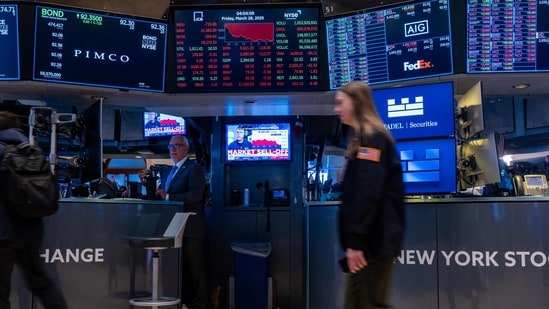
Dow Jones futures slipped 25 points, or 0.1%, at 3:09 a.m. ET (7:09 GMT). Futures tied to the S&P 500 and Nasdaq 100 were broadly unchanged. The move showed that investors were taking a pause after Monday’s strong gains. The S&P 500 had its strongest session since August on Monday. AI-related companies helped drive the rally, while investors also kept an eye on US Treasury yields and developments in the Middle East, according to Yahoo Finance.
AI stocks rise
Technology stocks had led Monday’s Wall Street gains. Meta Platforms gained after the company introduced a new AI model, renewing investor interest in the possibility of AI agents becoming more widely used by consumers.
Chip stocks also benefited from the AI rally. Advanced Micro Devices and Intel rose as investors continued to focus on companies supplying processors and other computing technology needed for AI applications, according to the report.
The 10-year US Treasury yield moved slightly lower on Tuesday. Bond prices and yields move in opposite directions, meaning a decline in yields reflects higher bond prices.
{{/usCountry}}The 10-year US Treasury yield moved slightly lower on Tuesday. Bond prices and yields move in opposite directions, meaning a decline in yields reflects higher bond prices.
{{/usCountry}}Also read: Why is QQQ rising? AI stocks rally as Treasury yields fall below 5%
Oil prices top $100
Oil prices remained a major focus as Brent crude moved above $100 a barrel. Brent futures were up about 1% at $101.36 in the report, as investors assessed the risk to energy supplies from tensions in the Middle East.
President Donald Trump is set to address the United Nations General Assembly in New York. His speech is expected to cover international security, conflicts in the Middle East and Ukraine, as well as artificial intelligence safety.
US Ambassador to the United Nations Mike Waltz said Trump would discuss how his administration has dealt with major global challenges. Waltz also said Trump would address efforts to prevent Iran from obtaining a nuclear weapon.
Middle East tensions
The UN address comes as tensions involving the US and Iran remain a concern for markets. The supplied report says hostilities between the two countries began in late February, while fighting has also intensified in Yemen between Iran-backed Houthi militants and Saudi-aligned forces.
The fighting in Yemen has raised concerns about oil shipments through the Bab el-Mandeb Strait. Saudi Arabia has relied on the waterway to reach international markets after major disruption to shipping through the Strait of Hormuz, according to the report.
Washington has declined Saudi requests to join military operations against the Houthis. However, US forces remain involved in protecting regional installations and supporting shipping through the Strait of Hormuz, the report said.
Trump has warned Iran's leadership of further consequences if a settlement is not reached. Tehran, meanwhile, has threatened retaliation against additional attacks, according to the supplied material.
Also read: Why is the S&P 500 under pressure as Fed rate hikes push interest rates higher?
There were also signs that diplomatic talks could be possible. Media reports said Trump was willing to meet Iranian President Masoud Pezeshkian during the UN gathering, although the supplied report did not confirm that a meeting had taken place or that any agreement had been reached.
Fed rate hike fears
Fed rate hike concerns were another major focus for investors. St. Louis Federal Reserve President Alberto Musalem said the central bank may need to raise interest rates again because higher energy prices could add to inflation pressures.
Musalem said acting sooner could be better than waiting before tightening policy further. He told Reuters that strong demand and recurring supply pressures were keeping inflation risks elevated and that inflation could remain above the Fed’s 2% target without additional policy restraint.
Musalem did not say exactly how high he believes interest rates should go. He is also not currently a voting member of the Federal Open Market Committee, which sets the Fed’s monetary policy.
Fed inflation concerns
The Federal Reserve raised interest rates by 25 basis points last week. Updated projections and comments from Fed Chair Kevin Warsh also pointed to the possibility of another rate increase before the end of 2026, according to the supplied report.
Investors are now weighing what another rate hike could mean for the US economy and markets. Higher rates can increase borrowing costs and affect the value investors place on stocks, making the Fed outlook particularly important for Wall Street.
Alibaba AI chip
Alibaba added another major AI development to the market’s focus on Tuesday. The Chinese technology company unveiled a new AI accelerator called the Zhenwu V900 at its annual Apsara Conference in Hangzhou. Alibaba CEO Eddie Wu said the new V900 delivers three times the performance of its predecessor, the Zhenwu M890. Alibaba described the V900 as the most powerful AI chip in China, although this was the company’s own claim and was not independently verified in the supplied report.
Alibaba said the V900 can be used in large clusters of up to 500,000 chips. The company said these clusters could be used to train advanced AI models, highlighting its plans to expand its AI computing capabilities. Alibaba also announced plans to increase its data centre capacity in the coming years. However, the supplied report did not provide details on the chip’s price, production volume or a specific timeline for the data centre expansion.
Paramount-Warner deal
A separate major corporate development involved Paramount Skydance and Warner Bros Discovery. Paramount Skydance reached a settlement with California and 11 other US states that had challenged its proposed $110 billion acquisition of Warner Bros Discovery, according to the supplied report.
The settlement resolves the states’ lawsuit seeking to block the deal. However, the supplied material does not say that all other conditions required to complete the acquisition have been satisfied. Under the settlement, Paramount must increase its US film production spending by at least $300 million a year. The company must also increase the number of films it produces after the acquisition closes.
Paramount will have to produce 30 films a year during the first two years after the deal closes. It must then produce 32 films annually during each of the following three years. The agreement also includes requirements for the type of films Paramount produces. At least four films each year must be independent productions, while at least 20% of annual film output must be blockbuster productions.
The settlement also addresses news operations at CBS and CNN. Paramount must create a news editorial independence board designed to protect editorial independence at the two networks, California Attorney General Rob Bonta said.
For Wall Street, the key focus heading into Tuesday’s session is a mix of market and economic risks. Dow Jones futures were little changed after Monday’s AI-led rally, while oil above $100, possible further Fed tightening, Trump’s UN address and Alibaba’s new AI chip kept investors focused on inflation, geopolitics and the technology sector.