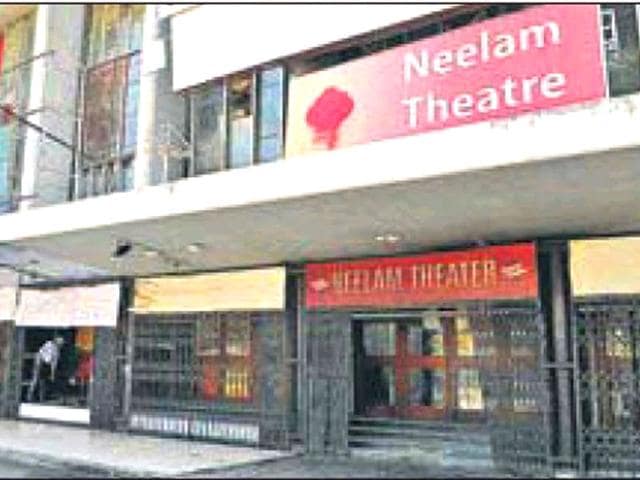
Neelam Theatre building ‘misuse’: Shops found closed a day after inspection
A day after an inspection by estate office officials underlined it as misuse of premises, three makeshift shops and at least two shacks selling eatables from the Neelam Theatre building in Sector 17 were found closed voluntarily.
A day after an inspection by estate office officials underlined it as misuse of premises, three makeshift shops and at least two shacks selling eatables from the Neelam Theatre building in Sector 17 were found closed voluntarily. But officials said the violations could not be seen as having ceased completely since the shops still existed, and so did other violations, including misuse of advertisement panels and non-permitted openings in the building.
As for the show-cause notice that had been drafted already on Tuesday, it wasn’t immediately clear if it had been issued yet or not. “We had told the owners orally to remove the violations by Tuesday evening. That, of course, was not done, so a showcause notice is the next step,” said an official who refused to be named.
Land acquisition officer Tilak Raj, who is to issue the notice, did not respond to calls and messages. The theatre is owned by Punjab minister and senior Shiromani Akali Dal leader Adeish Partap Singh Kairon.
The inspection on Tuesday was conducted by an estate office team. The shops right at the front of the theatre are essentially sub-units that are not permitted as per rules.
{{^htLoading}} {{/htLoading}}
{{^usCountry}}
The owners stare at a misuse fine of Rs 500 per square feet per day. It must be noted, however, that there is already a wider legal challenge to the misuse fine amount having been hiked some years ago from Rs 10 per sq ft per day. It is contended that the UT authorities cannot hike the amount without an amendment in the relevant law by Parliament. Around 2,000 misuse notices are already hanging fire due to the controversy over the fine amount.
{{/usCountry}}
{{#usCountry}}
The owners stare at a misuse fine of Rs 500 per square feet per day. It must be noted, however, that there is already a wider legal challenge to the misuse fine amount having been hiked some years ago from Rs 10 per sq ft per day. It is contended that the UT authorities cannot hike the amount without an amendment in the relevant law by Parliament. Around 2,000 misuse notices are already hanging fire due to the controversy over the fine amount.
{{/usCountry}}
Action on the theatre came on a “specific complaint”, said an official. For now, the notice talks of misuse of over 1,900 sq feet expressly.
Aarish Chhabra is an Associate Editor with the Hindustan Times online team, writing news reports and explanatory articles, besides overseeing coverage for the website. His career spans nearly two decades across India's most respected newsrooms in print, digital, and broadcast. He has reported, written, and edited across formats — from breaking news and live election coverage, to analytical long-reads and cultural commentary — building a body of work that reflects both editorial rigour and a deep curiosity about the society he writes for.
Aarish studied English literature, sociology and history, besides journalism, at Panjab University, Chandigarh, and started his career in that city, eventually moving to Delhi. He is also the author of ‘The Big Small Town: How Life Looks from Chandigarh’, a collection of critical essays originally serialised as a weekly column in the Hindustan Times, examining the culture and politics of a city that is far more than its famous architecture — and, in doing so, holding up a mirror to modern India. In stints at the BBC, The Indian Express, NDTV, and Jagran New Media, he worked across formats and languages; mainly English, also Hindi and Punjabi. He was part of the crack team for the BBC Explainer project replicated across the world by the broadcaster. At Jagran, he developed editorial guides and trained journalists on integrity and content quality. He has also worked at the intersection of journalism and education. At the Indian School of Business (ISB), Hyderabad, he developed a website that simplified academic research in management. At Bennett University's Times School of Media in Noida, he taught students the craft of digital journalism: from newsgathering and writing, to social media strategy and video storytelling. Having moved from a small town to a bigger town to a mega city for education and work, his intellectual passions lie at the intersection of society, politics, and popular culture — a perspective that informs both his writing and his view of the world. When not working, he is constantly reading long-form journalism or watching brainrot content, sometimes both at the same time.