
 E-Paper



Ahead of earning season, lockdown slugs potters’ wheel into slow motion
Artisans worry of losing the entire summer, during which they do maximum business in a year, amid the extension of restrictions


Lali was only a teenager when she migrated from Haryana with her husband to ferry soil on their donkeys from the excavated area at the Capitol Complex in Chandigarh, where Le Corbusier designed the iconic buildings like the Punjab & Haryana high court, assembly and secretariat.
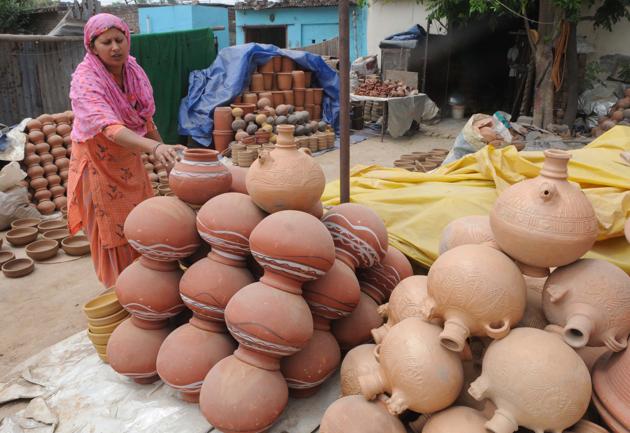
Seen the ‘City Beautiful’ being built from a scratch, Lali, along with other potter families from her home state, decided to stay back and start a new life here. These potters were settled in the Kumhar Colony in Sector 25 and later 50 more were allocated land at the western corner of the city, New Kumhar Complex in Maloya, Sector 39.
For the first time in the seven decades of being in Chandigarh, is Lali seeing the potter’s wheel move in slow motion and worries that the lockdown might put brakes on it ahead of their earning season — mid March to June. In this duration, potters earn enough money to for six to seven months.
“Potters work mainly five-to-six months in a year – three to four months in summer and then two months around Diwali – and for the rest part, they live off the money earned during the said time. Now because of the lockdown, potters are unable to sell their products. This time, earthen pots for plants were in great demand and if the lockdown continues, no potter is going to make any money and will be forced to wait for Diwali to make a living,” says Lali, who is in her eighties and but doesn’t know her exact age. “My son Randhir makes the pots and other earthen products, and I used to sell them on a roadside.”
The settlement of potters in Chandigarh is the largest in the region and apart from the Tricity, they sell their products in parts of Punjab, Haryana and Himachal. There are over 60 families, fulltime into the pottery business, residing at the New Kumhar Complex in Maloya. They mainly make earthen pots besides piggy banks and ewers (pitchers) during the summer season. Around Diwali, they make most earning by selling diyas and other small products. In the Sector 25 complex, over 50 families are in the potter business who make and diyas throughout the year.
“In summer, my wife and son make products that fetch us around ₹1.25- ₹1.5 lakh in the wholesale market. Deducting raw material and other costs, we make enough to survive for six-seven months. If the lockdown is not lifted soon, we will lose our entire earning season and face unprecedented losses. The small potters might have to borrow money to make ends meet,” says Ved Prakash, 46, whose family hails from Koka Kulana in Jhajjar.
“As the school dropout rate is quite high in our community, youngsters hardly get any job elsewhere and they are forced to stay in the family profession. Day-by-day the scope for pottery business is shrinking, so we can’t expect a good life from this line of work,” says Ved Prakash’s son Umesh, who left studies after Class 12 and doubles up as a part-time instructor in a small gymnasium in Maloya. “There is not much awareness about coronavirus in our area, and social distancing is not practiced much,” he reveals.
The lockdown has also halted the supply of clayey soil, which is used to make earthen pots and other products. The soil (clayey) comes from Punjab.
“With whatever soil stock is left with us, we are making earthen pots out of it and storing the finished products in a hope that things will be normalised very soon and we will be able to sell them in the market,” says Ishwar Singh, 48, whose father came to Chandigarh in 1952 from his native village Mangleshwar Majri in Rewari.


