It’s been around a year since rooftop solar panels were installed at government schools in Mohali district, but around 45% of these are yet to become functional. The reason: These cannot be connected with the power supply lines of Punjab State Power Corporation Limited (PSPCL) due to pending electricity bills to the tune of around ₹18 lakh.
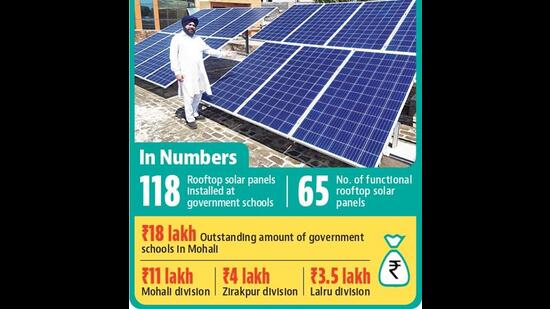
As many as 118 photovoltaic (solar) panels were installed on the rooftops of schools in two phases at a cost of around ₹6 crore. Only 65 of these are functional as of now. The panels were installed by the Punjab Energy Development Agency (PEDA) under the on-grid solar net metering project scheme.
PSPCL’s Mohali circle superintending engineer Ashwani Kumar said, “Government schools have not cleared the outstanding amount of nearly ₹18 lakh. We cannot give them new connections unless they clear their dues.”
PEDA chief executive officer Sumeet Jarangal, said, “I have called a meeting with PSPCL officials on August 1 and hope that the issue will be sorted out soon.”
Mohali district education officer Sushil Nath said, “I am not aware of the issue, but will check on this.”
Former MC councillor of Mataur, Harpal Singh Channa said, “Solar panels of 7 KV each were installed a year ago at government primary and high schools at Mataur, but so far PSPCL has not given us the connections. In one year, we could have saved so much electricity.”
{{/usCountry}}Former MC councillor of Mataur, Harpal Singh Channa said, “Solar panels of 7 KV each were installed a year ago at government primary and high schools at Mataur, but so far PSPCL has not given us the connections. In one year, we could have saved so much electricity.”
{{/usCountry}}In a move to make government schools smarter and reduce power consumption and electricity cost, the state government had set up solar energy projects in around 3,214 schools at a cost of around ₹98 crore. It was planned that excess solar energy generated by schools can be transferred back to the grid via net metering, thereby enabling the schools to earn revenue and plough back such revenue for effective schooling. Installing solar panels enables schools to run on eco-friendly energy while also reducing electricity bills of schools. Solar energy is stable and comparatively economical as compared to other sources of energy.