Having suffered repeated losses from failed cotton crops over the past four years, a group of farmers in two agriculture blocks of Bathinda are now pinning their hopes on groundnut cultivation as an alternative kharif crop.
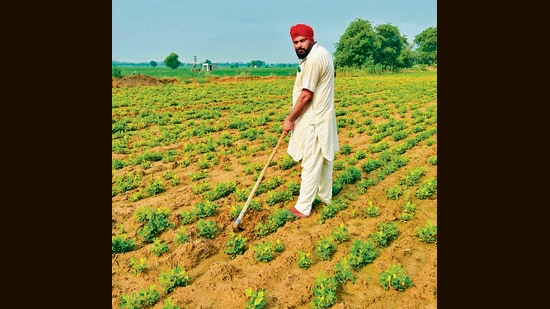
Encouraged by the state agriculture department, even paddy growers have adopted it on a small scale, hopeful of finding an alternative to the water-guzzling crop.
An acre needs around 30 kg of groundnut seeds, with the fields requiring only 3-4 cycles of irrigation through the crop’s growth cycle, compared to cotton’s 10 to 14 and paddy’s 25 to 30, experts said. The growing duration is also shorter at 105 to 120 days, while cotton takes up to 180 days and paddy up to 140.
The average yield of the groundnut crop is 7-10 quintals per acre. While the per-acre cost is pegged at around ₹8,000 from sowing to manual harvesting, it brings in up to ₹20,000 in returns — yielding 2.5 times the investment.
Kewal Singh from Dikh village, who attempted groundnut farming for the first time this year, said since 2022, the cotton yield had dropped drastically due to pink bollworm, whitefly infestations and erratic weather. Thus, distressed farmers were looking for an alternative to revive their incomes.
{{/usCountry}}Kewal Singh from Dikh village, who attempted groundnut farming for the first time this year, said since 2022, the cotton yield had dropped drastically due to pink bollworm, whitefly infestations and erratic weather. Thus, distressed farmers were looking for an alternative to revive their incomes.
{{/usCountry}}“Last year, I cultivated guar or cluster bean, but the results were unsatisfactory due to marketing challenges. I learnt about groundnut cultivation from agriculture department officials, and my field work informed me that it can be an ideal crop for the semi-arid (partially dry) region,” he said.
Bathinda chief agriculture officer Harpreet Kaur said the initiative was introduced under the guidance of Punjab Agricultural University, Ludhiana.
“We have provided farmers with the G40 variety, which is suitable for the semi-arid districts of southern Punjab. Groundnut has the potential to replace water-guzzling rice and cotton growers can also shift to this legume as the cotton cash crop is going through a rough phase,” she said.
Another farmer, Harvinder Singh, sowed the kharif crop late by three months in the first week of July, but he is happy with the plants’ growth.
“I had been sowing cotton and paddy. While cotton is no longer an economically viable crop, I have seen that paddy requires almost 10 times more water than groundnut fields. This crop can be used for non-oil extraction purposes during the winter season and local traders can buy the crop,” he said, adding that the government should ensure its purchase.
After sowing groundnut on 2 acres in 2025, Gurbaz Singh, a resident of Kuttiwal Khurd, has now enhanced cultivation to 3.5 acres this kharif season.
He said around 15 years ago, a few farmers in the Maur block cultivated groundnut, but everyone switched to paddy when the irrigation network in the Malwa region strengthened.
“I tried cultivating groundnut in the last season after a gap of about a decade. I recorded a yield of 7 quintals from an acre and earned around ₹22,000 after selling the produce in the local market. The most impressive part is its minuscule water requirement, which is crucial for natural resource conservation in a sizeable part of the state,” he said.