Once packed with students, the falling enrolment in schools in exile is turning out to be a major challenge for the exiled Tibetan community, with no new arrivals from Tibet.
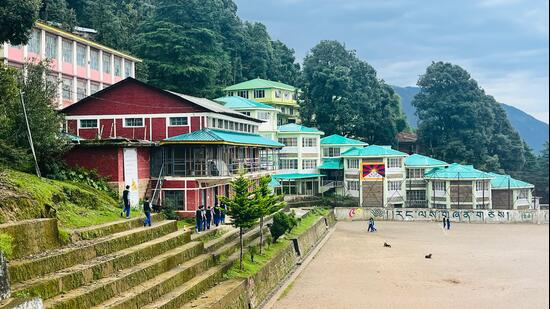
In recent years, the influx of Tibetans from Tibet has dwindled drastically, and for the past two years, no new student from Tibet has been admitted to Tibetan Children’s Village (TCV) schools. TCV is the largest Tibetan body of schools in exile and has residential schools in different states, including four in Himachal Pradesh.
Total student enrolment across Tibetan exile institutions has dropped sharply over the past years. According to TCV officials, the number of students in TCV schools has fallen to around 5,000 at present, compared with around 10,000 in the 2010s.
Overall enrolment in Tibetan exile schools has dropped from over 23,000 students in 2012 to roughly 13,000 now, which includes more than 60% Tibetans. The department of education of central tibetan administration (CTA) currently oversees around 60 Tibetan schools in India and Nepal under different autonomous administrative bodies including TCV, Sambhota Tibetan Schools Society, Tibetan Homes Foundation, and Snow Lion Foundation.
Exiled Tibetan officials attribute the decline to the decreasing influx of Tibetans arriving from Tibet, the migration of Tibetans abroad and the declining birth rate in the community. Strict border controls and security measures by China, especially after 2008 protests, have also stopped the flow of children who once crossed into India to study.
{{/usCountry}}Exiled Tibetan officials attribute the decline to the decreasing influx of Tibetans arriving from Tibet, the migration of Tibetans abroad and the declining birth rate in the community. Strict border controls and security measures by China, especially after 2008 protests, have also stopped the flow of children who once crossed into India to study.
{{/usCountry}}Looking for viability of merging schools
The exiled Tibetan government has in recent years been looking at the viability of merging and consolidating the schools in view of the dwindling number of Tibetan students. Tibetan political leader, Sikyong Penpa Tsering, said, “We started discussing this a few years ago with the schools, and the agreement at the time was that the schools would try to integrate (internally by schools). Now, I think we have reached a stage where we have to look at the overall situation. There is also a very low birth rate among Tibetans, which contributes to this.”
“We will have to look at the reality of new births and assess how things will shape up over the next 10-15 years. We need to see how we can integrate the schools to sustain ourselves because, while the administrative costs remain the same or increase, the number of students declines. This needs to be consolidated,” he said, adding that in the future, they will have to consolidate or merge schools as there is no choice.
As the number of students go down, TCV has in recent years restructured some of its schools. TCV Suja, located at Bir in Baijnath tehsil, was restructured a few years ago. The 2021-22 academic session was the last batch for Class 12 at TCV Suja, which now caters only up to Class 10.
TCV lower Dharamshala, was established at a time when upper TCV was undergoing its worst period of overcrowding. The school, which was opened in 1984, was also restructured in recent years and finally closed in December 2024, with its students, staff and teachers transferred to other TCV schools.
Kalsang Phuntsok, general secretary (external relations), TCV, said, “The Tibetans coming from Tibet have come to a complete halt. There has been a continuous decline in students in recent years. It is a major problem that we have to face. We are consolidating because there is no other way. But we are doing it more strategically and in a phased-manner because there are so many stakeholders. We cannot handle, say, 200 students in a school; that is financially unviable for us as a charitable organisation. We have to increase our birth rate. For that to happen, a policy change needs to be made by the government-in-exile.”
Caring for orphaned Tibetan refugee children became priority
Following China’s occupation of Tibet and the 14th Dalai Lama’s arrival in India in 1959, caring for orphaned and separated Tibetan refugee children became an urgent priority. The Dalai Lama proposed establishing a centre for destitute children in Dharamshala.
On May 17, 1960, 51 sick and malnourished children arrived from road construction camps in Jammu. The Dalai Lama’s elder sister, Tsering Dolma Takla, volunteered to care for them. The centre was initially called the nursery for Tibetan refugee children. The nursery expanded into a residential school and community, and in 1972, it was formally registered as the TCV.
TCV later expanded beyond Himachal Pradesh, establishing TCV Ladakh in 1975 and TCV Bylakuppe in 1980. A fresh influx of children from Tibet in the 1980s created further overcrowding, prompting the establishment of TCV Lower Dharamsala and, in 1990, expansion into Bir. A senior secondary school was subsequently established at Gopalpur to accommodate the growing number of Tibetan children.
The situation at the Sambhota Tibetan Schools Society, which runs around 33 schools across India with approximately 5,000 students, also remains the same.
Sambhota Tibetan School Chauntra in Mandi district, which was founded in 1978 to provide elementary education to Tibetan children in the area, has also been restructured. The school, which had been operating as a secondary school in recent years, now operates as a primary school since the 2026 academic session, with middle and secondary classes shifted to other nearby schools.
“We are facing the same problem as in other exile Tibetan schools. Depending upon the student trend in the schools, we are working on merging and consolidation. We are restructuring as well, wherever we feel the need. We may have to do it in the coming years as well, depending upon the enrolment trend,” said Tenzin Dorjee, deputy director (administration) at Sambhota Tibetan Schools Society.
“We analyse the numbers and apprise the matter to the education department and, based on the facts, we take the appropriate decision,” he added.