Tucked away in the snow-clad Himalayas with the Ravi and Chenab rivers meandering through its beautiful landscapes, Chamba, an erstwhile princely state, has a rich heritage of art and craft. Metal casting is one such matchless art form with its origin in the 10th century when King Sahil Verman shifted his capital from Brahmpur (present day Bharmour) to Chamba.
Believed to have been introduced by Kashmiri artisans, the metal craft, which showcases relics of Chamba’s past, stares at an uncertain future. Once a source of livelihood for thousands, this unique skill is waning fast with only two families left in the business today.
Ankit Verma, whose family has been into metal crafting for centuries, says the intricate art passed down generations requires years of practice. “We usually make idols and Mohra mask of deities, folk musical instruments and vessels. Chamba Thaal, a brass plate used for rituals, which was introduced only 40 years ago, is now representative of Chamba’s metal craft,” says the young artist. “However, there are few takers for this art today and it may soon fade away if steps are not taken to promote it,” he adds.
Livelihood gains primacy over art
{{/usCountry}}Livelihood gains primacy over art
{{/usCountry}}The new generation has shown little interest in picking up metal casting and is exploring other career options for a secure livelihood. “It takes long to master this art and needs big investment. Also, there is lack of knowledge about its value in terms of our cultural legacy,” Verma says.
He believes the craft stands a chance if introduced in schools and taught in institutes of fine art to encourage youngsters to take it up as a profession.
Moulding idols, crafting legacy
Making Chamba metal artefacts involves two techniques: The lost-wax method (cire perdue) and sand casting.
Cire perdue involves making a wax model (a sculpture), coating it with a refractory (clay) to form a mould. The wax is heated until it melts and runs out of small holes left in the mould, and then pouring metal into the space left vacant. Each artefact made using the lost-wax technique is unique and a masterpiece.
Sand casting is used for mass production.
Vijay Sharma, a Padma Shri awardee for Kangra miniature painting and a researcher, says statues in Bharmour and Chamba temples are marvels of Chamba metal craft. The beautiful craft is also seen in the form of metal casting on walls and door frames of temples.
“Of late, the art has lost favour due to lack of promotion and a marketing platform,” he says.
Glorious past, uncertain future
Another artist, Himanshu Anand, says his grandfather won a national award for metal craft in 1973, while his father Rajesh Anand’s works have been showcased in foreign museums, including in the US. “We need an apt platform for our products. Earlier, there was a government procurement centre in Chamba, but it shut shop a few years ago,” he says.
“In a technology-run and industrialised era, people are forgetting traditional crafts and moving towards machine-made artefacts that are cheaper. The younger generation of artisans’ families are also giving up the art for want of a secure livelihood,” he says.
Amid the gloom, a ray of hope
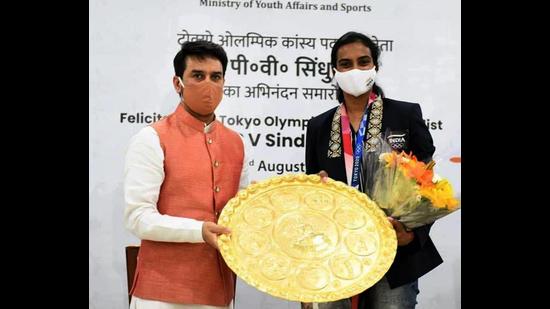
There is still a ray of hope as the Chamba Thaal, the decorative premium brass plate with vibrant images of gods and goddesses, such as the 10 incarnations of Vishnu and nine incarnations of Goddess Durga, is gaining popularity as a keepsake from Chamba.
Surender Thakur, who is in-charge of Chamba’s Bhuri Singh Museum, says Union sports minister Anurag Thakur presented the Chamba Thaal as a souvenir to Tokyo Olympic medal winners Mirabai Chanu and PV Sindhu recently. “This will help promote Chamba art at the national and international levels,” he says.
The district administration recently constituted the Chamba Art and Craft Promotion Society to prop up Chamba art. Society adviser Manuj Sharma says the Union sports ministry has requisitioned more Chamba Thaal to felicitate the hockey teams and other medal winners.