Inadequate drainage capacity, solid waste blocking road gullies and the overflowing N-choe were among the factors that left almost the entire Chandigarh inundated after 72.4 mm of rain in two hours on Tuesday evening. The waterlogging, which was more than three feet deep at some places, brought the city to a standstill, flooding roads, markets and houses and leaving commuters stranded for hours. Social media platforms were flooded with residents’ woes. Rainwater entered houses in Sector 16 and also the mobile shops in the basement of Sector 22, damaging phones and cameras. It laid bare the tall claims of the Municipal Corporation and the city administration regarding monsoon preparedness and exposed chinks in the drainage system.
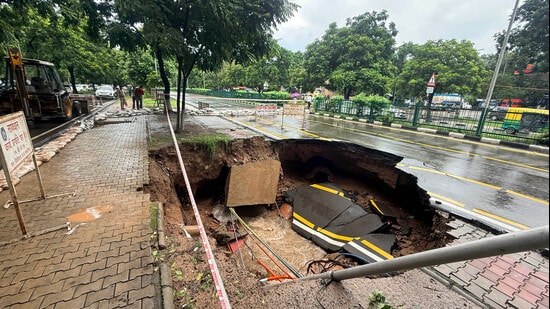
A road cave-in on Madhya Marg, caused by a burst stormwater drainage pipeline, is being seen as the result of a poor audit of underground infrastructure.
The drainage system, designed in the 1950s when the city came into being, has not seen any significant upgrade. The stormwater system has been designed to handle around 15 mm of rain per hour in the northern sectors and 20 mm per hour in the southern sectors. Tuesday’s 72.4 mm of rain in two hours works out to an average of about 36.2 mm per hour—substantially above those design figures.
The stormwater system is designed to channel rainwater into natural drainage channels, known as choes, including the N-choe. The N-choe—one of the main stormwater carriers in the city—was already running near saturation due to heavy rainfall, reducing the city’s drainage capacity. As a result, several northern sectors experienced severe waterlogging. Low-lying areas saw an accumulation of rainwater as storm inflows exceeded the carrying capacity of the choe system.
Choes blocked, says Joshi
{{/usCountry}}Choes blocked, says Joshi
{{/usCountry}}The MC is responsible for cleaning 30,452 road gullies ahead of the monsoon. Even as officials confirmed that road gullies had been cleared, a number of councillors, representatives of resident welfare associations (RWAs) and residents said the gullies are generally cleaned only on paper. “The road gullies are not cleaned properly. This is the main reason behind waterlogging,” said Gurpreet Singh Gabi, Congress councillor and leader of the opposition in the MC House.
Gabi also said the transfer of V3 roads from the MC to the UT administration last year was costing residents heavily. “Most of the waterlogged roads on Tuesday were V3 roads. The administration took the roads from the MC but failed to maintain them,” he said.
The MC was quick to blame the administration. Mayor Saurabh Joshi said the choes maintained by the administration were not cleaned properly. “Portions of the N-choe were found blocked, creating a situation where water was not drained properly,” he said.
Drainage burst behind Madhya Marg cave-in
The Madhya Marg cave-in was triggered by a burst stormwater drainage pipeline running parallel to the road, initial findings by the MC indicated. The rupture, aggravated by intense rainfall, led to continuous leakage of water into the surrounding soil.
“The escaping water caused severe soil erosion beneath the roadside edge, gradually washing away the supporting earth and forming an underground cavity. As the sub-base weakened, the surface layer collapsed, resulting in the incident,” said UT chief engineer CB Ojha.
Mukesh Anand, a former chief engineer, noted that underground infrastructure issues typically arise due to a combination of pipe leakage or bursting, soil scouring and ineffective drainage through road gullies. “Underground issues are difficult to detect in advance,” he said.
Pre-audit must: ex-chief engineer
According to former chief engineer Mukesh Anand, a mandatory pre-audit system for underground utilities is required before and after road construction. Key recommendations include mapping all underground services, including water, sewer and drainage lines; inspecting leakage-prone joints and pipe integrity; carrying out routine maintenance and preventive checks; desilting and fully cleaning road gullies before the monsoon; and ensuring proper evacuation of stormwater through connected channels.
Calling for thorough cleaning of road gullies, Anand said that failing to do so prevents proper drainage and thus increases surface and subsurface water pressure during heavy rainfall.
Clean waterlogged stretches: Kataria to officials
UT Administrator Gulab Chand Kataria directed the administration, the MC and the engineering department to take urgent and coordinated action while underscoring Tuesday’s waterlogging and the cave-in on Madhya Marg. The administrator also conducted an extensive ground visit across multiple affected parts of the city in a CTU bus. He directed officials to ensure immediate clearance of waterlogged stretches, removal of fallen trees and branches, and swift repair of damaged infrastructure.
Uproar in finance panel meet
No agenda was passed during the MC’s Finance and Contract Committee (F&CC) meeting, which had to be adjourned amid heated exchanges between councillors and MC officials over waterlogging on Wednesday. Joshi said that during Tuesday’s rain, QRT teams were found to be inactive on the ground in several areas. While two BJP councillors brought table agendas, opposition councillors walked out. “They could have listed their agendas earlier with the main agendas. We did not agree to the discussion,” AAP councillor Yogesh Dhingra said.