For the third year in a row, Dakshin Marg continues to be the most dangerous road in the city, according to the Road Safety in Chandigarh 2020 report released by the traffic police.
As per the reports’ findings, the number of fatalities halved between 2019 and 2020, and the number of black spots also went down from 14 to four.
However, all four of these spots are situated on Dakshin Marg, one after the other on National Highway-5, going from Tribune Chowk towards Zirakpur, and covering a length of around 5km.
Starting from the Sectors 25/38 light point in the west, Dakshin Marg traverses the whole width of the city, before ending at the road connecting to the Zirakpur-Ambala highway.
The Union ministry of road transport and highways defines black spots as a road stretch of about 500m where either five road crashes, involving fatalities and grievous injuries, or 10 fatalities took place during the last three years.
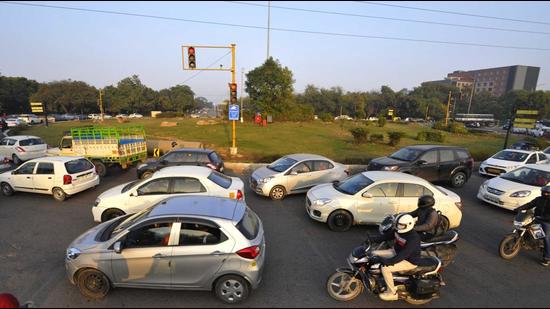
Among these four black spots, Tribune Chowk was the most dangerous with seven fatal accidents.
{{/usCountry}}Among these four black spots, Tribune Chowk was the most dangerous with seven fatal accidents.
{{/usCountry}}The other three – Airport light point, Poultry Farm Chowk and Hallomajra light point – saw six fatal accidents each. All these four points were also among the 14 black spots identified in Chandigarh in 2019.
Punjab traffic adviser Navdeep Asija, whose team also worked on this report, said, “Data shows that the Sector 32 GMCH Chowk, on the same stretch of Dakshin Marg, has continued to remain without fatal accidents, but the four intersections after it are all black spots. This is because of the presence of speed tables on this intersection, which forces vehicles to stop. Rather than looking at flashy solutions, like the Tribune flyover, which will lead to further problems, simple traffic control mechanisms like this are needed to control traffic at Tribune Chowk.”
According to a recent daily traffic flow study by the administration, as many as 1,43,170 vehicles, including 1,35,805 passenger car units, ply via Tribune Chowk over 16 hours.
Six vulnerable stretches also identified
The traffic police also identified six vulnerable stretches in the city, which don’t meet the criteria for black spots, but still have seen numerous accidents, both fatal and non-fatal. Most of these were earlier black spots.
Among these, three spots – the Sector 46/47-48/49 light point, Transport light point and Railway Station light point, had 10 crashes each, including a total of 10 fatalities.
As many as nine accidents took place at the Kalagram and Sector 25/38 light point, with loss of nine lives, while six crashes were reported at the Sector 16/23 small roundabout, where four people died.
Speaking about this, member of National Road Safety Council, Kamaljeet Singh Soi said, “Vulnerable spots are also important as commuters are at risk of accidents here. The authorities must conduct studies to prevent these areas from turning into black spots.”
Meanwhile, the traffic police have increased deployment around black spots to manage the traffic in a better manner.
Senior superintendent of police (SSP, Traffic) Manisha Choudhary said, “The road accident analysis cell of the Children’s Traffic Park visits every accident spot to find out why the mishaps happened and suggests corrective action. Night nakas are also set up in accident-prone areas.”