Former Haryana IAS officer, Ashok Khemka has sought an inquiry by an independent investigating agency into the orders passed by revenue authorities in a matter related to ownership of a 15 acre high valued disputed chunk in Panchkula’s chowki village.
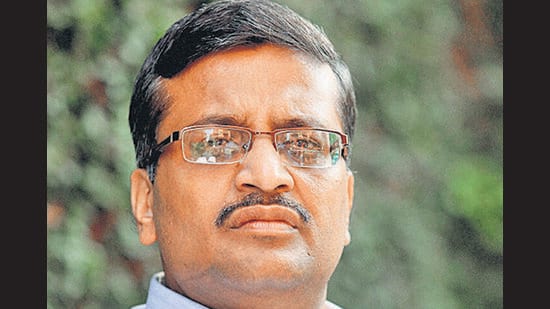
In an August 25 communication to Haryana chief minister Nayab Singh Saini, the former IAS officer has sought a review of the orders that declared the land recorded as shamlat deh (village commons) to be the private property of Polo Hotels Limited. He urged the government to take steps to protect the land.
The court of the Panchkula district collector in its January 16, 2024 order had recognised Polo Hotels Ltd and its director Abhey Ram Dahiya as the owners of about 15 acres and held that the disputed land was not an asset of gram panchayat Chowki and therefore could not have vested in the municipal corporation (MC). The Ambala divisional commissioner on May 13, 2026 affirmed the orders of district collector while hearing an appeal by Panchkula MC.
‘This is not the statutory test’
{{/usCountry}}‘This is not the statutory test’
{{/usCountry}}In his communication, Khemka said the collector reasoned from entries in the possession column of jamabandi of 1942-43 and later years showing named proprietors recorded against fractional shares. “That is not the statutory test. Section 2(g)(viii) requires three things cumulatively: that the land was shamlat deh, that it was assessed to land revenue, and that it was in the individual cultivating possession of co-sharers not exceeding their respective shares on or before January 26, 1950. A recorded fractional share in an unpartitioned khewat is evidence of the third condition’s absence. No partition instrument, no partition proceeding, and no order of partition appeared anywhere in the exhibit list,” he wrote.
‘Jamabandis from 1962 to 1975 missing’
The former officer said the record itself disclosed that after the 1942-43 jamabandi, no further jamabandi was prepared before January 26, 1950 and the jamabandis from 1962-63 to 1974-75 are missing from the record room. The statutory question is what was the position on the crucial date. It was answered by presumption drawn backwards from 1942-43 and forwards from 1951-52. A presumption is not proof, least of all where the burden lies on the party invoking it, he said.
Khemka said that having served Haryana as financial commissioner for over nine years, he was writing in that spirit and with no interest in this matter beyond the public one. “A decree has been passed and affirmed on appeal, which transfers roughly 15 acres of prime land in Sector 32, Panchkula out of the public domain and into private hands. On the material I have been able to examine, that decree rests on a legal premise which the Punjab and Haryana high court had rejected in a long and unbroken line of division bench and full bench authority well before it was passed, and which the Supreme Court (SC) has now conclusively repudiated,’’ he said.
“I place the matter before you because the remedy is still open, but it will not remain open indefinitely, and because every month of delay makes restitution harder and third party equities heavier,’’ the former officer said.
The apex court in August 2026 had ruled that mere proof of pre 1950 possession by village proprietors was not enough to take the shamlat deh land out of the purview of the Punjab Village Common Land (regulation) Act. Officials said the judgment will potentially affect the ownership claims of Polo Hotels Ltd over 15 acres.
The former IAS officer wrote the Panchkula MC assisted by development and panchayats and urban local bodies departments should immediately institute revision proceedings under Section 13AA(2) of the Punjab Village Common Lands (Regulation) Act, 1961 before the Financial Commissioner against the May 13 divisional commissioner’s order and collector’s decree of January 16, 2024.
“The sharat-wajib-ul-arz (revenue record) of the village be obtained alongwith with all available jamabandis and documents. Director, land records be directed to prepare an authenticated correlation statement mapping the pre-consolidation khasra numbers relied upon to the present khasra numbers 68/5/2, 69 and 73/3, so that the identity of the land is established one way or the other,’’ he wrote.
‘CLU be kept in abeyance pending decision’
The former officer said that pending decision in revision, no further transfer, alienation, mortgage, sub division, licence, construction, development or creation of third-party rights be permitted for this land and town and country planning director be directed to keep the change of land use and other approval and in abeyance.
Khemka said the collector, Panchkula, should be directed to obtain an official valuation of the land at prevailing market rates and an inquiry should be instituted by an independent investigative agency, preferably the CBI into the conduct of the defence in this matter.