Punjab recorded 50 fresh stubble burning incidents taking the cumulative tally to 454 as of October 21, surpassing the 415 cases reported during the corresponding period last year, according to data from the Punjab Pollution Control Board (PPCB). The state recorded 5,114 farm fires during the entire paddy harvesting season last year.
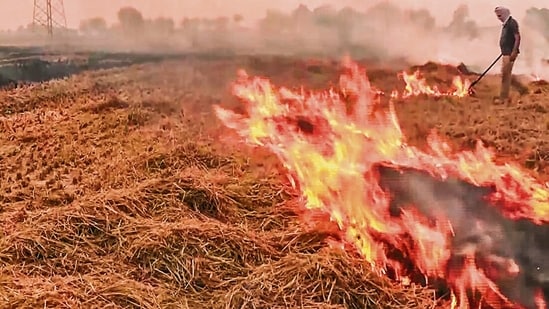
The annual farm fire monitoring period begins on September 15, two weeks before paddy procurement starts on October 1.
Stubble burning deteriorates air quality
Tarn Taran has emerged as the worst-affected district, accounting for 218 of the 454 incidents, nearly half of the state’s total. Amritsar followed with 125 cases, while Gurdaspur and Ferozepur reported 28 and 23 incidents, respectively.
Most fires have been reported from districts where early-maturing paddy varieties were cultivated. Harvesting has only recently begun in several other areas. According to the PPCB data, 83% of the paddy crop has already been harvested in Amritsar and 73% in Tarn Taran.
Stubble burning in Punjab and Haryana is among the factors contributing to the seasonal deterioration in air quality across the National Capital Region (NCR), particularly during October and November. With a narrow window between paddy harvesting and wheat sowing, farmers often burn crop residue to clear their fields quickly for the next crop.
Agriculture experts expect farm fires to peak in the first week of November as farmers race to complete harvesting and prepare their fields for wheat sowing before the November 15 deadline. Timely sowing is also considered important for achieving optimum wheat yields.
Authorities monitor farmer's activity
{{/usCountry}}Agriculture experts expect farm fires to peak in the first week of November as farmers race to complete harvesting and prepare their fields for wheat sowing before the November 15 deadline. Timely sowing is also considered important for achieving optimum wheat yields.
Authorities monitor farmer's activity
{{/usCountry}}Punjab cultivates paddy across approximately 31 lakh hectares, generating nearly 19.5 million tonnes of straw annually. Harvesting generally begins in mid-September and continues until the end of November. Unlike wheat straw, paddy residue has limited traditional uses on farms, making its management challenging within the short interval between the two crops.
State nodal officer at the PPCB Rajeev Gupta said enforcement teams were working round the clock to curb the practice. “Our teams are on the ground working 24x7. We urge farmers to adopt in-situ or ex-situ management of stubble instead of burning it,” he said.
Farmer unions, however, argue that most farmers in Punjab are marginal or small landholders who cannot afford the machinery required for stubble management.
Also Read I How Punjab cop in anti-drone unit helped smugglers clear 24 drug deliveries
General secretary of the Bharatiya Kisan Union (Dakunda) Jagmohan Singh said managing stubble cost small farmers between ₹3,000 and ₹3,500 per acre, making the process financially unviable for many. “The government should provide an incentive of ₹100 per quintal of paddy to help farmers manage the straw. Those who continue burning stubble despite receiving the incentive should be punished,” he said.
Rising farm fires have coincided with deteriorating air quality across the state. Jalandhar’s air quality index (AQI) climbed to 198 on Wednesday from 130 on Sunday. Mandi Gobindgarh recorded an AQI of 177, while Bathinda’s AQI rose to 142 on October 21, according to the PPCB monitoring dashboard.
₹8-lakh fine imposed, 62 FIRs registered across state
Enforcement against stubble burning has been stepped up, although violations continue across several districts.
According to a Commission for Air Quality Management (CAQM) report, environmental compensation totalling ₹8.3 lakh has been imposed in 164 cases, of which ₹4.38 lakh has been recovered. Authorities have registered 62 FIRs under Section 223 of the Bharatiya Nyaya Sanhita (BNS) and made red entries in land records in 130 cases. Such entries restrict farmers’ ability to secure loans against, sell or mortgage their land.
Field teams inspected 401 locations, with physical verification confirming crop burning at 168 sites. Burning traces were also detected in two fields classified as non-accidental fire (non-AFL) cases.
In Tarn Taran, 28 FIRs have been registered and environmental compensation of ₹4.3 lakh has been imposed in 84 cases, recovering ₹1.8 lakh, while red entries were made in 84 cases. In Amritsar, authorities registered 11 FIRs, imposed ₹2.3 lakh in compensation and recovered ₹2.08 lakh. Red entries were made in 28 cases. The report also noted 193 warning or show-cause notices issued to nodal and supervisory officers.