In a year when the tourism industry was looking to bounce back from the pandemic’s aftermath, the flood fury has washed away hopes of the state’s hoteliers and other business owners.
Hotel occupancy, which climbed to nearly 90% in June, has now plummeted to less than 6%. With visitors further choosing offbeat destinations and turning to Kashmir, those employed by the industry in the state’s erstwhile tourist favourites to fend for themselves.
70, 000 tourist rescued
The unprecedented rainfall earlier this month had left thousands of tourists stranded in the rain-ravaged areas in Kullu, Lahaul-Spiti, Kinnaur and Mandi. Over 70,000 of them were evacuated, including 457 foreign nationals.
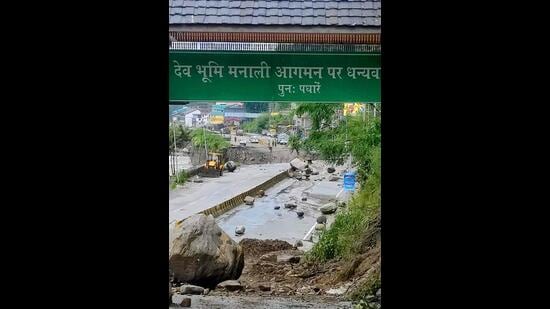
The lower area of the tourist town Manali, which witnesses heavy footfall throughout the year, was reduced to rubble. The flooding in Beas and its tributaries in Kullu snapped off-road connectivity to the town and other key tourist spots in the district.
Around 10,000 tourists were stuck in Kasol, a hamlet on the banks of the Parvati river popular with backpackers and foreign tourists, 30 km from Bhuntar. A swollen Parvati, meanwhile, has wreaked havoc along the banks.
{{/usCountry}}Around 10,000 tourists were stuck in Kasol, a hamlet on the banks of the Parvati river popular with backpackers and foreign tourists, 30 km from Bhuntar. A swollen Parvati, meanwhile, has wreaked havoc along the banks.
{{/usCountry}}The state government undertook special operations to evacuate stranded tourists, seeking help from National Disaster Response Force (NDRF) and Indian Air Force choppers were deployed to airlift visitors from high-altitude areas.
As many as 255 tourists were rescued from 14,100-ft high snow-laden Chandertal and it took rescue teams led by revenue minister Jagat Singh Negi and chief parliamentary secretary Sanjay Awasthi three days to reach the lake as they cut blocked roads.
A landslide of problems
Landslides and flash floods triggered by the heavy rainfall also washed away sections of highways across the state, snapping connectivity. “The broken roads came as a major jolt to our tourism business after Covid,” Manali Hotel and Restaurateurs Association president Anup Thakur said, adding, “We were just trying to recover from the effects of Covid-19, but have been hit hard by the rain and floods.”
Echoing the sentiments, Federation of Himachal Hotel and Restaurateurs Association president Gajender Thakur said, “It is a harsh truth that there is no business and hotel owners have sent their staff back home. The government should give relief to the tourism industry on GST and rebate in electricity.”
“Tourists have cancelled advance bookings and occupancy is nearly nil,” he rued.
The ₹25,000 crore tourism constitutes 7% of the state’s GDP and contributes around 14.42% of direct and indirect employment.
“The tourist footfall before the floods touched 1.6 crore. It was more than the pre-pandemic stage, now our hotels have an occupancy of 10% only,” said Himachal Pradesh Tourism Department Corporation managing director Amit Kashyap, who is also director of tourism.
The tourism department held conclaves in different states hoping for a boost. “We went with all-out aggressive marketing. There were states like Maharashtra and Gujarat from where hardly any tourist visited Himachal despite extensive promotion,“ Kashyap said, hoping that tourism will pick up after roads are restored.
This year, a total of ₹28.03 lakh tourists visited Himachal in June compared to 20.62 lakh last year. The numbers had remained low during the pandemic-hit years, with only 116 tourists visiting the state in June 2020, going up to 6 lakh in 2021.
Out of jobs
Loss losses is another major aspect of the falling tourist flow as Anil Thakur, the owner of a travel agency, noted, “Before the rains my company received scores of calls for advance booking, but the tourists have stopped calling now, there are hardly any inquiries. You cannot run a company on that.”
Similarly, Mahesh Sharma, a taxi driver from Kullu, said, “I used to earn about ₹1,000 daily. Now, there are no tourists and my car remained parked at home for days. I am worried about how I will fend for my family.”
The state has a total of 5,868 registered hotels and guest houses, 60 of which are being run by Himachal Tourism Corporation Comprising. The latter group has resorted to offering 50% discounts till September 15 in hopes of increasing occupancy.
“In the last ten days, all bookings have been cancelled. Shimla is the safest destination to travel, but the footfall is nil despite that,” Himachal Tourism Stakeholders Association resident Mohinder Seth said.
Hoteliers turn to government
Hotel owners, meanwhile, have urged the government to send daily updates on road conditions to dispel tourists’ concerns.
“It is not a revenue loss to just the tourism industry, but the government exchequer as well. It is requested that the government take up the matter with the Union finance minister and seek a special package for the tourism industry and give emergency working capital limits to the stakeholders of the tourism industry,” Seth said.
“We urge the government to also defer the payments of water, electricity and other taxes for three months. Similarly, the loan instalments of the hotels need to be deferred,” he added.
Taking note of the situation, chief minister Sukhvinder Singh Sukhu, meanwhile, said, “The losses to the state due to rains is tremendous. In a respite, not all the tourist places have suffered damages. Tourists are still to places which are not flood prone like Kangra, Dharamshala, Dalhousie, Chail, Kasauli and Narkanda.”