The National Green Tribunal (NGT) has directed the Punjab government to allocate ₹280 crore at the earliest to nine urban local bodies (ULBs) to mitigate groundwater contamination.
The NGT principal bench headed by chairperson justice Adarsh Kumar Goel also asked the state authorities to provide canal water supply to Fazilka villagers along the Pakistan border.
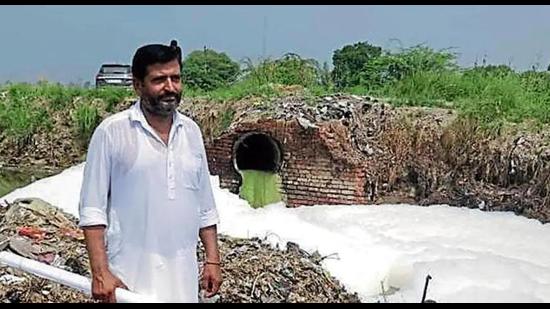
The NGT was hearing a petition filed by a farm rights activist from Fazilka, Vikram Ahuja, in July 2019 stating that untreated sewage of 21 municipalities of Punjab’s Malwa belt is flowing through drains into the district, resulting in contamination of groundwater in Fazilka villages.
These ULBs either lack STPs or work inefficiently and domestic and industrial effluents are thrown in drains that affect nearly 120 villages of Fazilka. Ahuja said drains continue to stink due to the discharge of untreated waste into them.
He said on Sunday that works undertaken by the state authorities to control the hazardous practice of discharging untreated municipal waste into the drainage networks is going on at a slow pace.
Nine municipalities of Fazilka, Ferozepur, Moga and Muktsar have submitted detailed project reports (DPRs) to the state government for laying of sewerage network, water supply schemes and installation of sewage treatment plants (STPs) as long-term measures for control of water pollution.
Nihal Singh Wala needs ₹49.13 crore, the highest among earmarked local bodies, and Fatehgarh Panjtoor municipality has the lowest requirement of ₹8 crore to check pollution.
{{/usCountry}}Nihal Singh Wala needs ₹49.13 crore, the highest among earmarked local bodies, and Fatehgarh Panjtoor municipality has the lowest requirement of ₹8 crore to check pollution.
{{/usCountry}}Accepting a report submitted by NGT’s state monitoring committee, the tribunal stated that to ensure transparency, Punjab should assure that data of sludge generated during the operation of STPs is maintained.
It directed deputy commissioners of Fazilka and Muktsar to ensure that STPs at Jalalabad and Muktsar towns are handed over to an expert agency, Punjab Water Supply and Sewerage Board for operation and maintenance (O&M).
It observed that in most of the STPs, the quantity of sludge generated during the operation of STP is not measured and no proper record is maintained for the same. Further, the disposal of sludge in an environmentally sound manner is not made by most of the ULBs.
“There is a need to maintain a record of operational hours of STPs, sludge generated per day and its disposal. Sludge should be used as manure. Also, state agencies should ensure regular payment to contractors for smooth operation and maintenance charges of STPs,” it observed.