The proposed desilting of the ecologically sensitive Harike Wetland has run into a regulatory hurdle, with the Punjab wildlife department objecting to any such activity within the sanctuary area.
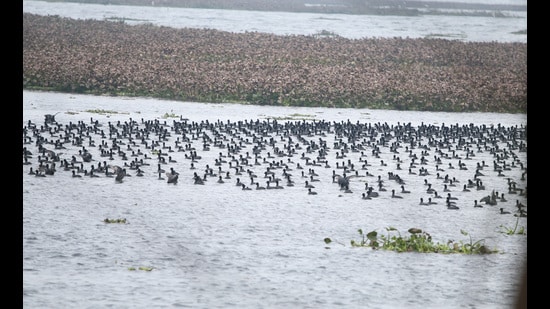
Recognised as a Ramsar site in 1990, Harike Wetland supports more than 390 bird species, including migratory waterfowl that arrive from Central Asia and the trans-Himalayan region during winter. Annual bird census data cited in the report indicates that the wetland attracts between 90,000 and 1.25 lakh migratory birds every year.
The State Technical Advisory Committee (STAC), which met on Tuesday, decided to forward the proposal to the National Board for Wildlife (NBWL) for consideration.
The proposal envisages desilting around 31 sq km of the wetland. The STAC, a high-powered committee constituted to scientifically vet, appraise and approve ecological interventions, desilting and sediment-management projects in Punjab, discussed various options for removing accumulated sediment from Harike.
Principal Secretary, Water Resources Department, Krishan Kumar, who chaired the meeting, said the state needed to explore viable options for desilting the wetland. He said the proposal would now be forwarded to the NBWL for consideration.
During the meeting, officials also discussed alternative mechanisms for disposing of the sediment removed from the wetland. The members noted that the National Green Tribunal (NGT) has stayed the revenue model for desilting, making it necessary to examine other options for the disposal of river material.
A wildlife department official pointed out that Harike is a protected site and, therefore, desilting could not be undertaken in the sanctuary area without the requisite regulatory clearances.
{{/usCountry}}A wildlife department official pointed out that Harike is a protected site and, therefore, desilting could not be undertaken in the sanctuary area without the requisite regulatory clearances.
{{/usCountry}}Spread across nearly 86 sq km in Tarn Taran, Kapurthala and Ferozepur districts, Harike Wetland was formed in 1952 following the construction of the Harike Barrage at the confluence of the Beas and Sutlej rivers. Developed originally to provide irrigation and drinking water to southern Punjab and Rajasthan, the wetland has evolved into one of north India’s most crucial freshwater ecosystems, supporting over one lakh migratory birds during winter and several threatened species, including the Indus river dolphin, smooth-coated otter and gharial.
Data forces rethink
Scientific assessments incorporated into the fresh proposal indicate that Harike has lost more than 83% of its original water-holding capacity due to heavy and unchecked siltation. Its open-water spread declined from nearly 40% in 1995 to just over 21% in 2017.
The deterioration has reportedly been compounded by agricultural encroachments along the wetland’s fringes, which, according to the assessment, have increased by around 150%.
The ecosystem is also facing mounting pollution pressures, with industrial effluents, urban sewage and agricultural runoff entering its feeder river systems. Pollution and nutrient enrichment have contributed to the proliferation of invasive water hyacinth, which has affected large stretches of the wetland and threatens aquatic biodiversity.
Engineering and ecological interventions
The revised blueprint proposes a combination of targeted engineering and ecological measures rather than relying solely on desilting. These include systematic removal of invasive weeds, habitat restoration and measures aimed at improving conditions for threatened species.
The strategy also seeks to integrate local economic activities with conservation measures to ensure the long-term sustainability of the wetland.