The Haryana government’s action against striking sanitation workers, including suspensions, terminations, FIRs and deployment of agency workers, has failed to break the prolonged agitation, with union leaders now threatening to intensify the stir unless the government implements the 17-point agreement reached with employees on May 13.
Nagar Palika Karmchari Sangh Haryana state president Naresh Shastri on Tuesday hit out at the government over its handling of the strike, accusing ministers of resorting to political theatrics instead of addressing the workers’ demands. He made it clear that the agitation will continue and the protesting sanitation workers to hold condolence meetings on September 9, followed by city-level Jan Nyaya Panchayats from September 10 to 12 and a state-level Jan Nyaya Panchayat in Kurukshetra on September 13.
Shastri claimed that 17 demands had been agreed upon on May 13 but had not been implemented. He said workers were seeking regularisation, an end to the contractor system, risk allowance and other demands. More than 10,000 sanitation workers are employed on contract in 87 cities, he claimed, alleging that contractors exploit workers and delay or deny wages.
He also rejected the government’s claim that the matter was pending before the Supreme Court, saying no regularisation policy had even been framed. “When there is no policy, who went to the Supreme Court?” he asked.
{{/usCountry}}He also rejected the government’s claim that the matter was pending before the Supreme Court, saying no regularisation policy had even been framed. “When there is no policy, who went to the Supreme Court?” he asked.
{{/usCountry}}Shastri said the government’s action had instead escalated the confrontation. He claimed 50 fire personnel had been terminated and around 500 contractual workers removed from municipal councils and corporations. He also alleged that cases were being registered against protesting workers.
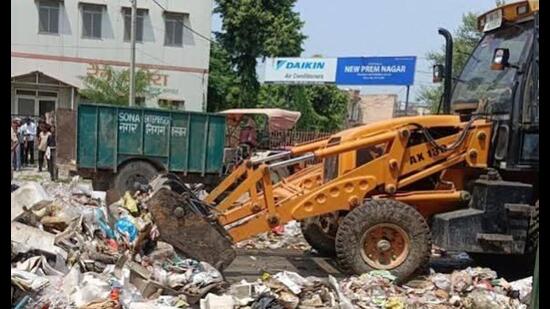
In Fatehabad, around 40 protesting workers were detained when they gathered at a highway dumping point to oppose the administration’s attempt to clear garbage with municipal and contractor teams. Garbage heaps were subsequently lifted from the highway and other dumping points.
In Hansi, an FIR was registered against 18 people for allegedly obstructing sanitation work, while 11 regular sanitation employees were served show-cause notices for remaining absent. ADC Lakshit Sarin said workers who returned to duty would not face action and warned that obstruction of sanitation work would not be tolerated.
Whereas, in Jhajjar, around 109 municipal sanitation workers continued their strike for the 33rd day on Monday. Workers refused notices directing them to resume duty and marched to Ambedkar Chowk, extending their agitation by another three days.
Shastri also accused the government of attempting to weaken the agitation by using people to hold press conferences claiming that demands had been accepted. He demanded that ministers stop “defaming” striking employees and instead create an atmosphere for genuine negotiations.
“The government should first create an atmosphere for talks and then hold talks,” Shastri said, warning that workers would intensify the agitation until their demands were implemented through written orders.