With 194 fresh cases reported over the past 24 hours, Punjab witnessed its highest single-day spike in stubble-burning incidents this paddy harvesting season, taking the total count to 1,007.
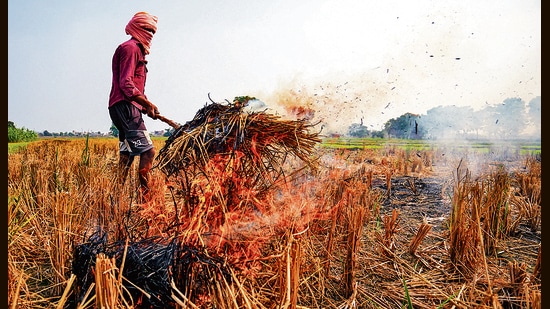
The spike comes at a time when 64.5% of the paddy harvesting process has been completed in Punjab, compared to 69.49% during the corresponding period last year. This means that a relatively larger proportion of the crop is still standing in the fields this season, raising concerns over the possibility of further escalation in farm fires as harvesting gathers pace.
Tarn Taran alone accounts for 397 incidents, followed by Amritsar with 171 and Ferozepur with 104 — together accounting for 67% of the state’s total cases.
According to the Commission for Air Quality Management’s (CAQM) monitoring report, Punjab recorded 1,007 farm-fire incidents as of October 29 this year, against 1,216 last year.
While the cumulative number is currently 209 lower than last year’s figure, the latest surge has raised concerns about the rate at which the situation could deteriorate in the coming days.
The farm-fire tracking period begins on September 15 every year, two weeks before paddy procurement begins on October 1.
The satellite-based historical data, meanwhile, shows a significant decline in stubble-burning incidents over the past few years. Punjab recorded 49,922 active fire events in 2022, which declined to 36,663 in 2023, 10,909 in 2024 and 5,114 in 2025 for the September 15-November 30 period.
246 FIRs registered
{{/usCountry}}246 FIRs registered
{{/usCountry}}In terms of enforcement, the CAQM report stated that 246 FIRs had been registered this season under Section 223 of the Bharatiya Nyaya Sanhita (BNS), compared to 376 during the same period last year. Besides, 297 red entries have been made in farmers’ land records against 432 last year.
The report further shows that environmental compensation of ₹17.50 lakh has been imposed in 349 cases, of which ₹13.15 lakh has been recovered. Last year, environmental compensation of ₹24.25 lakh was imposed, with ₹15.20 lakh recovered.
Meanwhile, 778 fields have been inspected this season, with crop burning physically verified at 379 sites. The report also records 426 warning/show-cause notices issued to nodal and supervisory officers, against 418 last year.
The latest numbers underline the continuing gap between the state’s efforts to promote in-situ and ex-situ management of paddy straw and the ground reality in the fields. Despite machinery distribution, awareness campaigns, monitoring teams and penal action, burning continues to remain an option for a section of farmers seeking to clear their fields quickly for the next crop.
CAQM team inspects paddy straw management arrangements in Patiala
A CAQM team on Friday inspected paddy straw management arrangements in Patiala district, reviewing the utilisation of crop residue by industries and the availability of machinery to farmers amid the ongoing harvesting season.
The team, comprising CAQM member-technical Dr SD Attri and scientist-C Vijay Kumar, visited a biomass pellet manufacturing unit at Badanpur village in Samana before assessing the implementation of crop residue management measures in villages across the district.
At SPS Ecofriendly Fuels, the officials inspected the facility and reviewed the process of converting paddy straw into biomass pellets, which are supplied for use as fuel in industries and thermal power plants.
The team subsequently visited Duttal and Gulhar villages in Patran subdivision to assess the ground-level implementation of in-situ and ex-situ management measures.
Interacting with farmers, the officials sought feedback on the availability of crop residue management machinery and the challenges faced in managing paddy straw without burning it.